


In an era defined by relentless technological disruption and shifting market dynamics, large organizations are increasingly seeking innovative models to maintain competitive advantage and drive new growth. Among these, the venture studio has emerged as a particularly compelling, albeit resource-intensive, framework for systematic value creation through structured innovation. This model, championed by pioneers like Google, offers a disciplined approach to incubating and scaling multiple new ventures, moving beyond traditional R&D or sporadic corporate venture capital (CVC) investments to foster a continuous pipeline of entrepreneurial initiatives.
The venture studio concept distinguishes itself by systematically assembling ideas, people, and resources to build and launch multiple enterprises in parallel. Unlike traditional incubators or accelerators that primarily support external startups, studios are deeply involved in co-founding ventures, often taking significant equity stakes and providing extensive operational support from ideation through market launch. This hands-on, highly structured approach aims to mitigate the inherent risks of new venture creation by leveraging shared resources, proven methodologies, and a deep understanding of market opportunities. The model’s growing popularity is evident in its rapid expansion; market analysis indicates that the number of both independent and in-house venture studios globally more than doubled from 2018 to 2023, reaching an estimated 870 entities. This surge reflects a broader recognition of the need for internal innovation engines capable of generating sustained, strategic growth.
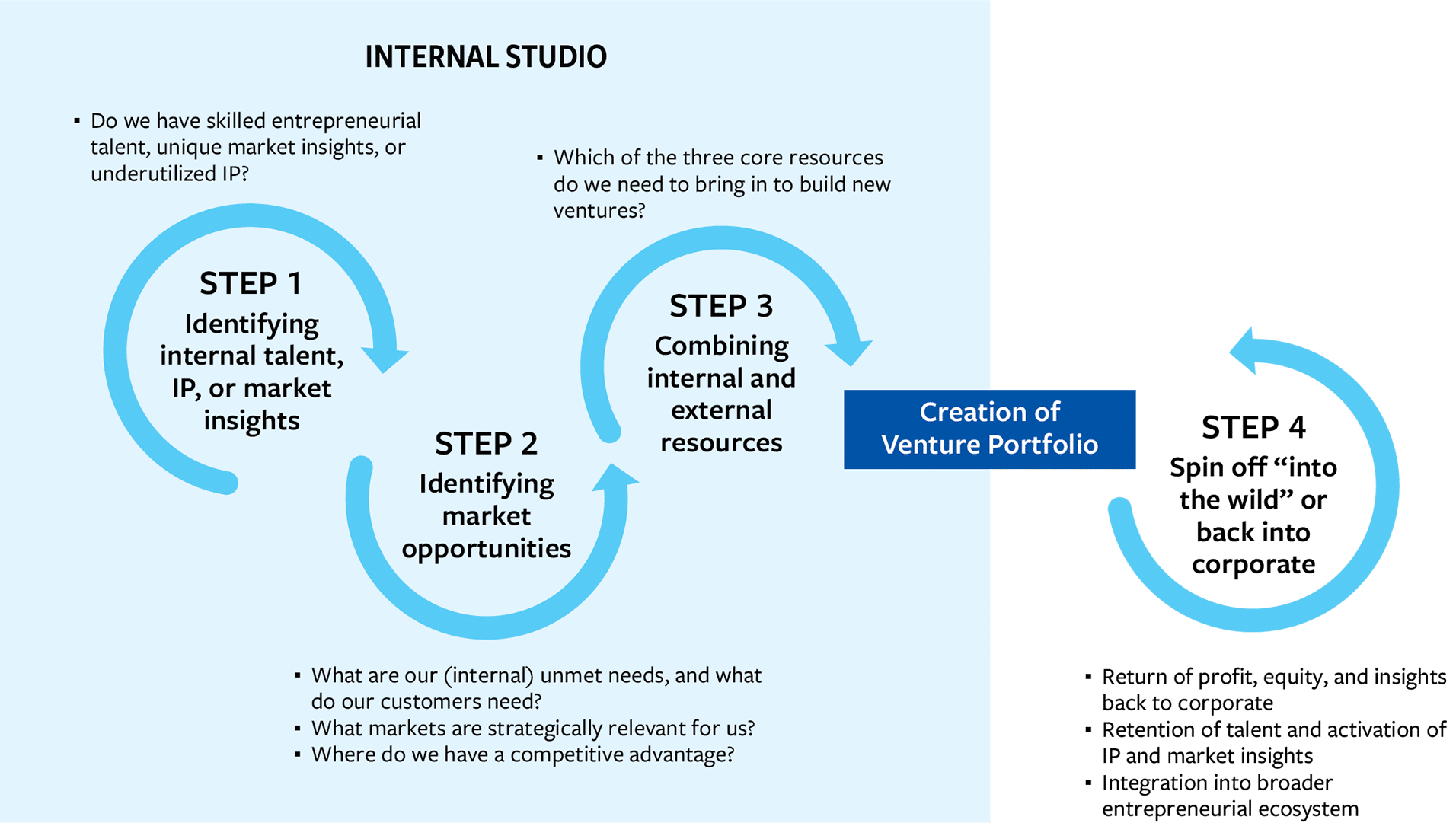
The operational blueprint of a venture studio typically involves several distinct phases. It begins with identifying and thoroughly validating promising opportunity spaces, often drawing on internal intellectual property, market intelligence, or deep industry expertise. Once an opportunity is validated, the studio actively recruits entrepreneurial talent, co-founding ventures with these individuals and providing the initial capital, infrastructure, and strategic guidance. Crucially, studios advance multiple ventures simultaneously through structured experimentation, applying rigorous down-selection processes to narrow the field of choices and ensure resources are allocated to the most promising initiatives. This systematic approach, which contrasts with the sequential nature of serial entrepreneurship, allows for continuous learning and adaptation, providing ongoing operational support until ventures are either successfully spun out as independent companies, integrated into the parent organization, or, in some cases, terminated.
Despite its allure, the venture studio model is not without its complexities and significant challenges. One primary hurdle is the substantial capital requirement. Supporting multiple ventures simultaneously with considerable investment before any returns materialize demands patient capital and a robust financial runway. The long lead times for venture maturation and profitability mean that immediate financial returns are unlikely, making sustained commitment crucial. Furthermore, the high equity stakes and operational control often maintained by venture studios can sometimes deter top-tier external founders from joining, as they may perceive a diminished sense of ownership or autonomy. Similarly, attracting follow-on funding from external venture capitalists can be challenging if the studio’s involvement or ownership structure is perceived as overly restrictive. Dilution of the pipeline, without careful and rigorous down-selection, also poses a risk, weakening the funnel logic central to effective venture development and scaling, and potentially leading to a misallocation of resources.
For internal venture studios embedded within large corporations, additional layers of complexity arise. While some corporate studios, such as Google X (responsible for Waymo, now valued at over $100 billion) and SC Ventures (which incubated Mox, Hong Kong’s fastest-growing digital bank), have demonstrated remarkable success, many grapple with the inherent friction between corporate bureaucracy and entrepreneurial agility. These internal units are often subject to the parent organization’s evolving strategic priorities, stringent governance structures, and extensive corporate oversight mechanisms, including legal, risk, and compliance functions. Such layers can impede the speed and flexibility essential for startup success, making them vulnerable to shifts in corporate strategy that may reduce funding, alter strategic direction, or even lead to their premature shutdown. The challenge lies in striking a delicate balance between leveraging corporate assets and maintaining the operational independence necessary for rapid innovation.

To truly unlock the transformative potential of venture studios, organizations must critically assess their strategic fit and readiness across four fundamental conditions. The first condition centers on possessing a unique concentration of specialized talent, proprietary intellectual property (IP), or deep market insights. A studio’s success hinges on its ability to generate high-quality venture ideas and attract the right people to execute them. This could manifest as a technology giant leveraging its vast engineering talent and patent portfolio to develop breakthrough solutions, a pharmaceutical company utilizing its drug discovery IP to launch new biotech ventures, or a logistics firm transforming its extensive operational data into novel supply chain analytics platforms. Without a distinct competitive advantage in these core assets, a studio risks producing undifferentiated ventures.
The second critical condition involves a strategic combination of internal assets and external capabilities. The most successful venture studios bridge the gap between the structured resources of a large organization and the agile, market-responsive attributes of a startup. This means leveraging the parent company’s financial capital, established brand reputation, customer base, distribution channels, and infrastructure, while simultaneously tapping into external entrepreneurial networks, market feedback, and specialized startup methodologies. This hybrid approach allows new ventures to benefit from corporate scale and stability without being stifled by internal constraints, fostering a symbiotic relationship where corporate resources fuel innovation, and new ventures provide fresh perspectives and market insights back to the parent.
Third, establishing the right governance mechanisms is paramount. Effective governance for a venture studio requires a delicate balance between providing sufficient autonomy for entrepreneurial teams and maintaining strategic alignment with the parent organization’s objectives. This involves creating a clear reporting structure that shields ventures from excessive corporate interference while ensuring accountability. Decision-making processes must be streamlined, allowing for rapid iteration and pivoting, typical of startup environments. Furthermore, performance metrics should be tailored to the early-stage nature of venture development, focusing on learning, validation, and progress milestones rather than immediate profitability, thereby fostering a culture that embraces calculated risk and iterative failure as part of the innovation journey.
Finally, a long-term commitment of both time and financial resources is indispensable. Venture building is inherently a marathon, not a sprint. Organizations must recognize that returns from venture studios typically do not materialize for several years, often requiring patient capital over a 5-10 year horizon or more. This commitment extends beyond mere funding; it encompasses leadership buy-in, strategic patience, and a willingness to ride out the inevitable failures and setbacks inherent in innovation. Without this unwavering, long-term perspective, studios risk being prematurely dismantled before their ventures have had a chance to mature and deliver substantial value.
Globally, the venture studio landscape is diversifying. While Silicon Valley has long been a hub for independent studios, Europe is witnessing a rapid growth in corporate-backed and independent models, often with a focus on deep tech, sustainable solutions, and industry-specific innovation. In Asia, corporate behemoths are increasingly establishing studios to explore new digital frontiers, particularly in fintech, e-commerce, and AI, leveraging their vast domestic markets and technological prowess. This global proliferation underscores the venture studio’s versatility as an innovation vehicle, adaptable to various economic contexts and strategic imperatives.
In conclusion, venture studios represent a sophisticated evolution in corporate innovation, offering a structured, systematic pathway to building multiple new ventures and unlocking significant value. They provide a powerful mechanism for organizations to deploy talent, ideas, and resources into strategic areas, driving diversification, market expansion, and sustained growth. However, their success is not guaranteed. Organizations considering this model must undertake a rigorous strategic assessment, ensuring they possess the requisite specialized assets, are prepared to forge a hybrid model of internal and external capabilities, can implement robust and agile governance structures, and, critically, are committed to the long-term journey of venture creation. When these conditions are met, the venture studio can transcend being merely a trend to become a foundational pillar of an organization’s future-proof innovation strategy, fostering not just new products or services, but entirely new markets and economic opportunities.