For over seventy years, Germany has stood as a paragon of post-war reconstruction, a beacon of economic prosperity, political stability, and international admiration. From the foundational leadership of Konrad Adenauer to the steady hand of Angela Merkel, the Federal Republic of Germany consistently demonstrated a remarkable capacity for resilience, even integrating the economically challenged German Democratic Republic within a year of the Berlin Wall’s collapse. While the post-war decades were not devoid of turbulence—marked by the Red Army Faction’s terrorism in the 1970s and the inflationary pressures following global oil price shocks—Germany’s economy largely charted a course of consistent, inclusive growth, propelled by a world-leading export sector. Yet, this narrative of uninterrupted success is now facing a profound reckoning. The very export-led model that fuelled decades of prosperity is buckling under the strain of diminished global competitiveness, particularly in the face of China’s ascendancy. Concurrently, a palpable wave of resentment towards immigration, exacerbated by Chancellor Merkel’s 2015 decision to open the country’s borders to over a million refugees, has reached its post-war zenith. This socio-economic climate has given rise to a potent populist movement, exemplified by the Alternative for Germany (AfD) party, which is actively challenging the fundamental tenets and norms that have underpinned German political and economic life since the Federal Republic’s inception in 1949.
The Architects of the "Wirtschaftswunder"
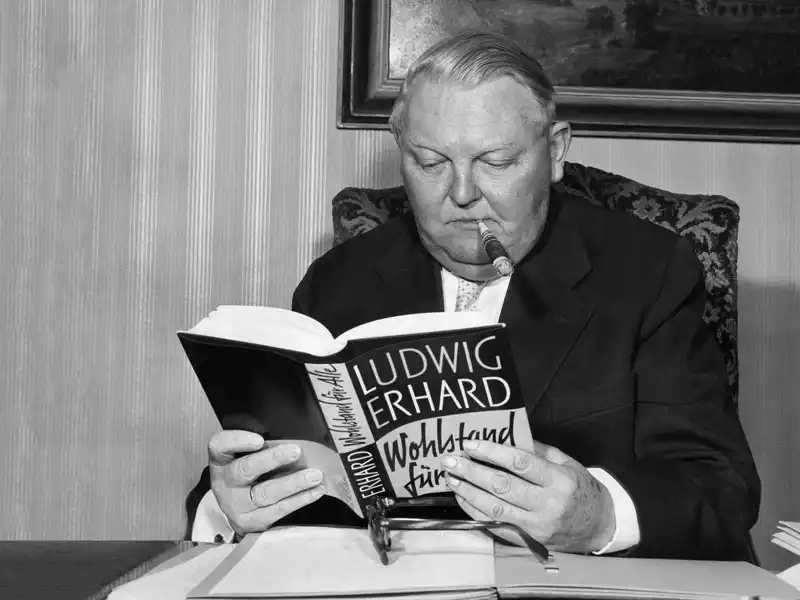
To fully grasp the current economic and political landscape, a return to the origins of Germany’s post-war resurgence, the celebrated "Wirtschaftswunder" or economic miracle, is instructive. Conventional historical accounts typically pinpoint the genesis of this recovery to two pivotal events in 1948: the currency reform engineered by Ludwig Erhard and the implementation of the European Recovery Programme (ERP), widely known as the Marshall Plan. Signed into law by U.S. President Harry Truman on April 3, 1948, the Marshall Plan saw its initial disbursements arrive in Germany by early July. This crucial aid package came with a set of conditions for German authorities: the imperative to balance the budget, curb inflation, dismantle rationing systems, abolish wage and price controls, foster private enterprise, and liberalize trade. In essence, these stipulations foreshadowed what would later be recognized as the "Washington Consensus" economic principles.
A linchpin of this economic revival was Erhard’s currency reform, initiated shortly after the ERP’s enactment and preceding the full influx of Marshall Plan aid. On June 20, 1948, the Deutsche Mark supplanted the Reichsmark as the official currency in the Bizone, the western occupation zone jointly administered by the United States and Great Britain. This reform effectively neutralized the vast monetary overhang that had fueled black market inflation and perpetuated shortages within the state-controlled economy. The conversion of Reichsmarks to Deutsche Marks at a significantly depreciated rate of ten to one addressed this fundamental imbalance. Ludwig Erhard, holding the highest German economic office under the occupation authorities, oversaw the introduction of the new currency. Crucially, on the following day, acting unilaterally, he abolished the majority of price controls and rationing measures.
The combined impact of eliminating the monetary overhang, coupled with fiscal austerity and the removal of price restrictions, led to a remarkable resurgence of goods availability in previously bare shops. Farmers, now possessing currency with genuine purchasing power, were incentivized to invest in equipment and fertilizers—much of which was supplied by the U.S. through the Marshall Plan—and to bring their produce to market, thereby alleviating food scarcity. The stabilization of the exchange rate provided German firms with the confidence to export and sell domestically, stimulating hiring, investment, and production. This sequence of events, according to triumphalist narratives, laid the foundation for the Wirtschaftswunder, a period during which West Germany experienced an unprecedented annual growth rate of six percent, propelling it to become the world’s third-largest economy by 1973.
Revisiting the Miracle’s Foundations
However, recent scholarship challenges this widely accepted narrative. Two new books, one by Carl-Ludwig Holtfrerich, a former economics professor at the Free University of Berlin, and another by Tobias Straumann, a professor at the University of Zurich, offer a more nuanced perspective on the origins and sustainability of Germany’s post-war economic success. Holtfrerich contends that Erhard played no direct role in the design of the currency reform, despite his lifelong claim to authorship. Straumann, meanwhile, argues that West Germany’s economic recovery was far from assured in the immediate aftermath of the 1948 reforms. He posits that the enduring success of the economic miracle was critically dependent on the 1953 London Debt Agreement. This agreement, by eliminating the specter of crippling reparation obligations—a burden that had devastated Germany after World War I—removed a significant impediment to economic recovery.
The London Debt Agreement was the culmination of extensive negotiations between a German delegation, led by Hermann Josef Abs, a prominent Deutsche Bank official, and twenty creditor nations, with the United States, the United Kingdom, and France holding considerable sway. Straumann suggests that the outcome, so starkly different from the punitive reparations imposed after World War I, was largely a consequence of drawing historical lessons. Negotiators on all sides recognized the devastating economic and political consequences of the 1921 reparations burden, which contributed to the downfall of the Weimar Republic and the rise of Nazism. Consequently, there was a collective determination to avoid a similar trajectory.
Beyond Historical Precedent: Geopolitical Imperatives and European Integration
While the "lessons of history" hypothesis holds considerable weight, Straumann himself acknowledges that the full picture is more complex. The geopolitical landscape of the 1950s, particularly the escalating Cold War, played a profoundly influential role. The urgent need to revitalize West Germany’s economy, the linchpin of Western Europe’s industrial capacity, was paramount. This necessitated a pragmatic approach to reparations, coupled with the normalization of Germany’s financial relations with the international community. German firms needed the assurance that their exports would not be subject to seizure, thereby facilitating foreign borrowing and trade.
Under the terms of the London Debt Agreement, the newly formed West German government committed to servicing and repaying pre-war and post-war foreign debts and loans from Western governments, while crucially exempting Nazi-era war debts and occupation costs. Reparation obligations were deferred indefinitely, contingent upon the eventual reunification of East and West Germany. A second, interconnected factor differentiating this post-war settlement from that of World War I was the burgeoning movement towards European integration.
In parallel with the debt negotiations, France, under the leadership of Foreign Minister Robert Schuman, proposed a groundbreaking initiative for the joint control of French and German heavy industry, which ultimately led to the establishment of the European Coal and Steel Community (ECSC). The Soviet threat underscored the necessity of restoring Western Europe’s heavy industry, particularly Germany’s, to full operational capacity. However, this objective required assurances that Germany’s industrial might would not again be wielded as a threat against its neighbors. The ECSC provided a framework for this reconciliation, ensuring that German industrial power would serve a common European purpose. It is difficult to conceive of the ECSC’s successful launch without concurrent progress on the debt front. In a notable aside, Straumann recounts the surprise and strong negative reaction of British Foreign Minister Ernest Bevin and other British officials when the French plan was presented, presaging Britain’s enduring ambivalence towards what would evolve into the European Community and subsequently the European Union.
Furthermore, the London Debt Agreement enabled the nascent German government to begin normalizing relations with Israel, a critical step in confronting the legacy of the Holocaust. Without the financial resources and political will facilitated by the agreement, Germany would have been unable to provide vital aid, such as DM3 billion in German goods and financing for Israel’s essential imports from British oil companies.
The Unsung Architect of the Deutsche Mark
Holtfrerich’s biography of Edward Tenenbaum, whom he identifies as the true architect of the currency reform, offers a compelling counter-narrative to Erhard’s widely credited role. Tenenbaum’s journey—from his parents’ immigration from Polish Galicia to his upbringing in New York and education at the International School of Geneva and Yale—parallels that of Harry Dexter White, the mastermind behind the Bretton Woods system, another crucial component of the monetary architecture supporting the Wirtschaftswunder. Tenenbaum served as an intelligence officer during World War II and later joined the Office of Military Government, United States (OMGUS), responsible for administering the American occupation zone. After his military discharge in 1946, he continued as a civilian advisor to OMGUS, where he conceptualized and designed the currency reform. During his time in Army Intelligence and OMGUS, Tenenbaum collaborated closely with Charles Kindleberger, a senior economic expert who would later become a distinguished professor of international economics and economic history at MIT. Kindleberger’s role in Holtfrerich’s account is far from incidental; it was during an academic sabbatical in Cambridge, Massachusetts, in 1975-76 that Kindleberger revealed Tenenbaum’s pivotal contribution to the currency reform, sparking Holtfrerich’s research for his book. Holtfrerich also notes, with a touch of irony, that Kindleberger had withheld the fact that he had been involved in selecting strategic bombing targets during the war, a campaign that resulted in the death of Holtfrerich’s father in 1944.
Holtfrerich attributes Erhard’s public acclaim for the currency reform to three key factors. Firstly, Tenenbaum was remarkably self-effacing, a trait that even his biographer struggles to fully explain. When confronted with Erhard’s appropriation of credit, Tenenbaum is reported to have casually remarked, "Who cares who gets the credit?" Secondly, in stark contrast to Tenenbaum’s reticence, Erhard was a master of self-promotion. This divergence highlights the perennial differences between economists and politicians. Erhard also possessed a remarkable ability to adapt his policy positions to prevailing circumstances; before and during the war, he advocated for strong state intervention in the economy, but with the advent of the Marshall Plan, he readily embraced the principles of sound money, private enterprise, and competition. Thirdly, post-war West Germany was desperately in need of a positive national identity, seeking to overcome the profound guilt and historical burden associated with the Third Reich’s atrocities. The narrative of a home-grown currency reform led by a German hero provided a crucial element for rebuilding national pride.
The Legacy and the Future
Today’s Germany stands as a testament to the legacy of the post-war Wirtschaftswunder: a prosperous, democratic nation deeply integrated within the European framework. However, the foundations of this success are not immutable. To sustain and build upon the economic gains of the past decades, Germany is once again at a crossroads, requiring a significant economic reorientation and visionary political leadership capable of navigating the complex challenges of the 21st century. The current economic headwinds, marked by the deceleration of global trade, geopolitical uncertainties, and the imperative to transition towards a more sustainable and digitally driven economy, demand a strategic recalibration akin to the transformative reforms of the mid-20th century. The question is whether Germany possesses the political will and economic ingenuity to engineer another era of enduring prosperity.