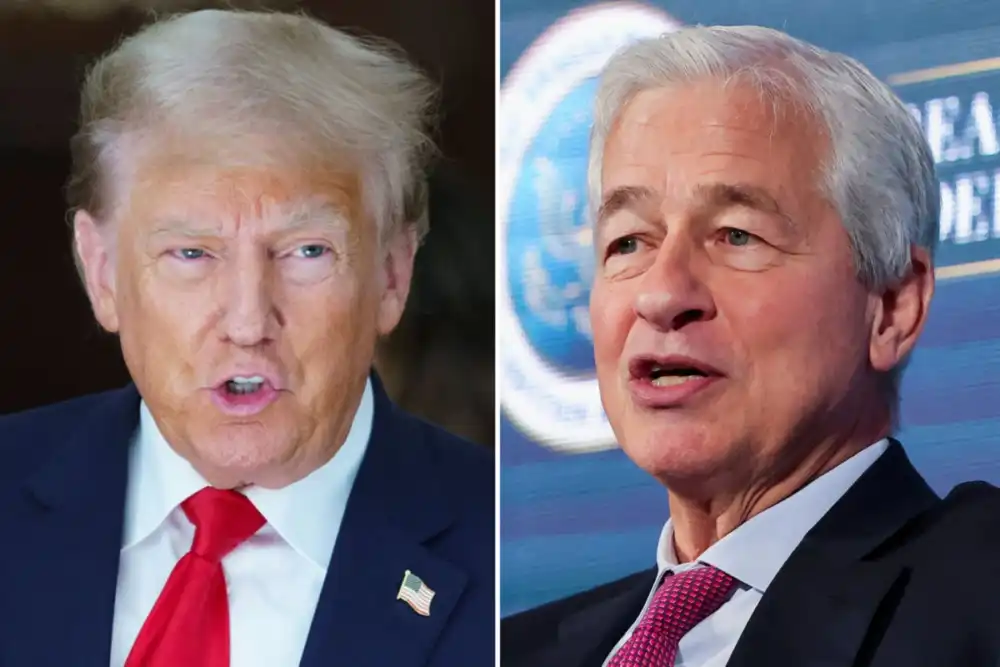
The intersection of high finance and executive power has reached a volatile flashpoint as Jamie Dimon, the Chairman and CEO of JPMorgan Chase, publicly addressed the $5 billion lawsuit filed against his institution by President Donald Trump. Speaking from the sidelines of a high-profile JPMorgan investor conference in Miami, Dimon characterized the legal action—which alleges that the bank shuttered accounts for political reasons—as being “without merit.” However, in a move that underscores the delicate balancing act required of modern corporate titans, Dimon simultaneously voiced a surprising level of sympathy for the President’s frustrations, framing the issue not as a matter of partisan bias, but as a systemic failure driven by an overzealous regulatory environment.
The lawsuit, initiated by the President in early 2024, represents a significant escalation in the ongoing tension between the Trump administration and the nation’s largest financial institutions. The complaint alleges that JPMorgan Chase, along with several other major lenders, engaged in "debanking"—the practice of closing the accounts of individuals or entities perceived to pose a reputational or political risk—as a form of ideological discrimination. Specifically, the President’s legal team points to the closure of dozens of accounts associated with his business empire and political orbit in the weeks following the January 6, 2021, Capitol riot. JPMorgan has since acknowledged these closures in court filings, setting the stage for a protracted legal battle over the rights of private corporations versus the protections afforded to high-profile political figures.
"The case has no merit," Dimon stated bluntly during an interview with CNBC’s Leslie Picker. Yet, his subsequent comments revealed a nuanced critique of the very system his bank operates within. "I agree with them," Dimon added, referring to those who feel unfairly targeted by financial institutions. "They have the right to be angry. I’d be angry, too. Like, why is a bank allowed to do that?" According to Dimon, the answer lies not in a desire to play politics, but in a survival instinct triggered by federal oversight. He argued that banks are effectively "forced" to sever ties with certain clients to satisfy regulators who monitor "reputational risk"—a nebulous metric that can lead to severe penalties, increased capital requirements, or restricted growth opportunities if a lender is deemed to be associated with controversial figures or industries.
The phenomenon of debanking has become a central pillar of conservative economic grievance in recent years. Critics argue that financial institutions have become "social gatekeepers," using their immense power to shadow-ban legal but politically unpopular businesses, ranging from firearms manufacturers and fossil fuel companies to controversial political figures. This sentiment mirrors the controversy surrounding "Operation Choke Point," a dynamic during the Obama administration where federal regulators were accused of or suspected of pressuring banks to deny services to "high-risk" industries. In the current climate, the focus has shifted toward individuals, with the Trump lawsuit serving as the most prominent example of a broader movement seeking to classify banking as a "common carrier" service, similar to telecommunications or electricity, which cannot be denied based on personal or political beliefs.
From an economic perspective, the stakes of this litigation are immense. JPMorgan Chase, the world’s largest bank by market capitalization, manages trillions of dollars in assets and serves as a cornerstone of the global financial system. A $5 billion judgment, while not existential for a bank of JPMorgan’s scale, would represent a landmark precedent that could fundamentally alter the relationship between banks and their clients. Legal analysts suggest that the President’s team faces a high bar in proving that account closures were a violation of existing law, as banks generally maintain broad discretion in their Terms of Service to terminate relationships at will. However, the political optics of the case are perhaps more significant than the legal mechanics. Dimon’s comments suggest a strategic attempt to deflect blame toward the "administrative state," aligning the bank’s interests with the President’s deregulatory agenda while defending its specific operational decisions.
The timing of this legal friction is particularly ironic given the broader economic landscape. Since the President regained office, the financial sector has seen a significant boost from a wave of deregulation. Appointees in key roles at the Office of the Comptroller of the Currency (OCC) and the Federal Reserve have signaled a retreat from the "Basel III Endgame" proposals, which would have required banks to hold significantly higher levels of capital. This shift has allowed banks to deploy more capital toward buybacks, dividends, and lending, fueling a rally in bank stocks. For Dimon, maintaining a productive relationship with the administration is essential for long-term profitability, even as he finds himself a named defendant in the President’s litigation.
The debate over reputational risk is not unique to the United States. Globally, the banking industry is grappling with how to reconcile "Know Your Customer" (KYC) and Anti-Money Laundering (AML) protocols with the rights of "Politically Exposed Persons" (PEPs). In the United Kingdom, a similar firestorm erupted when politician Nigel Farage had his accounts closed by Coutts, a subsidiary of NatWest. That incident led to the resignation of the bank’s CEO and a government-led review into the legality of debanking for non-financial reasons. The global trend suggests a growing consensus that while banks must guard against illicit finance, the use of "reputational risk" as a catch-all for political discomfort is increasingly untenable in a democratic society.
Within the U.S., the debate is manifesting in legislative efforts at both the state and federal levels. Several Republican-led states have introduced "Fair Access" laws that prohibit financial institutions from discriminating against customers based on subjective criteria. At the federal level, Dimon’s hope that "the law will change" reflects a desire for clearer guidelines that would immunize banks from political fallout. If the law were to explicitly define the boundaries of "reputational risk," banks could arguably return to a more neutral stance, avoiding the "awkward position" Dimon currently occupies.
The economic impact of debanking extends beyond the individuals directly affected. When large institutions withdraw services from specific sectors or high-profile figures, it can create a "chilling effect" throughout the economy. Smaller regional banks may follow suit to avoid regulatory scrutiny, leading to a concentration of financial power and the potential for a bifurcated economy where certain viewpoints are effectively "demonetized." For a global economy that relies on the seamless flow of capital, the introduction of political litmus tests into the banking relationship represents a significant friction point that could hamper investment and market efficiency.
Expert insights suggest that the resolution of the Trump-JPMorgan dispute may ultimately lie in the hands of the Supreme Court or through comprehensive Congressional action. Until then, the banking industry remains in a state of defensive crouch. JPMorgan’s recent concessions—acknowledging the closure of Trump-linked accounts post-January 6—highlight the vulnerability of even the most powerful institutions to shifting political winds. Dimon’s strategy of "agreeing with the anger while denying the liability" may serve as a blueprint for other CEOs facing similar pressures. By positioning the bank as a victim of a rigid regulatory framework, Dimon is attempting to pivot the conversation away from his bank’s specific actions and toward a broader critique of government overreach—a theme that resonates deeply with the current administration’s stated goals.
As the lawsuit progresses through the discovery phase, the financial world will be watching closely for any internal communications that might reveal the true motivations behind the account closures. Regardless of the outcome, the case has already succeeded in bringing the opaque world of bank compliance into the public square. The $5 billion figure serves as a bold statement of intent, signaling that the era of banks operating as quiet arbiters of social and political acceptability may be coming to a close. For Jamie Dimon, the challenge will be to ensure that JPMorgan Chase remains a dominant force in a rapidly changing world where the lines between finance, law, and politics are becoming increasingly blurred. The "misunderstandings" Dimon cited in Miami are, in reality, a fundamental disagreement over the role of private capital in public life—a conflict that will likely define the economic narrative of the coming decade.