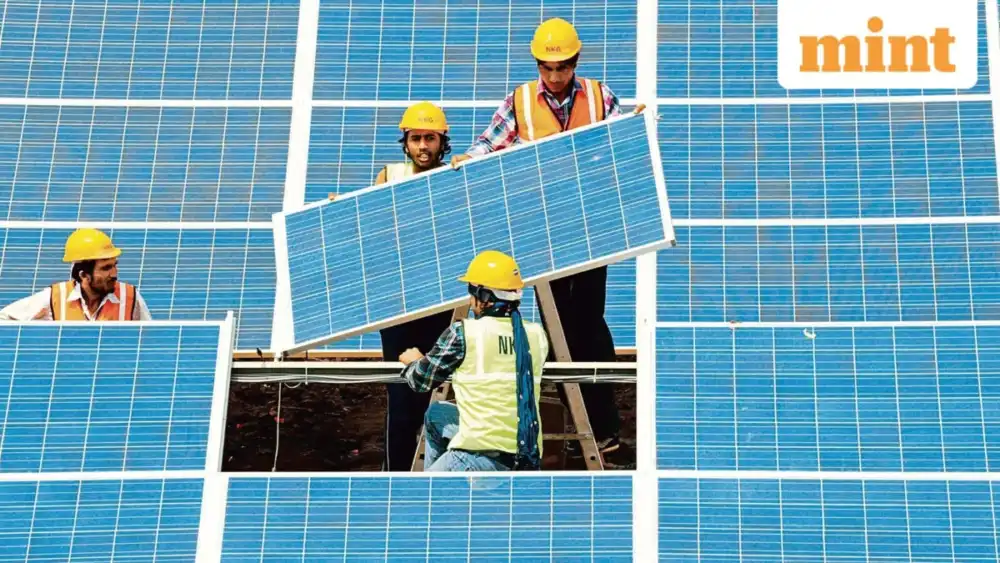
The United States has initiated a significant recalibration of its renewable energy import landscape, imposing a preliminary countervailing duty (CVD) of 125.87% on solar modules manufactured in India, a move that reverberates across the global green energy sector and spotlights the complex interplay of trade policy and climate ambitions. This substantial tariff, announced by the US Department of Commerce, stems from an accusation that New Delhi unfairly subsidizes its solar exports, a charge that has immediate implications for international trade dynamics and the burgeoning solar industry worldwide. The decision, which also levied duties on solar products from Indonesia (104.38%) and Laos (80.67%), has injected considerable uncertainty into market forecasts, prompting a sharp downturn in the share prices of major Indian solar manufacturers, yet simultaneously catalyzing strategic shifts within the industry.
The immediate market reaction in India was palpable, with solar stocks experiencing a notable decline. Shares of Waaree Energies Ltd, a leading player, plunged by 10.47%, followed by Premier Energies Ltd (-6.27%), Vikram Solar (-5.45%), and Emmvee Photovoltaic Power (-2.11%). This investor apprehension reflects concerns over potential reduced access to the lucrative American market, which is experiencing robust growth driven by ambitious clean energy targets and increasing demand from power-hungry data centers, a byproduct of the artificial intelligence boom. Despite the market jitters, Indian manufacturers have largely adopted a resilient posture, signaling their intent to navigate the evolving trade environment through diversified supply chains and a heightened focus on the domestic market.
At the heart of the US action is a broader push towards fortifying domestic manufacturing and reducing reliance on foreign supply chains, particularly in critical sectors like renewable energy. This protectionist stance aligns with policies such as the Inflation Reduction Act (IRA), which offers substantial incentives for US-made clean energy components. The preliminary CVD aims to neutralize what the US Commerce Department views as unfair competitive advantages derived from government subsidies, creating a level playing field for American producers. This move is part of a growing trend of trade disputes in the green technology space, as nations increasingly vie for dominance in the burgeoning renewable energy market, often employing tariffs and other non-tariff barriers to shield nascent domestic industries.
Indian solar companies, however, are not entirely unprepared for such headwinds. Many have already begun to implement strategies to mitigate the impact of unpredictable international trade policies. Waaree Energies, for instance, a significant exporter to the US and holding a third of its substantial ₹60,000-crore outstanding orderbook from overseas markets, stated that its existing US orders would remain unaffected. The company clarified that the US duties primarily target where solar cells are manufactured, rather than where modules are assembled. Consequently, Waaree has strategically sourced cells from jurisdictions attracting lower US tariff rates, often around 10-15%, to produce modules destined for the American market. This multinational sourcing approach, combined with its operational assembly capacity in the US – currently 2.6 GW annually, with plans to expand to 4.2 GW – provides a crucial hedge against such duties.
Beyond export-oriented strategies, a significant number of Indian solar manufacturers are increasingly turning their focus inward. Companies like Emmvee Photovoltaic Power, Premier Energies, and Vikram Solar primarily serve the robust Indian domestic market, positioning them as insulated from these external trade developments. Adani New Industries Ltd had also reportedly shifted its focus to the domestic market as a temporary measure even before the duties were officially announced. This domestic pivot is strongly supported by India’s ambitious national goals to achieve 500 GW of non-fossil energy capacity by 2030, a target that necessitates massive investment in local manufacturing and deployment. Policy interventions by the Indian government, such as the Approved List of Models and Manufacturers (ALMM), further incentivize domestically made cells and modules, often fetching a premium in the local market.

The Indian government has, for its part, adopted a "hands-off" approach to the direct legal challenge against these duties. Santosh Kumar Sarangi, secretary to the Union Ministry of New and Renewable Energy, indicated that while embassy support might be provided, the onus of legally challenging the countervailing duty in appellate forums rests with the affected companies. This stance underscores a preference for private sector-led dispute resolution within the international trade framework, while acknowledging the government’s role in facilitating such efforts.
However, the duties are expected to create palpable challenges for export-focused manufacturers and could introduce volatility into the broader Indian solar sector. Sehul Bhatt, director at Crisil Intelligence, highlighted that the duties would negatively impact companies that had planned significant capacity expansion over the next three years, particularly those eyeing export markets. He noted that some Indian firms are already exploring capacity expansion outside India to circumvent tariff uncertainties. Furthermore, modules produced in India using domestically manufactured cells would face a cost increase of at least 30% compared to modules assembled in the US using imported cells, fundamentally altering competitive dynamics. The final determination of these rates, scheduled for July 2026, prolongs a period of uncertainty, compelling companies to navigate a constrained market amidst a global surge in supply.
Ankit Jain, vice president & co-group head – corporate ratings at ICRA Ltd, echoed these concerns, predicting that the CVD and the growing regulatory uncertainty in the US would likely dampen India’s export volumes. This potential redirection of export-oriented production back to the domestic market could exacerbate an already oversupplied Indian module manufacturing landscape. India’s current solar module manufacturing capacity stands at over 140 GW and is projected to exceed 165 GW by March 2027. Such an influx could intensify pricing pressures within India, impacting the profitability of domestic manufacturers.
Despite these challenges, India’s long-term vision for solar energy remains robust. Indian solar equipment makers, including Waaree Energies, Adani Solar, Reliance Industries Ltd, ReNew Energy Global plc, Brookfield, and PTT-backed Avaada Group, are collectively planning investments of ₹30,000 crore to establish 50 GW of new solar cell manufacturing capacity in the next financial year (FY27). This substantial investment underscores the nation’s commitment to self-sufficiency in solar technology, moving beyond module assembly to encompass the more complex manufacturing of solar cells – the fundamental building blocks of solar panels. This strategic localization effort is crucial for India to meet its ambitious renewable energy targets and to insulate its industry from global supply chain disruptions and protectionist trade measures.
The US market remains a critical focus due to its attractive margins and surging demand for clean electricity, driven by both climate goals and the burgeoning energy needs of the digital economy. The ongoing US actions, including a separate anti-dumping investigation into solar cell makers from India and other countries to determine if products are being sold below cost, underscore a broader strategy to reshape the global solar supply chain. These measures, while creating short-term turbulence, may ultimately accelerate the diversification of solar manufacturing bases worldwide, fostering regional hubs of production and potentially leading to a more resilient, albeit more complex, global renewable energy ecosystem. The next few years, leading up to the final US determination in 2026, will be crucial in defining how India’s solar sector adapts and thrives amidst these evolving international trade dynamics.