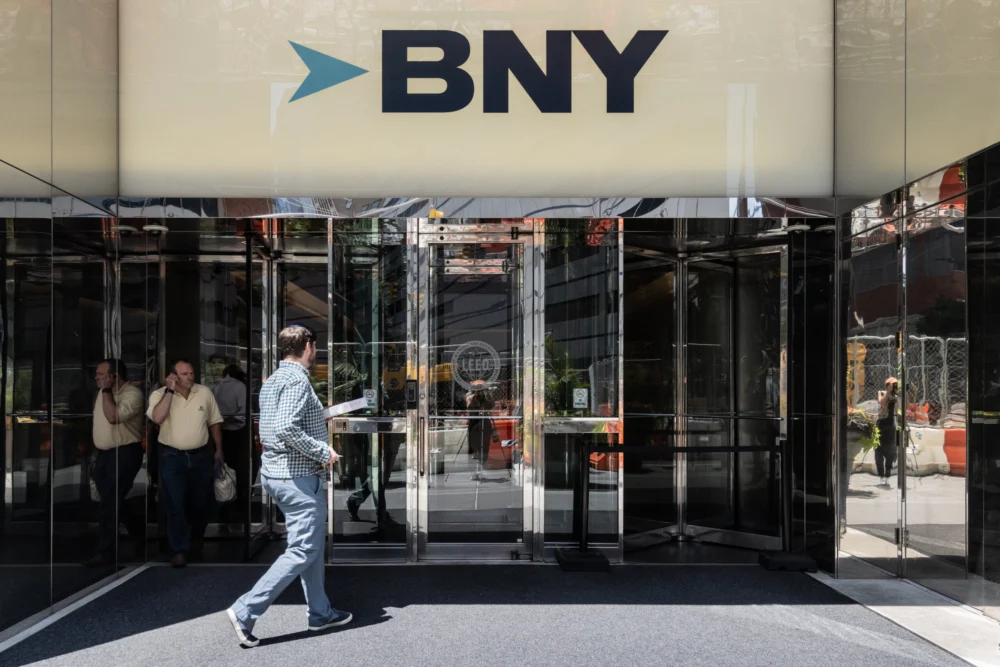
At the headquarters of BNY, the financial institution founded by Alexander Hamilton in 1784, a new class of worker has arrived that requires neither a desk nor a salary. These 134 "digital employees" do not take vacations, never fall ill, and operate with a 24/7 efficiency that their human counterparts cannot match. They are the frontline of a multi-billion dollar technological transformation at America’s oldest bank, representing a shift in the global financial landscape where the traditional boundaries between human labor and algorithmic processing are rapidly dissolving.
As the financial sector grapples with the disruptive potential of generative artificial intelligence, BNY has emerged as an aggressive early adopter. The bank’s commitment to this transition is reflected in its balance sheet: in 2025, BNY allocated $3.8 billion toward technology expenditures. This figure represents approximately 19% of the firm’s total revenue, the highest proportion among its large-cap banking peers. While giants like JPMorgan Chase and Bank of America spend more in absolute dollar terms, BNY’s decision to commit nearly a fifth of its top-line income to digital infrastructure signals a fundamental pivot in its business model.
The 134 digital employees currently deployed at the bank are not merely software scripts or basic automation macros. They are integrated entities with specific job descriptions, performance metrics, and roles within the bank’s operational hierarchy. Rachel Lewis, BNY’s head of payment operations, oversees thousands of human staff alongside nine of these digital agents. According to Lewis, these entities are tasked with the high-volume, repetitive processes that have historically bogged down human productivity. By offloading these "mechanical" duties to AI, the bank aims to liberate its human workforce to focus on high-touch client relations, complex problem-solving, and strategic decision-making.
The shift comes at a time of significant transition for BNY’s workforce. Recent earnings presentations reveal that the bank’s human headcount has declined from approximately 53,400 in 2023 to 48,100. While such a reduction often triggers concerns regarding automation-led displacement, BNY leadership maintains a more nuanced perspective. CFO Dermot McDonogh recently addressed analysts, clarifying that while the headcount has trended downward, the primary driver is not yet direct AI replacement. Instead, the firm views AI as a tool for "unlocking capacity." The strategic goal, according to McDonogh, is to optimize the potential of current employees and scale the business without a linear increase in human costs.
This "unlocking of capacity" is particularly relevant to BNY’s core business. As a global leader in custody banking and asset servicing, BNY oversees nearly $50 trillion in assets under custody or administration. The nature of this work—reconciling accounts, processing cross-border payments, and managing massive datasets—is uniquely suited for AI intervention. Unlike retail banking, which relies heavily on consumer interaction, the "plumbing" of the financial system managed by BNY involves trillions of data points where a fraction of a percentage increase in efficiency can translate into hundreds of millions of dollars in saved costs or found revenue.
The broader investment community is watching BNY’s experiment with a mixture of optimism and scrutiny. Mike Mayo, a veteran banking analyst at Wells Fargo, describes the current environment as an "AI arms race" among major financial institutions. However, Mayo cautions that spending alone is not a guarantee of success. In an industry prone to "spraying and praying" when it comes to technology budgets, the ultimate differentiator will be the tangible return on equity and operational efficiency.

Despite these cautionary notes, some analysts see BNY as the primary beneficiary of the AI revolution. A research team at Goldman Sachs recently screened the Russell 1000 to identify companies with the highest potential for productivity gains through AI automation. BNY ranked near the top of that list. The analysis suggested that by automating labor-intensive processes and reducing wage exposure, BNY could see a potential 19% boost to its earnings per share (EPS). This projection underscores why the bank is willing to spend nearly 20% of its revenue on tech: the potential for margin expansion in a historically low-margin business is too significant to ignore.
To support this transition, BNY has focused heavily on "upskilling" rather than just "out-hiring." Following the public release of ChatGPT in late 2022, the bank established a dedicated AI Hub to centralize its developmental efforts. The cornerstone of this internal revolution is a proprietary platform named "Eliza." The name is a deliberate nod to Elizabeth Schuyler Hamilton, the wife of the bank’s founder, bridging the institution’s 241-year history with the cutting edge of 21st-century engineering.
Eliza acts as a secure gateway for the bank’s employees, integrating various open-source and commercially available large language models (LLMs) with BNY’s proprietary internal data and strict compliance frameworks. This ensures that while employees use the latest AI tools, sensitive financial data remains within the bank’s "walled garden." The adoption has been nearly universal; almost the entire workforce has completed a mandatory 10-hour training program on the platform. Furthermore, thousands of employees have participated in multi-day AI bootcamps. These sessions are designed to turn non-technical staff—from HR managers to compliance officers—into "citizen developers" who can identify and build their own automation solutions.
Leigh-Ann Russell, BNY’s Chief Information Officer and Global Head of Engineering, views this democratization of technology as the bank’s competitive advantage. By empowering the entire workforce to interact with AI, the bank is attempting to foster a culture where technology is seen as a collaborator rather than a competitor. Russell notes that the juxtaposition of being a centuries-old institution and a leader in AI is a "lovely reminder" of how technology has consistently evolved to serve the financial sector over the centuries.
However, the economic implications of this shift extend beyond a single bank’s balance sheet. BNY’s strategy reflects a broader trend in the global economy where the "middle-office" functions of finance are being aggressively automated. In Europe, banks like UBS and HSBC are similarly investing billions in AI to handle everything from anti-money laundering (AML) checks to wealth management advice. The global banking industry is expected to spend an additional $31 billion on generative AI by 2027, according to data from IDC.
The challenge for BNY and its peers will be managing the social and economic friction that accompanies such rapid change. While executives like Michelle O’Reilly, BNY’s Global Head of Talent, emphasize that the goal is to enable productivity rather than eliminate roles, the long-term trend of declining headcounts in data-heavy sectors is difficult to ignore. The "digital employee" represents a new variable in the labor economics of Wall Street. As these agents become more sophisticated, the definition of "entry-level" work in finance is likely to be rewritten, requiring new hires to possess a blend of financial literacy and prompt engineering skills.
As 2025 progresses, the success of BNY’s $3.8 billion bet will be measured in its quarterly reports. If the 19% EPS boost predicted by Goldman Sachs materializes, it will provide a blueprint for the "Bank of the Future"—an institution that combines the legacy and trust of a founding father with the tireless, algorithmic precision of a digital workforce. For now, the 134 digital employees at BNY continue their work in the quiet of the cloud, proving that in the modern economy, the most valuable workers may be the ones who never need to clock out.