For over seventy years, Germany has stood as a beacon of post-war recovery, embodying a potent blend of economic prosperity, political stability, and international admiration. From the foundational chancellorship of Konrad Adenauer through the tenures of Willy Brandt, Helmut Schmidt, Helmut Kohl, and the influential 16-year leadership of Angela Merkel, the Federal Republic of Germany projected an image of unwavering resilience. This stability was so profound that it facilitated the swift integration of the East German economy into the West German framework within a year of the Berlin Wall’s collapse. While the post-war decades were not without their trials – including the terrorism of the Red Army Faction in the 1970s and the economic turbulence triggered by oil price shocks – Germany’s economy largely charted a course of consistent, inclusive growth, driven by a formidable export sector. However, the nation now finds itself grappling with a palpable economic malaise. The very export-led model that fueled its ascent is struggling to maintain its competitive edge against the rising economic might of China. Simultaneously, public sentiment towards immigration has reached its zenith in the post-war era, a direct consequence of Chancellor Merkel’s 2015 decision to open the country’s borders to over a million refugees. This confluence of factors has contributed to a resurgence of right-wing populism across Germany, with parties like the Alternative for Germany (AfD) actively challenging the fundamental tenets and norms of political conduct that have defined the Federal Republic since its inception in 1949.
Forging the Miracle: The Architects of Post-War Recovery
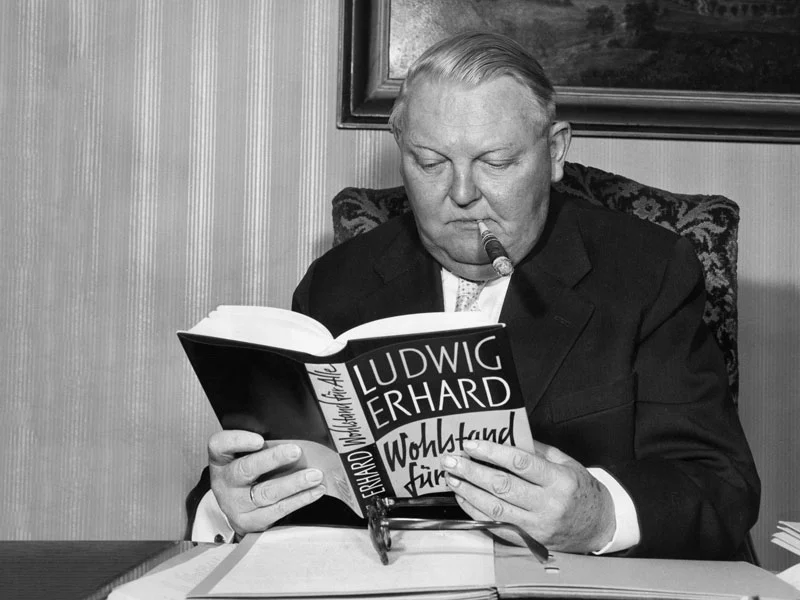
To fully grasp the current economic climate, a retrospective look at the genesis of Germany’s post-war ascendancy is essential. The widely accepted narrative of the Wirtschaftswunder, or West Germany’s miraculous economic transformation after World War II, typically points to two pivotal interventions: the currency reform orchestrated by Ludwig Erhard and the European Recovery Programme (ERP), commonly known as the Marshall Plan, both implemented in 1948. The Marshall Plan, formally signed into law by U.S. President Harry Truman on April 3, 1948, saw its initial aid disbursements reach Germany by early July. In return for this critical financial assistance, German authorities were tasked with a stringent set of economic reforms. These included balancing the national budget, curbing inflation, dismantling rationing systems, removing wage and price controls, fostering private enterprise, and liberalizing trade – policies that, decades later, would be encapsulated by the "Washington Consensus."
A cornerstone of this economic revival was Erhard’s currency reform, enacted between the signing of the ERP and the arrival of the first aid shipments. On June 20, 1948, the Deutsche Mark replaced the Reichsmark as the official currency in the Bizone, the combined American and British occupation zone. This reform effectively addressed the substantial monetary overhang that had fueled black market inflation and created widespread shortages within the price-controlled economy. The conversion rate of approximately 10 Reichsmarks to one Deutsche Mark mopped up excess currency, injecting a sense of monetary stability.
Ludwig Erhard, then the highest-ranking German economic official operating under the occupation authorities, oversaw the introduction of the Deutsche Mark. Crucially, on the following day, he unilaterally abolished the majority of price controls and rationing measures, acting on his own initiative. The combined effect of eliminating the monetary overhang, implementing fiscal austerity, and removing price controls was a dramatic and almost immediate reappearance of goods in previously empty stores. Farmers, now holding a stable currency, were incentivized to invest in equipment and fertilizers, much of which was supplied through the Marshall Plan. This renewed incentive led them to bring their produce to market, alleviating critical food shortages. The stabilization of the exchange rate empowered German firms to both export and sell domestically, spurring investment, employment, and production.
This sequence of events, as detailed in triumphant accounts of the Wirtschaftswunder, marked the beginning of an unprecedented economic boom. Over the subsequent quarter-century, West Germany experienced an average annual growth rate of six percent. By 1973, the Federal Republic of Germany had ascended to become the world’s third-largest economy.
However, recent scholarly works challenge this established narrative. Two new books, by Carl-Ludwig Holtfrerich, a former economics professor at the Free University of Berlin, and Tobias Straumann, a professor of economics at the University of Zurich, offer a more nuanced perspective. Holtfrerich contends that Erhard played no direct role in the design of the currency reform, despite his lifelong claims of authorship. Straumann, meanwhile, argues that West Germany’s economic recovery was far from secure in the immediate aftermath of the 1948 reforms. He posits that the sustained success of the economic miracle was contingent upon the 1953 London Debt Agreement. This agreement crucially eliminated the prospect of Germany being burdened with crippling reparation obligations to its former adversaries, a stark contrast to the punitive reparations imposed after World War I.
The London Debt Agreement was the culmination of extensive negotiations between a German delegation, led by Hermann Josef Abs, a prominent official from Deutsche Bank, and representatives from 20 creditor nations, with the United States, the United Kingdom, and France holding significant influence. Straumann suggests that the differing outcomes of these debt negotiations, compared to those following World War I, can be attributed to a potent "lessons of history" hypothesis. Negotiators on all sides recognized the devastating economic and political consequences of the 1921 reparations burden on Germany, which they saw as a direct precursor to the collapse of the Weimar Republic and the subsequent rise of Adolf Hitler and the Nazi Party. Consequently, in the post-World War II era, there was a concerted effort to avoid a similar historical trajectory at all costs.
Echoes of Reparations and the Cold War Imperative
While historical lessons undoubtedly played a role, Straumann acknowledges that the full picture is more complex. The geopolitical landscape of the Cold War proved to be a critical factor in the 1950s, creating an urgent imperative for economic recovery in West Germany, an imperative that was absent among the victors of World War I. With the Soviet Union posing a significant threat to Western Europe, revitalizing West Germany’s economy – a vital source of capital goods for the continent – became paramount. This necessitated avoiding an excessive reparations burden, but it also demanded the normalization of the Federal Republic’s financial relations with the international community. Such normalization was essential to enable German firms to secure foreign loans and engage in export activities without the perpetual threat of asset seizure.
Under the terms of the London Debt Agreement, the newly formed West German government committed to servicing and repaying pre-war (Reich and Weimar-era) foreign debts and post-war loans from Western governments. However, crucially, Nazi-era war debts and occupation costs were excluded. All reparations obligations were deferred indefinitely, contingent on the eventual reunification of the two German states. Another significant divergence from the post-World War I era, intrinsically linked to the debt negotiations, was the burgeoning process of European integration.
In parallel with the debt discussions, the French government, under the leadership of Foreign Minister Robert Schuman, initiated a groundbreaking proposal for the joint control of French and German heavy industry, which ultimately led to the establishment of the European Coal and Steel Community (ECSC). The Soviet threat underscored the urgent need to restore Western Europe’s heavy industry, particularly Germany’s, to full operational capacity. However, this also required assurances that Germany’s industrial might would not again be weaponized against its neighbors. The ECSC served precisely this purpose, fostering cooperation and interdependence. It is difficult to envision the successful launch of the ECSC without concurrent progress on the debt front. In an aside, Straumann recounts the initial startled and strongly negative reaction from British Foreign Minister Ernest Bevin and other British officials when the French plan was presented, a reaction that foreshadowed Britain’s enduring ambivalence towards what would evolve into the European Community and, subsequently, the European Union.
Furthermore, the London Debt Agreement enabled the new German government to commence the normalization of relations with Israel, a vital step in confronting the legacy of the Holocaust. Without this agreement, the Federal Republic would likely have lacked both the financial resources and the political will to provide DM3 billion worth of German goods to Israel, or to finance Israel’s crucial imports from British oil companies.
The Unsung Architect of the Deutsche Mark
While Straumann’s work offers a comprehensive political narrative, Holtfrerich’s biography delves into the life of Edward Tenenbaum, whom Holtfrerich identifies as the true architect of the currency reform. Holtfrerich’s account traces Tenenbaum’s journey, from his parents’ immigration from Polish Galicia to his formative years in New York and his education at the International School of Geneva and Yale. An interesting, though unstated, parallel can be drawn between Tenenbaum and Harry Dexter White, the principal architect of the Bretton Woods system, another foundational element of the monetary framework that underpinned the Wirtschaftswunder.
Tenenbaum served as an intelligence officer within the Twelfth Army Group during World War II, subsequently joining the Office of Military Government, United States (OMGUS), responsible for administering the American occupation zone. After his military discharge in 1946, he continued his service as a civilian advisor to OMGUS, where he developed the crucial currency reform proposals. Within Army Intelligence and later at OMGUS, Tenenbaum collaborated closely with Charles Kindleberger, a senior economic expert who would later become a distinguished professor of international economics and economic history at MIT. Kindleberger’s presence in Holtfrerich’s narrative is more than coincidental.
Holtfrerich recounts how, during an academic sabbatical in Cambridge, Massachusetts, in 1975-1976, he learned from Kindleberger about Tenenbaum’s pivotal role in the currency reform, thus planting the seeds for his current book. He reveals that Kindleberger, perhaps out of consideration, withheld the fact that he had, at one point, been responsible for selecting targets for America’s wartime strategic bombing campaign, a campaign that tragically claimed the life of Holtfrerich’s father in 1944.
Holtfrerich offers three primary explanations for why Ludwig Erhard, rather than Tenenbaum, received – and continues to receive – public credit for the currency reform. Firstly, Tenenbaum was remarkably self-effacing, a trait that even his biographer finds perplexing. When confronted with Erhard’s appropriation of his work, Tenenbaum is reported to have casually remarked, "Who cares who gets the credit?"
Secondly, in stark contrast to Tenenbaum, Erhard was a master of self-promotion. This disparity, it is tempting to observe, highlights the inherent differences between academics and politicians. Erhard possessed a remarkable ability to adapt his policy stances to prevailing circumstances. Before and during the war, he had advocated for strong state intervention in the economy. With the advent of the Marshall Plan, however, he swiftly transformed into a vocal champion of sound monetary policy, private enterprise, and market competition.
Thirdly, post-war West Germany was in desperate need of a positive national identity. The horrific actions of the Third Reich and the collective guilt associated with that history created a profound void. The narrative of a homegrown currency reform, spearheaded by a German leader, offered a much-needed sense of national pride and redemption. Today’s Germany stands as a testament to the legacy of the post-war Wirtschaftswunder: a wealthy, democratic nation deeply integrated into the fabric of Europe. However, this prosperity and stability are not immutable. To safeguard the hard-won gains of the past decades, Germany requires a renewed period of economic restructuring and visionary political leadership capable of navigating the complex challenges of the 21st century.