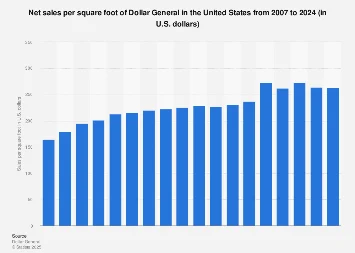
In the fiscal year concluding early 2025, Dollar General, the ubiquitous American variety store chain, registered net sales of $263 per square foot across its expansive U.S. footprint. This figure, while representing a slight dip from the $264 achieved in the preceding fiscal year, underscores the company’s consistent ability to extract significant revenue from its retail space. Headquartered in Tennessee, Dollar General’s operational prowess is further highlighted by its relentless expansion; the company reported a record 20,662 stores in operation during the same period, solidifying its position as a dominant force in the discount retail sector.
The metric of net sales per square foot is a critical indicator of a retailer’s efficiency and profitability. It measures how effectively a company utilizes its physical store space to generate revenue. For Dollar General, a business model predicated on high volume, low-price goods, this metric is particularly telling. The ability to achieve $263 in sales for every square foot of retail floor space suggests efficient inventory management, effective merchandising, and a strong understanding of its core customer base’s purchasing habits.
Analyzing the historical trend reveals a fascinating trajectory. From $165 per square foot in 2007, the figure has shown remarkable resilience and growth, albeit with some fluctuations. By 2022, the metric had climbed to a peak of $273, a testament to a period of strong consumer spending and perhaps strategic adjustments to product mix and store layout. The subsequent slight moderation in 2023 and 2024, while noticeable, should be viewed within the broader context of a dynamic retail environment, characterized by shifting consumer preferences, inflationary pressures, and increased competition.
The period between 2018 and 2020 saw a significant upward trend, with sales per square foot rising from $231 to $273. This surge coincided with a robust economic climate and likely benefited from Dollar General’s strategic placement of stores in rural and suburban areas, where access to other retail options might be limited. The company’s ability to serve these underserved markets with everyday necessities and convenience items has been a cornerstone of its success.
The COVID-19 pandemic, while disruptive to many sectors, paradoxically proved to be a period of relative strength for discount retailers like Dollar General. As consumers tightened their belts and sought value, Dollar General’s essential product offerings and accessible price points resonated strongly. The data from 2020 and 2021, showing $273 and $262 per square foot respectively, reflect this resilience. Even as the initial surge of pandemic-related demand normalized, the company’s expanded store count continued to contribute to overall revenue growth.
The slight decline from the 2022 peak to $263 in 2024 warrants a closer examination. Several factors could be at play. Increased operational costs, including labor and supply chain expenses, may have influenced profitability margins, indirectly impacting the per-square-foot calculation if not fully offset by price increases. Furthermore, evolving consumer shopping behaviors, such as a greater adoption of e-commerce for certain categories, could be subtly influencing in-store purchasing patterns. However, Dollar General’s business model is inherently less exposed to the online shift than many other retailers, given the impulse-driven nature of many of its product categories and its focus on immediate convenience.
The sheer scale of Dollar General’s operations cannot be overstated. With over 20,000 stores, it is one of the largest retailers in the United States by store count. This vast network allows for significant economies of scale in purchasing, distribution, and marketing. The company’s strategic approach to store placement, often in areas with limited competition and lower overheads, contributes to its ability to maintain profitability even with modest price points.
Comparatively, while direct per-square-foot sales figures for competitors like Dollar Tree or Family Dollar are not as readily available or presented with the same historical depth, industry analysts generally place Dollar General at the higher end of performance within the dollar store segment. This suggests a more optimized operational model and a product assortment that better aligns with sustained consumer demand. However, the discount retail landscape is highly competitive. Retailers like Walmart and Target, while operating at different price points, also compete for the value-conscious consumer, and their substantial investments in private label brands and efficient supply chains present ongoing challenges.
The economic impact of Dollar General extends beyond its financial performance. The company is a significant employer, providing jobs in communities across the nation. Its expansionary strategy often revitalizes local commercial areas and provides essential goods and services to populations that might otherwise face limited options. The consistent investment in new store openings and the maintenance of existing ones contribute to local economies through construction, employment, and property taxes.
Looking ahead, Dollar General faces the perennial challenge of adapting to evolving consumer preferences and economic conditions. The ongoing battle against inflation, potential shifts in discretionary spending, and the continued rise of e-commerce will undoubtedly shape its future performance. However, the company’s proven ability to cater to a broad demographic, its strategic store placement, and its focus on essential goods provide a strong foundation. The slight moderation in net sales per square foot in 2024 is not indicative of a crisis but rather a sign of a mature retail giant navigating a complex and ever-changing market. The company’s ability to maintain its sales efficiency while continuing to expand its physical footprint will be key to its sustained success in the years to come. Investors and analysts will continue to monitor this crucial metric as a barometer of Dollar General’s operational health and its capacity to adapt and thrive in the dynamic retail landscape.