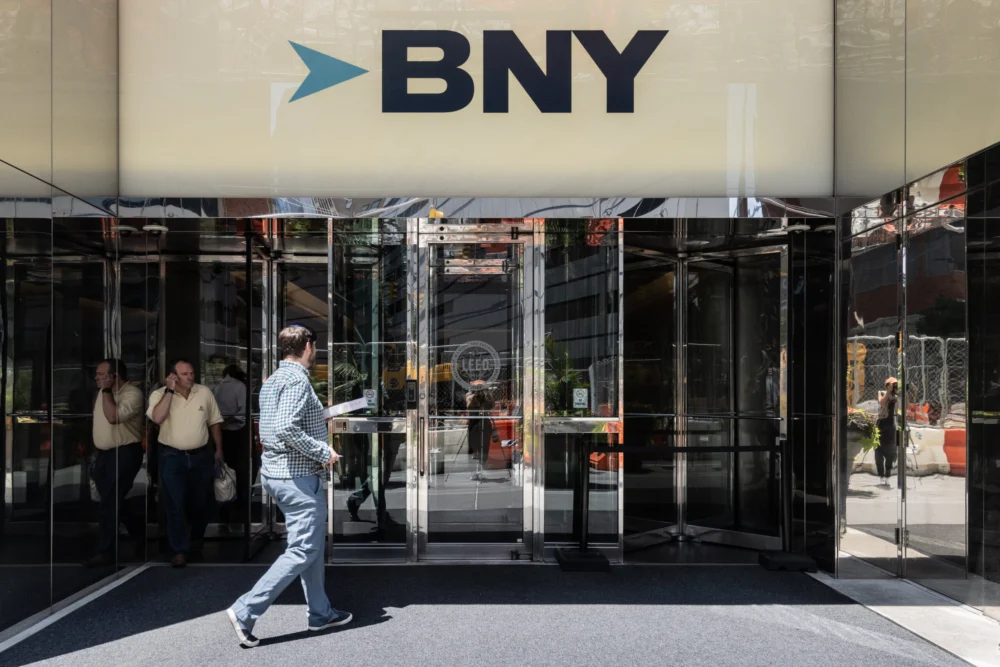
At the corner of Greenwich and Barclay Streets in Lower Manhattan, the headquarters of BNY—the financial institution founded by Alexander Hamilton in 1784—serves as a physical testament to the enduring nature of American capitalism. Yet, inside this 240-year-old bastion of tradition, a quiet revolution is taking place. The bank’s newest cohort of employees does not require desk space, health insurance, or annual leave. These are "digital employees," a fleet of 134 autonomous agents that represent the vanguard of a multi-billion-dollar bet on the transformative power of artificial intelligence in the global financial system.
These digital entities are not merely software scripts running in the background; they are integrated into the corporate hierarchy, assigned specific roles, and evaluated against performance metrics just like their human colleagues. In some instances, the responsibilities these bots now handle were, until very recently, the sole domain of human staff. According to Rachel Lewis, BNY’s head of payment operations, these digital workers operate on a 24/7 cycle, providing a level of continuity that human labor cannot match. The strategic goal, Lewis maintains, is to offload repetitive, data-heavy tasks to algorithms, thereby liberating human employees to focus on high-value, "human-intense" roles that require emotional intelligence, complex problem-solving, and nuanced judgment.
The scale of this transition is reflected in BNY’s shifting workforce demographics. Recent earnings presentations reveal that the bank’s human headcount has contracted from approximately 53,400 in early 2023 to 48,100. While corporate leadership, including CFO Dermot McDonogh, insists that this decline is not yet directly attributable to AI, the trend underscores a broader movement within Wall Street to optimize labor costs through technological leverage. McDonogh describes the current phase of AI integration as "unlocking capacity" rather than a simple drive for efficiency. In the lexicon of modern banking, this means the ability to scale operations and grow revenue without a corresponding increase in human overhead—a concept known as operational leverage.
The financial commitment required to maintain this technological edge is staggering. In 2025, BNY allocated $3.8 billion toward technology spending, representing roughly 19% of its total revenue. This ratio is the highest among its peer group of large-cap American banks, suggesting that BNY is attempting to punch above its weight class in the silicon-driven arms race. For comparison, while behemoths like JPMorgan Chase spend upwards of $15 billion annually on tech, BNY’s proportional commitment indicates a more aggressive pivot toward an AI-first business model.
This aggressive spending has caught the attention of equity analysts. Mike Mayo, a prominent banking analyst at Wells Fargo, characterizes the current environment as an "AI arms race," though he cautions that the winner will be determined by outcomes rather than outlays. He notes that much of the industry’s tech spending has historically been "spraying and praying"—investing broadly in the hope that some innovations stick. However, BNY has emerged as a potential outlier in terms of tangible benefits. Research from Goldman Sachs recently screened the Russell 1000 for companies with the highest exposure to AI productivity gains, ranking BNY near the top. The analysis suggests that the bank could see a potential 19% boost to its earnings per share (EPS) as a direct result of AI-driven labor efficiencies.
To facilitate this transition, BNY has moved beyond the mere purchase of third-party software. The bank has established a dedicated "AI Hub" and developed its own proprietary platform named "Eliza." The name is a deliberate nod to Elizabeth Schuyler Hamilton, the wife of the bank’s founder, bridging the gap between the firm’s 18th-century roots and its 21st-century ambitions. Eliza functions as an internal ecosystem that integrates various open-source and commercial AI models with the bank’s proprietary data and strict compliance protocols.

The rollout of Eliza has been accompanied by a massive internal "upskilling" initiative. Unlike many firms that restrict AI tools to engineering departments, BNY has democratized access to the technology. Nearly the entire workforce has completed a foundational 10-hour training course, and thousands of employees have participated in multi-day "AI bootcamps." These intensives are designed to turn non-technical staff—from accountants to compliance officers—into "citizen developers" who can identify and build automation solutions for their own workflows.
This internal cultural shift is essential for a "systemically important" bank that manages nearly $50 trillion in assets under custody or administration. As a "plumbing" bank—one that handles the back-end settlement and record-keeping for the global financial markets—the margin for error is non-existent. The integration of AI into these critical pathways requires a delicate balance between innovation and risk management. Leigh-Ann Russell, BNY’s chief information officer and global head of engineering, views the bank’s longevity as an asset in this regard. She suggests that the juxtaposition of a 241-year history with cutting-edge AI serves as a reminder that technology has always been the driver of institutional evolution.
However, the rapid adoption of "digital employees" raises fundamental questions about the future of work in the financial sector. While BNY executives like Michelle O’Reilly, the global head of talent, argue that AI is "unlocking productivity" rather than replacing people, the economic reality of the industry suggests a shrinking role for entry-level clerical and administrative positions. In the broader global context, BNY’s strategy mirrors moves by European giants like UBS and HSBC, which are also experimenting with autonomous agents to handle everything from trade reconciliation to client onboarding.
The shift toward autonomous finance also introduces new regulatory and systemic risks. As banks increasingly rely on black-box algorithms to manage trillions of dollars in transactions, regulators at the Federal Reserve and the SEC are closely monitoring for "algorithmic bias" and the potential for "hallucinations" that could trigger market volatility. BNY’s decision to keep its AI models within the "Eliza" walled garden is a strategic move to mitigate these risks, ensuring that all automated processes remain within the firm’s rigorous governance framework.
As the 2025 fiscal year progresses, the market will be looking for concrete evidence that BNY’s $3.8 billion investment is yielding the "best results" mentioned by analysts. If the bank can successfully demonstrate that its 134 digital employees—and the thousands more likely to follow—can drive a 19% increase in earnings, it will provide a blueprint for the survival of legacy institutions in an era of fintech disruption.
The transformation of BNY is a microcosm of a larger structural shift in the global economy. The era of the "banker" as a relationship-driven, paper-shuffling professional is giving way to a hybrid model where humans act as the creative and ethical supervisors of a vast, invisible digital workforce. For America’s oldest bank, the path to the future is not about abandoning its history, but about translating the principles of its founder—Alexander Hamilton, a man who famously sought to bring order and efficiency to the chaotic finances of a young nation—into the language of machine learning. In the halls of BNY, the ghost of Hamilton now shares the workload with Eliza, proving that even the most venerable institutions must evolve or risk becoming footnotes in the very history they helped write.