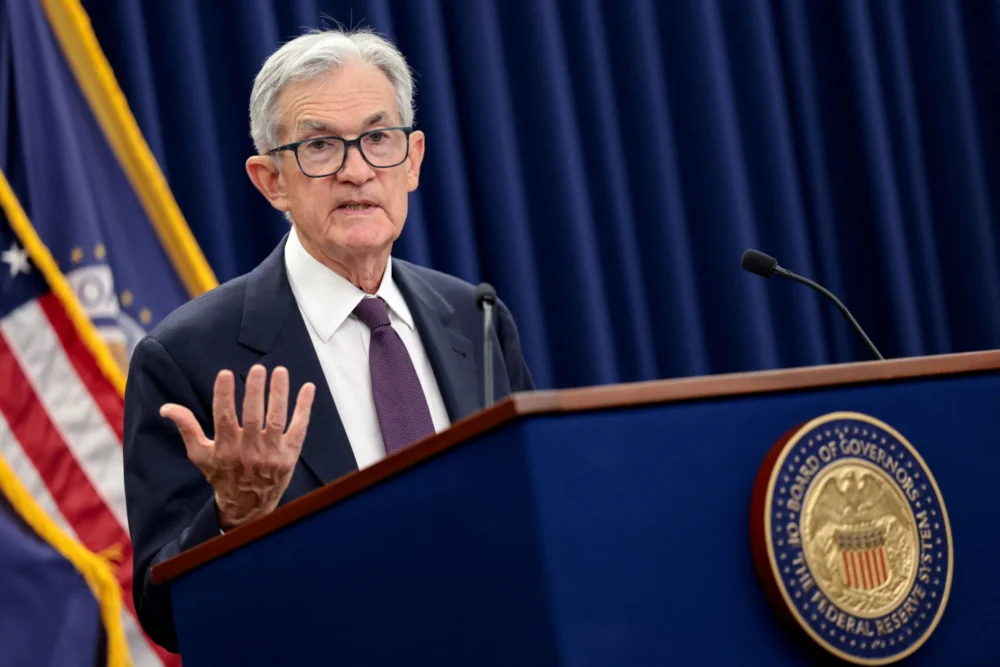
The Federal Open Market Committee (FOMC) concluded its highly anticipated two-day policy meeting on Wednesday, delivering a widely expected interest rate reduction that nonetheless carried a complex message for global markets. While the headline move—a cut to the federal funds rate—aimed to provide a cushion for the American economy, the accompanying rhetoric from Federal Reserve Chair Jerome Powell suggested a central bank that is growing increasingly cautious about the pace of future easing. This "hawkish cut" reflects a delicate balancing act as the Fed attempts to guide the U.S. economy toward a "soft landing" while grappling with robust growth data and a looming transition in its own leadership.
Market participants, who had largely priced in the move, found themselves dissecting a policy statement that signaled a high bar for subsequent reductions. The central bank’s decision to lower rates comes at a time when the traditional signals for easing—such as a sharp economic slowdown or a collapse in consumer spending—are conspicuously absent. Instead, the U.S. economy continues to exhibit a surprising degree of resilience, with Gross Domestic Product (GDP) growth maintaining a solid trajectory. This paradox has forced the Fed into a defensive crouch, prioritizing the preservation of current economic gains while remaining vigilant against any potential resurgence in inflationary pressures.
The current economic landscape is characterized by what many analysts describe as a "détente" between restrictive monetary policy and market expectations. For much of the past year, the narrative was dominated by the aggressive fight against inflation, which saw the Fed hike rates to their highest levels in two decades. Now, with inflation having significantly retreated from its 2022 peaks, the focus has shifted toward finding the "neutral rate"—the theoretical interest rate that neither stimulates nor constrains economic activity. Chair Powell’s commentary on Wednesday suggested that the Fed believes it is nearing this equilibrium, prompting a tactical shift toward a more deliberate, data-dependent approach.
However, the path to neutral is fraught with complications. One of the primary concerns for policymakers is the divergence between top-line economic growth and the health of the labor market. While consumer spending remains robust and corporate earnings have largely outperformed expectations, the pace of job creation has shown signs of moderation. Ellen Zentner, chief economic strategist for Morgan Stanley Wealth Management, noted that while the Fed delivered the expected cut, the "hawkish package" surrounding it raises the stakes for future action. According to Zentner, the economy is expected to grow at a solid pace in the coming year, but this growth must be validated by consistent job gains. Should the upcoming rounds of employment data show a meaningful deterioration, the Fed’s current "wait-and-see" posture could be tested sooner than anticipated.
The concept of a "long pause" has become a central theme for investment strategists. Charlie Ripley, senior investment strategist for Allianz Investment Management, observed that the Wednesday meeting served as an affirmation of what many institutional investors had already suspected: labor conditions are not currently in a state of freefall, growth has actually accelerated in certain sectors, and inflation has reached a temporary plateau. In this environment, the necessity for rapid-fire rate cuts has diminished. By signaling a potential pause, the Fed is attempting to avoid the mistake of over-stimulating an economy that is already running at a healthy clip, which could inadvertently reignite the very inflation it worked so hard to extinguish.

Beyond the immediate mechanics of interest rate policy, the Federal Reserve is also facing a period of significant institutional change. The shadow of a leadership transition looms large over the FOMC’s deliberations, with Chair Jerome Powell’s term set to conclude in May. This upcoming shift introduces a layer of political and administrative uncertainty that central banks typically strive to avoid. Heather Long, chief economist at Navy Federal Credit Union, described the current state of affairs as a temporary calm before a potential shakeup. A new Fed Chair could bring a different ideological approach to monetary policy, potentially altering the central bank’s reaction function to economic data or shifting the weight given to the "dual mandate" of price stability and maximum employment.
This internal transition occurs against a backdrop of shifting global dynamics. The U.S. Federal Reserve does not operate in a vacuum, and its decisions have profound implications for the global financial system. As the Fed adopts a more cautious stance on rate cuts, the interest rate differential between the United States and other major economies—such as the Eurozone and Japan—remains a critical factor for currency markets. A "higher for longer" or even a "steady for longer" approach by the Fed tends to support the strength of the U.S. dollar, which can create headwinds for emerging market economies burdened with dollar-denominated debt. Conversely, if the European Central Bank (ECB) or the Bank of England (BoE) move toward more aggressive easing while the Fed pauses, the resulting currency fluctuations could impact global trade flows and inflation dynamics abroad.
The U.S. housing market also remains a focal point for the impact of Fed policy. Mortgage rates, which are closely tied to the yield on the 10-year Treasury note, have remained elevated despite the recent moves by the FOMC. For many prospective homebuyers, the relief of a federal funds rate cut has yet to translate into significantly lower borrowing costs. The Fed’s cautious outlook suggests that the era of ultra-low mortgage rates is unlikely to return in the near term, as the "neutral rate" may be higher than it was in the decade following the 2008 financial crisis. This "new normal" for interest rates is forcing a recalibration of expectations across the real estate and construction sectors.
In the equity markets, the reaction to the Fed’s announcement was one of cautious validation. Investors have largely accepted the reality that the central bank will not be as accommodative as they might have hoped six months ago. The focus has moved from "how many cuts" to "how strong is the underlying economy." As long as corporate earnings remain resilient and the consumer continues to spend, the market appears willing to tolerate a higher plateau for interest rates. However, the volatility seen in the wake of Powell’s press conference underscores the sensitivity of asset prices to any perceived shift in the Fed’s commitment to supporting growth.
Looking ahead, the Federal Reserve’s "hawkish" posture suggests that the upcoming economic data releases will carry even more weight than usual. The "bar for further action" that Chair Powell has raised implies that only a significant deviation from the current economic trajectory—either a sharp spike in unemployment or a renewed surge in consumer prices—will prompt the FOMC to deviate from its projected path. This data-dependency is a double-edged sword; while it allows the Fed to remain flexible, it also keeps markets in a state of perpetual anticipation, where every monthly jobs report or Consumer Price Index (CPI) reading is viewed as a potential catalyst for a policy shift.
The Federal Reserve’s latest decision marks the end of one chapter in the post-pandemic economic recovery and the beginning of another. The transition from aggressive tightening to a cautious search for a neutral stance reflects an economy that has proved more durable than many predicted. Yet, with a leadership change on the horizon and global economic uncertainties persisting, the Fed’s "long pause" may be less of a resting point and more of a strategic regrouping. As Powell and his colleagues navigate the final months of his current term, the goal remains clear: to solidify the progress made on inflation without sacrificing the hard-won stability of the American labor market. Whether they can achieve this delicate balance will be the defining story of the economic year.