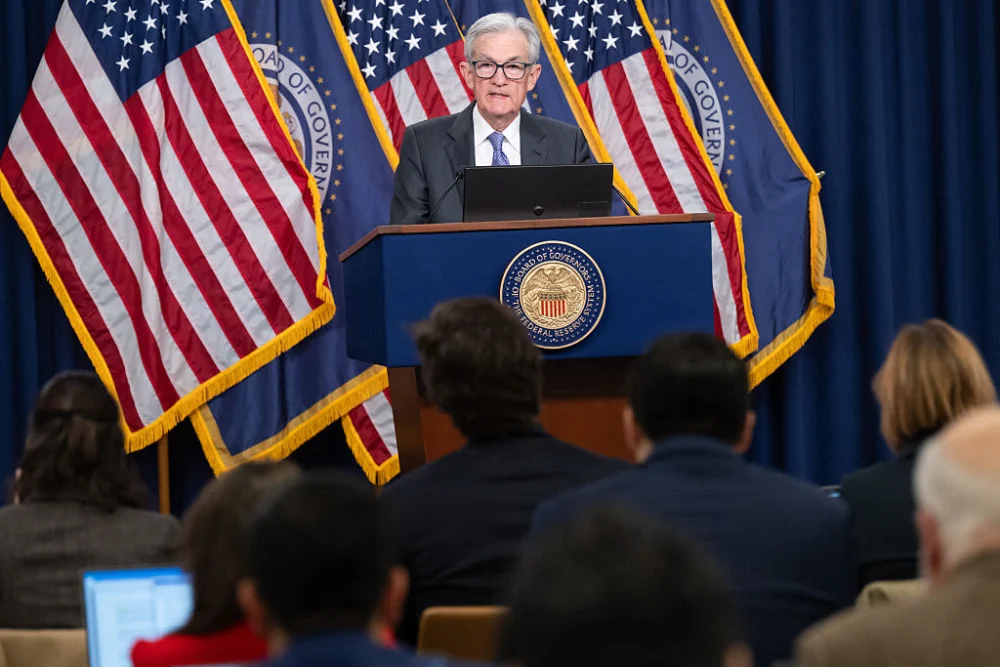
In a statement that underscored the profound sense of institutional crisis currently permeating the world’s most powerful financial body, Federal Reserve Chair Jerome Powell has characterized an ongoing Supreme Court battle as the most consequential legal challenge in the central bank’s 113-year history. Speaking during a high-stakes press conference following the January 2026 Federal Open Market Committee (FOMC) meeting, Powell defended his unprecedented decision to personally attend oral arguments in the case involving Fed Governor Lisa Cook. The Chair’s presence at the nation’s highest court has sparked a firestorm of debate over the boundaries between monetary policy and partisan politics, highlighting a deepening rift between the Federal Reserve and the executive branch.
At the heart of the legal drama is the attempt by President Donald Trump to remove Governor Cook from her post. The administration has cited allegations of mortgage fraud—claims that Cook has categorically denied—as the primary justification for her dismissal. However, the case has transcended individual misconduct allegations to become a referendum on the "for cause" removal protections that have long shielded Federal Reserve officials from political retribution. For over a century, the ability of a President to fire a central banker has been strictly limited to instances of legal or ethical "inefficiency, neglect of duty, or malfeasance in office." If the Supreme Court rules in favor of the White House, it could effectively grant the President the power to terminate Fed governors over policy disagreements, a shift that economists warn would dismantle the wall of separation between the U.S. Treasury and the printing press.
Powell’s decision to sit in the courtroom gallery last week was described by Treasury Secretary Scott Bessent as a "mistake" and a "politicization" of the judiciary. Yet, Powell remained steadfast during Wednesday’s briefing, arguing that the gravity of the moment required his physical presence. He noted that as the steward of the institution, he found it difficult to justify staying away from a proceeding that could redefine the very architecture of American economic governance. Seeking historical cover, Powell pointed to the 1980s, noting that legendary Fed Chair Paul Volcker—who famously broke the back of double-digit inflation—had also attended a Supreme Court hearing. While Powell did not specify the exact case, the invocation of Volcker served as a potent symbol: a reminder that the defense of the Fed’s autonomy has occasionally required its leaders to step into the political and legal arena.
The timing of this constitutional showdown is particularly sensitive. The Federal Reserve, established by the Federal Reserve Act of 1913 under President Woodrow Wilson, was designed specifically to prevent the short-term electoral incentives of politicians from dictating the long-term stability of the dollar. This independence was further codified in the 1951 Treasury-Federal Reserve Accord, which ended the practice of the Fed artificially suppressing interest rates to lower the government’s borrowing costs. Modern economic theory suggests that central bank independence is the single most important factor in maintaining low inflation expectations. When markets believe that interest rate decisions are made based on data rather than polling numbers, they demand a lower "inflation risk premium" on government bonds.
Currently, the U.S. economy finds itself in a precarious position. While the Fed has been navigating a complex "soft landing" following the post-pandemic inflationary surge, the political pressure for aggressive rate cuts has intensified. President Trump has been a vocal critic of the Fed’s restrictive stance, frequently arguing that lower rates are necessary to fuel industrial growth and reduce the national debt service. Critics of the administration argue that the move to oust Governor Cook is less about the alleged mortgage fraud and more about clearing the way for a board that is more subservient to the White House’s economic agenda. During the Supreme Court arguments, several justices expressed skepticism regarding the administration’s broad interpretation of executive power, voicing concerns that a ruling against Cook could trigger a domino effect, undermining the independence of other regulatory bodies such as the Securities and Exchange Commission (SEC) and the Federal Trade Commission (FTC).

The pressure on Powell himself has also reached a fever pitch. Earlier this month, the Chair revealed that he is the subject of a federal investigation regarding the multi-million-dollar renovations of the Federal Reserve’s headquarters in Washington, D.C. While the investigation is ostensibly focused on procurement and budgetary oversight, many veteran Fed watchers view it as a tactical maneuver to weaken Powell’s standing as his term nears its conclusion in May. The dual pressure of a criminal probe into the Chair and a Supreme Court case to fire a Governor has created a climate of uncertainty that is beginning to register in global financial markets.
Market analysts have noted that any perceived erosion of Fed independence typically manifests in the "term premium" of the 10-year Treasury note. If investors fear that the Fed will be forced to keep rates low to satisfy political demands—thereby allowing inflation to run hot—they will demand higher yields to compensate for the loss of purchasing power. This would paradoxically lead to higher borrowing costs for mortgages and corporate loans, the very outcome the White House seeks to avoid. Historically, countries where the executive branch has seized control of monetary policy, such as Turkey or Argentina, have suffered from chronic currency devaluation and capital flight. While the U.S. dollar’s status as the world’s reserve currency provides a significant buffer, institutional decay is a slow process that is difficult to reverse once it begins.
Powell addressed this risk with uncharacteristic bluntness during the press conference. "The point of independence is not to protect policymakers," he stated. "It is a common practice that every advanced economy and democracy in the world has come around to because it works." He warned that once the credibility of the central bank is compromised, "it would be hard to restore." This sentiment is echoed by international peers. The European Central Bank (ECB) and the Bank of England are both governed by strict mandates that prevent political interference, a standard that has become the "gold standard" for global financial stability since the 1990s.
As the legal community awaits the Supreme Court’s decision, the Federal Reserve is also preparing for a leadership transition. With Powell’s term ending in a few months, the President will have the opportunity to nominate a successor who may have a fundamentally different view of the Fed’s relationship with the executive branch. Speculation is rife in Washington about potential candidates who might favor a more "coordinated" approach to fiscal and monetary policy—a prospect that has many traditionalists on Wall Street on edge. Powell, perhaps sensing the end of his tenure, offered a final piece of advice for his eventual successor: "Don’t get pulled into elected politics. Don’t do it."
The outcome of the Lisa Cook case will ultimately determine whether the Federal Reserve remains an technocratic island of stability or becomes another battlefield in the nation’s increasingly polarized political landscape. For Jerome Powell, the stakes could not be higher. His legacy will likely be defined not just by his management of the federal funds rate, but by his success—or failure—in defending the 113-year-old tradition of central bank autonomy against a concentrated challenge from the presidency. As the justices deliberate, the global financial community remains on high alert, recognizing that the integrity of the U.S. financial system hinges on the word of law and the independence of those who execute it.