The Great Hall of the People in Beijing has become the epicenter of a profound shift in the global geopolitical order. Throughout January 2026, a steady procession of world leaders has made the pilgrimage to the Chinese capital, signaling a cautious but definitive departure from the era of "de-risking" and isolation that defined the early 2020s. This diplomatic surge represents more than just a return to pre-pandemic norms; it is a calculated "selective reset" by middle powers and traditional Western allies who are increasingly wary of the protectionist and unpredictable economic policies emanating from Washington.
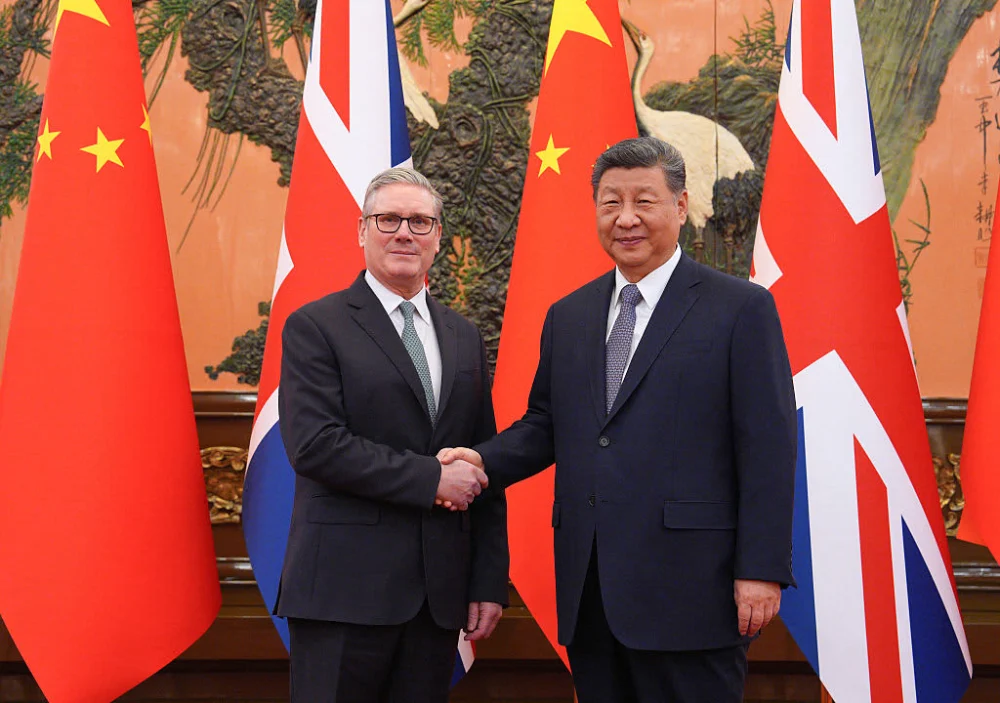
In a single month, Beijing has hosted high-level delegations from the United Kingdom, Canada, Ireland, South Korea, and Finland. The arrival of British Prime Minister Keir Starmer and Canadian Prime Minister Mark Carney marks the first time leaders from these G7 nations have set foot in China in nearly a decade. For Ireland, the gap was even wider, with the January 5 visit being the first by an Irish premier in 14 years. These visits are occurring against a backdrop of intensifying trade friction between the United States and its closest partners, as President Donald Trump’s second administration continues to wield tariffs as a primary tool of foreign policy.
The motivation for this pivot is rooted in pragmatic economic survival. While many of these nations remain ideologically aligned with the United States on matters of regional security and democratic values, the reality of a $18.74 trillion Chinese economy—the world’s second-largest—is impossible to ignore. For leaders like Starmer and Carney, the visits are less about a strategic realignment toward the East and more about preserving "strategic optionality." By reopening high-level communication channels with President Xi Jinping, these nations are seeking to insulate their domestic economies from the shocks of a possible transatlantic or transpacific trade war.
The economic dividends of these diplomatic efforts are already becoming tangible. Accompanying Prime Minister Starmer was a delegation of nearly 60 British corporate and cultural giants, eager to re-establish a foothold in the Chinese consumer market. The most significant outcome of the visit was an announcement by pharmaceutical titan AstraZeneca, which committed to a $15 billion investment in China through 2030. This move underscores a broader trend: despite political rhetoric regarding "de-coupling," multinational corporations are doubling down on China’s massive middle class and its increasingly sophisticated biotech and manufacturing ecosystems.

Canada’s engagement has been equally transactional and transformative. In a landmark agreement reached during Prime Minister Carney’s visit, Ottawa agreed to slash tariffs on Chinese-made electric vehicles (EVs) from a prohibitive 100% to just 6.1%. In exchange, Beijing agreed to lower trade barriers on Canadian canola seeds, a vital export for the Canadian prairie provinces. This "EVs-for-Canola" deal serves as a microcosm of the new era of global trade: a series of bilateral, sector-specific arrangements that bypass the broader, more contentious ideological battles between the superpowers.
However, this balancing act is fraught with risk. The United States remains the world’s largest economy, with a GDP of approximately $28.75 trillion, and its influence over the global financial system remains unparalleled. President Trump has already issued stern warnings to allies who appear to be drifting too close to Beijing’s orbit. Recently, the White House threatened 100% tariffs on Canadian goods if Ottawa "makes a deal" that undermines U.S. economic interests, and the administration has characterized British efforts to engage with Xi as "very dangerous."
The geopolitical landscape has been further complicated by recent U.S. maneuvers in South America, the Middle East, and the Arctic. The U.S. capture of Venezuelan leader Nicolás Maduro and his wife in early January, alongside renewed pressure on Iran and renewed interest in Greenland, has left many global leaders feeling that the current international order is becoming increasingly volatile. In this vacuum of stability, Beijing is positioning itself as the "steady hand." Chinese state media and officials have been quick to promote a "Chinese model of modernization" that offers an alternative to the "Western-centric" system, specifically targeting developing nations and middle powers looking for a predictable partner.
Next week’s scheduled visit by Uruguay’s President Yamandú Orsi—the first South American leader to visit Beijing since the Venezuelan crisis—highlights China’s growing role as a diplomatic refuge. For many in the Global South, China is no longer just a buyer of commodities but a provider of infrastructure, technology, and a diplomatic counterweight to U.S. hegemony. By hosting these leaders, President Xi is demonstrating that China is not isolated, despite years of U.S.-led efforts to restrict its access to high-end technology and global markets.
From a market perspective, the "Beijing flock" reflects a realization that China’s domestic slowdown has forced its leadership to be more accommodating to foreign capital. As Chinese electric vehicle manufacturers and tech firms face saturated domestic markets, they are accelerating their global expansion. Beijing is now urging visiting nations to create "fair and non-discriminatory" environments for Chinese investment, effectively using market access as a carrot to discourage these countries from joining U.S.-led sanctions or tariff blocs.

The data suggests a stark disparity in the leverage held by these visiting nations versus the two superpowers. The five countries whose leaders visited in January—Ireland, South Korea, Canada, Finland, and the UK—possess a combined GDP of roughly $8.71 trillion. While significant, this is less than half of China’s GDP and less than a third of the United States’. This power imbalance necessitates a "hedging strategy," where smaller economies must maintain functional relationships with both giants to avoid being crushed in the inevitable collisions between the two.
Expert analysis suggests that while the current flurry of diplomacy is a positive sign for global trade, it does not signify a return to the "Golden Era" of relations. Trust, particularly between the European Union and Beijing, remains at an all-time low due to ongoing disputes over industrial subsidies and the war in Ukraine. French President Emmanuel Macron’s recent threat of new tariffs on Chinese goods, issued just 24 hours after returning from a state visit to Beijing, illustrates the fragility of these diplomatic "resets."
Looking ahead, the focus will shift to the Asia-Pacific Economic Cooperation (APEC) forum, which China is hosting this year. With a senior officials’ meeting scheduled for Guangzhou in early February and the main leaders’ summit in November, 2026 is poised to be a year of high-stakes summits. There is even the potential for President Trump and President Xi to meet as many as four times this year, including a tentative visit by Trump to China in April.
Business leaders in Beijing are watching these developments with a mixture of hope and trepidation. At a recent gathering of the American Chamber of Commerce in China, executives urged both Washington and Beijing to move past the "tit-for-tat" retaliations that began with the "Liberation Day" tariffs of April 2025. The current one-year trade truce is fragile, and the global business community is desperate for a long-term framework that provides regulatory certainty.
Ultimately, the influx of world leaders to Beijing is a testament to the enduring reality of a multipolar world. While the United States remains the preeminent military and financial power, China’s role as the "world’s factory" and a primary source of global demand makes it an indispensable partner for any nation seeking economic stability. As the "selective resets" continue, the global order is being reshaped not by a single grand bargain, but by a thousand smaller deals struck in the shadow of the Great Hall, as the rest of the world learns to navigate the turbulent waters between two competing suns.