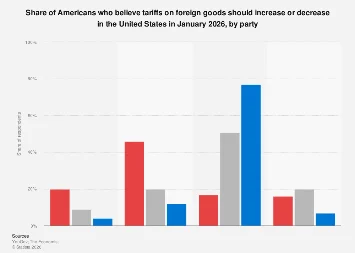
A recent survey conducted in January 2026 reveals a significant divergence in American public opinion regarding tariffs on foreign goods, with stark differences emerging along party lines. The findings suggest that the debate over trade protectionism and free trade continues to be a potent wedge issue, shaping the economic outlook and potentially influencing future policy decisions as the United States heads towards another election cycle. The survey, which polled 1,722 U.S. citizens aged 18 and older via an online panel, indicates a complex landscape where core economic philosophies are deeply intertwined with political identities.
A key takeaway from the data is the relatively low level of support among Republicans for maintaining the status quo on tariffs. Less than half of Republican respondents indicated a belief that current tariff levels on imported goods should remain unchanged. This suggests a segment of the Republican base may be open to either increasing or decreasing tariffs, or perhaps is undecided, reflecting a potential internal debate within the party on the optimal approach to international trade. Historically, the Republican party platform has often emphasized free trade principles, but recent years have seen a notable shift towards protectionist sentiments, particularly concerning specific industries and perceived unfair trade practices by other nations. This survey data hints that this evolution may not be universally embraced, or that new economic pressures are prompting a reassessment of established stances.
Conversely, the survey highlights a more pronounced inclination among Democrats to advocate for a reduction in tariffs. A significant percentage of Democratic respondents expressed a clear preference for lowering existing tariffs on foreign goods. This aligns more closely with traditional Democratic stances that often favor open markets and the potential benefits of reduced trade barriers for consumers and businesses reliant on imported components. However, the Democratic party is not monolithic on this issue, with various factions holding differing views on the balance between free trade and the need to protect domestic industries and workers. The strong showing for tariff reduction among Democrats in this survey suggests that concerns about the economic impact of tariffs, such as increased consumer prices and retaliatory measures from trading partners, may be weighing heavily on the party’s supporters.
The independent voter bloc, often seen as a crucial swing demographic in U.S. elections, presents a more nuanced picture. While specific figures for independents are not fully detailed in the provided summary, their positions are critical to understanding the broader political trajectory of trade policy. Their views are likely to be influenced by a range of factors, including local economic conditions, personal financial situations, and broader national economic trends. The degree to which independents lean towards protectionism or free trade could ultimately determine the direction of any significant policy shifts.
The economic implications of these diverging opinions are substantial. Tariffs, by definition, are taxes imposed on imported goods, which can have a ripple effect throughout the economy. Proponents often argue that tariffs protect domestic industries from foreign competition, leading to job creation and higher wages for American workers. They can also serve as a tool to address perceived trade imbalances and to encourage the repatriation of manufacturing. Industries such as steel, aluminum, and automobiles have frequently been at the center of these debates, with domestic producers often lobbying for higher tariffs to level the playing field against lower-cost imports.

However, critics of tariffs point to several negative consequences. Increased tariffs can lead to higher prices for consumers as the cost of imported goods rises, and domestic producers who rely on imported materials or components may face increased operational expenses. This can stifle innovation and reduce competitiveness. Furthermore, tariffs can provoke retaliatory measures from other countries, leading to trade wars that harm export-oriented industries and disrupt global supply chains. The agricultural sector, for instance, has often been vulnerable to retaliatory tariffs from trading partners.
Globally, the United States’ approach to tariffs has significant international ramifications. As one of the world’s largest economies, its trade policies influence global trade flows, investment decisions, and the economic health of its trading partners. A move towards higher tariffs by the U.S. could lead to a broader increase in protectionist measures worldwide, potentially undermining the principles of multilateral trade agreements and leading to a more fragmented global economic order. Conversely, a reduction in tariffs could signal a renewed commitment to global economic integration and cooperation.
The timing of this survey, January 2026, is particularly relevant. It precedes a period of significant political activity leading up to potential elections, where economic issues are often at the forefront of voter concerns. The differing partisan views on tariffs suggest that candidates will need to carefully articulate their trade platforms to appeal to their respective bases and to independent voters. The debate could become a focal point for discussions on national economic strategy, job growth, inflation, and the United States’ role in the global economy.
The methodology of the survey, conducted by YouGov, involved an online panel of 1,722 respondents. While online panels offer broad reach and cost-effectiveness, it’s important to consider potential biases related to internet access and demographic representation. The specific wording of the question – "Do you think that tariffs on foreign goods imported into the U.S. should be increased or decreased?" – is crucial. It forces respondents into a binary choice, potentially oversimplifying the complex considerations involved in trade policy. Future research could explore more nuanced options, such as maintaining existing levels or specific types of tariffs.
Looking ahead, the persistent partisan divide on tariff policy underscores the challenge for policymakers in forging a consensus. Any significant legislative or executive action on tariffs would likely face considerable political headwinds. The economic data available to inform these decisions is often complex and subject to varying interpretations, further complicating the debate. As the U.S. navigates the intricate landscape of international trade, the public’s evolving sentiment, as captured by this survey, will undoubtedly play a role in shaping the nation’s economic future and its relationships with the rest of the world. The question of whether the United States will embrace more protectionist measures or lean towards further trade liberalization remains a central and contentious issue, with its resolution likely to have profound and lasting economic consequences.