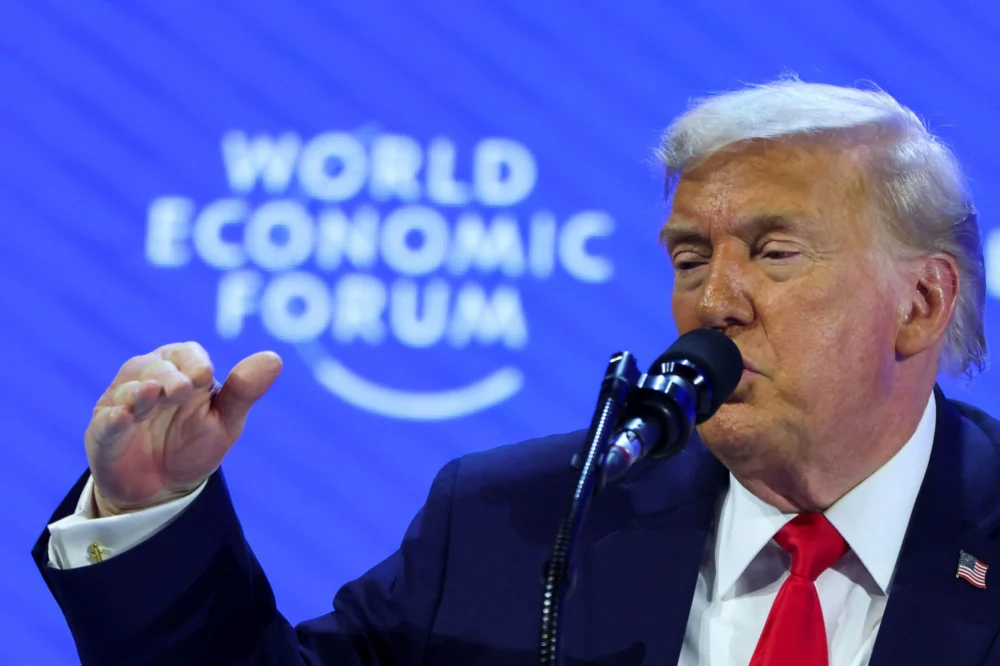
Speaking before a global audience of financiers and political leaders at the World Economic Forum in Davos, Switzerland, President Donald Trump escalated his campaign against the American banking establishment by calling on Congress to implement a strict 10% ceiling on credit card interest rates. The proposal, framed as a one-year emergency measure to alleviate the financial burden on American households, represents a significant shift from the administration’s previous attempts to persuade lenders toward voluntary rate reductions. By invoking the historical and moral concept of "usury," the President has reignited a fierce debate over price controls, credit availability, and the fundamental mechanics of the U.S. consumer lending market.
The timing of the announcement is particularly poignant as American household debt reaches unprecedented levels. According to data from the Federal Reserve Bank of New York, total credit card balances in the United States recently surpassed the $1.1 trillion mark, driven by persistent inflation and the highest benchmark interest rates seen in two decades. With average annual percentage rates (APRs) hovering between 21% and 25%—and often exceeding 30% for subprime borrowers—the President’s rhetoric targeted what he described as an exploitative environment. "They charge Americans interest rates of 28%, 30%, 31%, 32%," the President remarked during his address. "Whatever happened to usury?"
Despite the potentially catastrophic implications such a cap would have on bank profit margins, Wall Street’s initial reaction was unexpectedly positive. The KBW Bank Index, a key benchmark for the sector, climbed 2.2% in the wake of the comments, while shares of major card issuers like Capital One—which derives a vast majority of its net income from interest on revolving credit—advanced nearly 2%. Market analysts suggest this "relief rally" stems from the realization that the President is now deferring to a legislative process that is notoriously slow and fraught with partisan gridlock. By moving the issue to Congress, the immediate threat of unilateral executive action or regulatory mandates appears to have diminished.

The legislative path for a 10% interest rate cap is indeed steep. While the proposal finds unusual common ground in the "horseshoe" of American politics—aligning the populist right, represented by Senator Josh Hawley (R-Mo.), with the progressive left, led by Senator Bernie Sanders (I-Vt.)—it lacks broad support within the mainstream Republican caucus. House Speaker Mike Johnson and other GOP leaders have expressed deep skepticism regarding government-mandated price controls, which many conservatives view as anathema to free-market principles. Sanjay Sakhrani, a veteran analyst at KBW, noted that the odds of implementation remain low because the policy would likely disrupt a wide array of interconnected industries, including retail and airline sectors that rely heavily on co-branded credit card partnerships for loyalty programs and revenue.
The banking industry’s counter-offensive has been swift and focused on the "unintended consequences" of credit rationing. Industry giants, including JPMorgan Chase, have warned that a 10% cap would make it mathematically impossible for lenders to extend credit to higher-risk individuals. In a market where the "risk-free rate" (set by Treasury yields) and the cost of operations already consume a significant portion of the margin, a 10% ceiling would leave little room for banks to account for the probability of default among subprime borrowers. Jamie Dimon, CEO of JPMorgan Chase, used his own platform at Davos to suggest a provocative "pilot program" for the policy, recommending that the cap be tested exclusively in Vermont and Massachusetts—the home states of Senators Sanders and Elizabeth Warren. Dimon argued that such a move would quickly demonstrate the "economic disaster" of price controls, leading to a "drastic reduction" in credit access for up to 80% of the population.
From an economic perspective, the implementation of an interest rate cap often triggers a phenomenon known as "credit flight." When the price of a service (in this case, the cost of borrowing) is capped below the market-clearing level, the supply of that service tends to contract. For the millions of Americans with credit scores below 660, a 10% cap could mean the immediate cancellation of their accounts or the inability to secure new lines of credit. This would force many "underbanked" individuals into the arms of even less regulated and more expensive alternative financial services, such as payday lenders or title loan providers, effectively achieving the opposite of the President’s stated goal of helping Americans save for homes.
The President’s focus on usury laws also brings a historical dimension to the current policy debate. For much of American history, interest rates were governed by state-level usury laws. However, a landmark 1978 Supreme Court decision, Marquette National Bank of Minneapolis v. First of Omaha Service Corp., effectively deregulated the industry by allowing national banks to "export" the interest rates of their home state to customers nationwide. This led to a concentration of credit card operations in states like South Dakota and Delaware, which had eliminated interest rate ceilings to attract banking jobs. A federal 10% cap would represent the first significant reversal of this trend in nearly half a century, overriding the existing state-level frameworks that have defined the modern era of consumer finance.

Globally, the United States remains an outlier in its lack of a national interest rate cap for credit cards. In the European Union, many member states employ "usury limits" that are pegged to the average market rate. In France, for instance, the taux d’usure (usury rate) is adjusted quarterly by the central bank and varies based on the type and size of the loan. While these caps prevent the 30%+ rates common in the U.S., they also result in a more conservative lending environment where credit cards are less ubiquitous and credit scores are scrutinized with extreme rigor. Proponents of the Trump plan argue that the U.S. has allowed the pendulum to swing too far toward lender profitability at the expense of consumer stability, while critics argue that the American model’s flexibility is exactly what drives consumer spending—a primary engine of the U.S. economy.
The broader economic impact of a sudden rate cap would also reverberate through the retail sector. Many Americans use credit cards as a bridge for essential spending during periods of high inflation. If credit lines are retracted, consumer spending—which accounts for approximately 70% of U.S. GDP—could see a sharp decline. Furthermore, the lucrative rewards programs that many middle-class Americans rely on for travel and cash back are funded largely by the interchange fees and interest income generated by the cards. A cap as low as 10% would likely result in the immediate elimination of these perks, as banks look to cut costs to maintain viability.
As the debate moves to the halls of Congress, the President’s influence over the Republican base will be the ultimate wildcard. While traditional economic conservatives remain opposed to the measure, the "America First" populist wing of the party has shown an increasing willingness to challenge corporate interests in favor of direct consumer relief. Whether this proposal is a genuine policy goal or a strategic political maneuver designed to pressure banks into smaller, voluntary concessions remains to be seen. However, by bringing the "usury" debate to the world stage, the President has ensured that the cost of credit will remain a central theme of the national economic discourse for the foreseeable future.
The coming months will likely see intense lobbying from both consumer advocacy groups, who view the 10% cap as a necessary correction to corporate greed, and the financial services lobby, which views it as a threat to the stability of the American financial system. For the average consumer caught in the middle, the outcome of this legislative battle will determine not just the interest rate on their monthly statement, but their very access to the revolving credit that has become a staple of modern American life. Regardless of the bill’s eventual fate, the conversation has shifted; the "law of the market" is now facing its most significant challenge from the "law of the land" in decades.