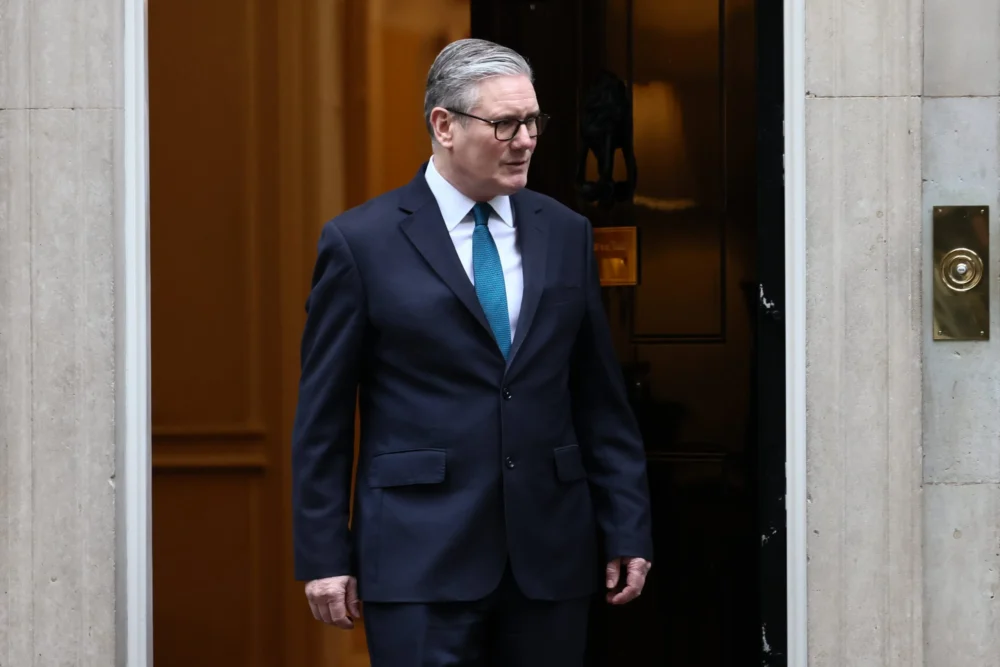
The arrival of Prime Minister Keir Starmer in Beijing this week marks a watershed moment in British foreign policy, signaling the end of a nearly decade-long deep freeze in top-level diplomatic engagement between the United Kingdom and the world’s second-largest economy. Accompanied by a delegation of nearly 60 business leaders and cultural representatives, Starmer’s visit is the first of its kind in eight years, aimed at navigating a precarious path between the urgent need for domestic economic growth and the increasingly complex demands of national security. As the Prime Minister prepares for high-stakes meetings with President Xi Jinping and Premier Li Qiang, the mission is being framed not as a return to the unfettered optimism of the "Golden Era," but as a "consistent, pragmatic partnership" designed to stabilize a relationship that has often been characterized by volatility.
The composition of the traveling party underscores the sectors the British government views as critical to its post-Brexit economic strategy. The presence of HSBC Group Chairman Brendan Nelson and Aberdeen Group CEO Jason Windsor highlights the enduring importance of the City of London as a global financial hub with deep-seated interests in the Chinese market. For HSBC, which generates a significant portion of its profits from its Asian operations, the thaw in relations offers a reprieve from years of navigating the crossfire of geopolitical sanctions and regulatory pressures. Financial services remain one of Britain’s most potent exports, and securing better access to China’s vast domestic capital markets and wealth management sectors is a top priority for the Downing Street team.
In the industrial and technological spheres, the inclusion of John Harrison, General Counsel for Airbus, and Colm Lacy, Chief Commercial Officer of British Airways, points to the critical nature of the aerospace and aviation sectors. As global air travel continues its post-pandemic realignment, the Chinese market remains the primary growth engine for wide-body aircraft demand. For Airbus, maintaining a robust relationship with Beijing is essential not only for sales but also for its manufacturing footprint in Tianjin, especially as it seeks to maintain its competitive edge over its American rival, Boeing, which has faced significant headwinds in the region.
The life sciences sector is equally well-represented, with AstraZeneca CEO Pascal Soriot and GSK Chair Sir Jonathan Symonds joining the mission. These pharmaceutical giants view China not just as a consumer market with an aging population, but as an increasingly vital hub for research and development. AstraZeneca, in particular, has embedded itself deeply within the Chinese healthcare ecosystem, and Soriot’s presence suggests a push for greater regulatory alignment and protection for intellectual property—areas that have historically been points of contention between Western firms and Chinese authorities.
The timing of this diplomatic outreach is far from coincidental. It occurs against a backdrop of significant global instability, characterized by a radical shift in American foreign policy. The resurgence of protectionist rhetoric from Washington, including threats of sweeping tariffs and unconventional diplomatic demands, has forced traditional U.S. allies to reconsider their economic dependencies. The specter of a 10% tariff on European nations and the pressure placed on Canada regarding its own trade ties with China have created a vacuum that London is now attempting to fill. By positioning the UK as a stable, pragmatic partner, Starmer is attempting to insulate the British economy from the "America First" volatility that has unsettled markets from Brussels to Ottawa.
This "Beijing Season" of diplomacy has seen a flurry of international leaders making the trek to the Great Hall of the People. In recent weeks, the Chinese leadership has hosted Canadian Prime Minister Mark Carney, Irish leader Michael Martin—the first Irish visit in 14 years—South Korea’s President Lee Jae Myung, and Finnish Prime Minister Petteri Orpo. This diplomatic offensive suggests that Beijing is actively seeking to diversify its own economic partnerships in response to escalating tensions with the United States. For Starmer, the challenge lies in ensuring that the UK is not merely one of many voices in the crowd, but a primary interlocutor capable of securing tangible concessions for British firms.
The domestic context for the visit is equally significant. Only last week, the British government cleared the way for the construction of a massive new Chinese Embassy in London, a project that had been stalled for years due to intense political opposition and security concerns. The approval is widely interpreted as a "goodwill gesture" intended to smooth the path for Starmer’s discussions in Beijing. It signals a move away from the more confrontational stance of previous administrations, which had prioritized "de-risking" to the point of near-total economic decoupling in sensitive sectors.
However, the Prime Minister’s office has been careful to manage expectations at home, where hawks in both the Labour and Conservative parties remain wary of Chinese influence. The official government line emphasizes that economic cooperation will not come at the expense of national security. Starmer is expected to raise difficult issues, including human rights, the erosion of autonomy in Hong Kong, and cyber-security threats. This "dual-track" approach—pursuing trade while maintaining a firm stance on security—is a high-wire act. The success of the trip will be measured by whether the UK can secure meaningful market access in the creative industries, life sciences, and financial services without being seen as capitulating on core democratic values.
Economically, the stakes are immense. Bilateral trade between the UK and China has grown steadily, reaching approximately £110 billion in recent years, yet the trade deficit remains a point of concern for British policymakers. By focusing on high-value services and advanced manufacturing, the UK hopes to rebalance this relationship. The goal is to move beyond the exchange of commodities and consumer goods toward a more sophisticated partnership involving joint ventures in green technology, digital trade, and healthcare innovation.
Global market analysts suggest that the UK’s pivot toward China is a recognition of the shifting centers of economic gravity. As the European Union grapples with its own internal divisions and the United States turns inward, the UK must find new avenues for growth to sustain its public services and fund its transition to a net-zero economy. China’s "New Quality Productive Forces" initiative, which emphasizes high-tech manufacturing and green energy, aligns with many of the UK’s own industrial goals, providing a potential framework for future collaboration.
Nevertheless, the path forward is fraught with risks. The threat of secondary sanctions from the United States remains a constant concern for British banks like HSBC and Standard Chartered. Furthermore, any perceived softening of the UK’s stance on security could strain the "Special Relationship" with Washington, which remains the cornerstone of Britain’s defense policy. Starmer’s task is to convince both his domestic audience and his international allies that engagement with China is not a sign of weakness, but a strategic necessity in a multipolar world.
As the delegation moves through a series of high-level forums and private meetings in Beijing, the world will be watching to see if this "pragmatic" approach yields results. If Starmer can return with concrete investment commitments and improved market access for British firms, he will have gone a long way toward proving that the UK can navigate the complexities of the 21st-century global economy. If, however, the visit is seen as purely symbolic, it may only serve to highlight the limited leverage a mid-sized power possesses when caught between two superpowers.
Ultimately, the 2026 visit represents a gamble that the rewards of economic engagement outweigh the risks of geopolitical friction. By bringing the heavyweights of British industry to the table, Starmer is making a clear statement: Britain is open for business, and it is prepared to engage with the world as it is, rather than as it wishes it to be. In the cold calculus of international trade, this may be the only viable path forward for a nation seeking to redefine its place on the global stage.