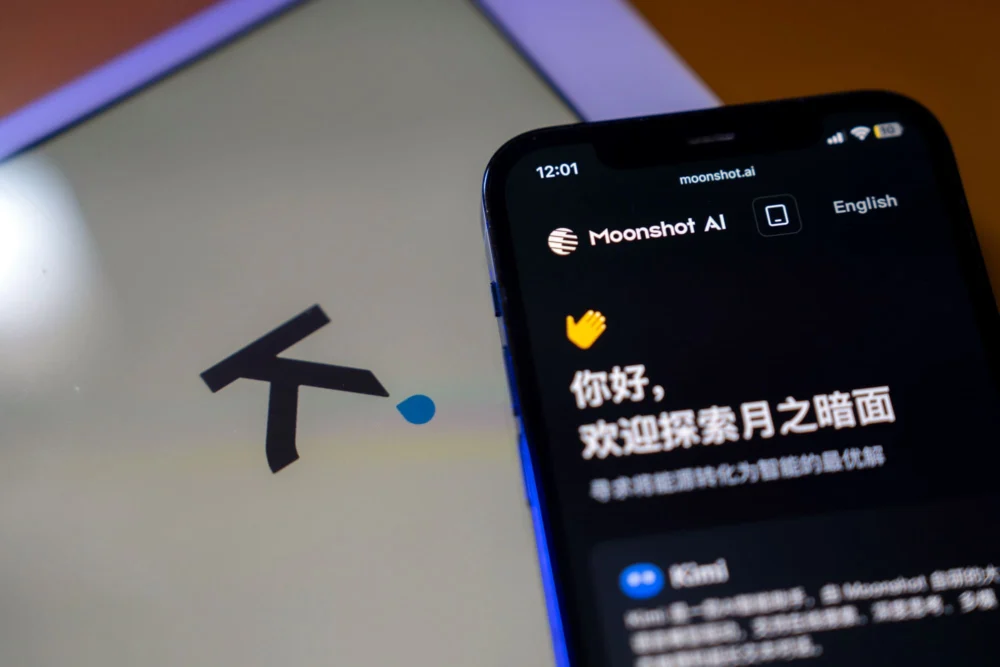
The rapid escalation of China’s domestic generative artificial intelligence sector reached a new milestone this week as Moonshot AI, one of the nation’s most prominent "AI Tigers," saw its private market valuation surge to $4.8 billion. This latest capital injection, which adds approximately $500 million to the company’s valuation in a matter of weeks, highlights an intensifying arms race among Chinese tech giants and venture capital firms to crown a domestic successor to global leaders like OpenAI. The valuation leap follows a previous funding round in late December that pegged the startup at $4.3 billion, reflecting a blistering pace of appreciation that has become characteristic of Beijing’s high-growth technology corridor.
The primary catalyst for this valuation spike is not merely internal performance but a broader market recalibration triggered by the successful public debuts of Moonshot’s primary competitors. In recent weeks, the Hong Kong Stock Exchange has served as a critical exit and liquidity venue for the Chinese AI sector. Rivals Zhipu AI, which trades under the name Knowledge Atlas, and MiniMax have both completed initial public offerings (IPOs) in Hong Kong, achieving market capitalizations that have far exceeded early projections. As of the most recent market close, Knowledge Atlas commanded a valuation of $13 billion, while MiniMax stood at an impressive $15.2 billion. These public benchmarks have provided a "valuation floor" for private peers, encouraging investors to aggressively bid up the remaining private players in anticipation of their own eventual listings.
Moonshot AI, founded by computer scientist Yang Zhilin—a veteran of Google and Meta and a former co-founder of Recurrent AI—has distinguished itself through its flagship product, the Kimi chatbot. Kimi gained significant traction in the Chinese market by focusing on "long-context" processing capabilities, which allow the model to ingest and analyze massive datasets, such as entire books or complex legal documents, in a single prompt. This technical niche allowed Moonshot to carve out a loyal user base months before the global emergence of DeepSeek, another Chinese AI heavyweight that recently disrupted the global tech narrative with its cost-efficient training models.
The investor appetite for Moonshot is bolstered by a "who’s who" of the Chinese technology ecosystem. The company has secured backing from Alibaba Group, Tencent Holdings, and the veteran venture firm IDG Capital. For Alibaba and Tencent, these investments represent a strategic hedge. While both tech conglomerates are developing their own proprietary large language models (LLMs)—Tongyi Qianwen and Hunyuan, respectively—they are simultaneously funneling capital into the "AI Tigers" to ensure they maintain a stake in whatever platform eventually dominates the Chinese consumer and enterprise markets. This dual-track strategy underscores the existential importance of AI to the future of the Chinese digital economy.
The economic backdrop for this surge is inextricably linked to the ongoing technological decoupling between Washington and Beijing. United States-based AI services, including OpenAI’s ChatGPT, Anthropic’s Claude, and Google’s Gemini, are largely inaccessible within mainland China due to a combination of local regulatory requirements and American export restrictions. This "digital vacuum" has created a protected domestic incubator where Chinese firms can scale without direct competition from Silicon Valley’s incumbents. Furthermore, the White House’s increasingly stringent controls on the export of high-end semiconductors, such as Nvidia’s H100 and Blackwell chips, have forced Chinese startups to innovate in software efficiency and architectural design—a necessity that has arguably made firms like Moonshot more resilient and resourceful.
Market analysts suggest that the $500 million valuation jump is a direct response to the "DeepSeek effect," which proved that Chinese AI firms could achieve world-class performance with a fraction of the compute power used by Western counterparts. This realization has shifted the investor narrative from a focus on "who has the most chips" to "who has the best architecture." Moonshot’s Kimi model, particularly the recently released K2 "thinking" model, aims to compete in the high-reasoning space, targeting professional users in the legal, financial, and academic sectors who require more than just creative text generation.

The role of the Hong Kong Stock Exchange (HKEX) cannot be overstated in this narrative. For years, Chinese tech firms looked to the NASDAQ or the New York Stock Exchange for prestige and liquidity. However, geopolitical tensions and the complexities of the Holding Foreign Companies Accountable Act (HFCAA) have made U.S. listings less attractive and more politically sensitive. Hong Kong has stepped into the breach, positioning itself as the premier hub for "New Economy" stocks. The success of Zhipu and MiniMax in Hong Kong has signaled to the global investment community that there is deep liquidity for AI assets in Asia, provided the companies can demonstrate a clear path to monetization.
Despite the optimism, Moonshot AI and its peers face significant headwinds. The cost of training and maintaining large-scale models remains astronomical. Even with the backing of Alibaba’s cloud infrastructure, the "burn rate" for these startups is a constant concern. Unlike traditional software-as-a-service (SaaS) businesses, AI companies face high marginal costs for every query processed. As Moonshot approaches a potential IPO, it will need to transition from a focus on user growth and technical benchmarks to a sustainable revenue model. Currently, the Chinese enterprise market is becoming a primary battleground, with startups racing to integrate their LLMs into the workflows of state-owned enterprises (SOEs) and private industrial giants.
The regulatory environment in China also presents a unique set of challenges and opportunities. Beijing has been proactive in establishing a framework for generative AI, emphasizing data security, "core socialist values," and the prevention of algorithmic bias. While these regulations are often viewed as restrictive by Western observers, they provide a level of legal certainty for domestic firms that their American counterparts—currently embroiled in a patchwork of copyright lawsuits and emerging state-level regulations—do not yet have. By complying with these standards early, Moonshot and its rivals are effectively "pre-cleared" for large-scale domestic deployment.
Looking ahead, the trajectory of Moonshot AI’s valuation suggests that the window for private entry into the top tier of Chinese AI is rapidly closing. Sources close to the current funding round indicate that demand has been so high that the company may seek even higher valuations in subsequent "bridge rounds" before moving toward a public filing. The broader economic impact of this AI boom is expected to be a significant driver of China’s GDP in the coming decade. As traditional sectors like real estate and low-end manufacturing face structural slowdowns, the "New Three" (electric vehicles, lithium batteries, and solar cells) and now "Artificial Intelligence" are being positioned as the primary engines of the nation’s high-quality development strategy.
The global implications of Moonshot’s ascent are equally profound. As Chinese AI firms achieve multibillion-dollar valuations and successful public exits, they are beginning to look beyond their borders. While the U.S. market may remain closed, there is significant potential for Chinese AI expansion in Southeast Asia, the Middle East, and Latin America—regions where "AI sovereignty" is a growing concern and where Chinese infrastructure investment is already well-established.
Moonshot AI’s $4.8 billion valuation is more than just a number; it is a barometer for the health of the Chinese venture ecosystem and a testament to the country’s determination to remain a central pillar of the global AI revolution. Whether Moonshot can maintain this momentum and eventually eclipse the market caps of Zhipu and MiniMax remains to be seen, but for now, the "AI Tigers" are successfully navigating the transition from experimental laboratories to high-stakes public market contenders. The coming months will likely reveal whether this valuation surge is the precursor to a broader tech renaissance in the region or a symptom of a localized speculative bubble. For Alibaba and the other institutional backers involved, the bet is clear: the future of Chinese technology is being written in the code of companies like Moonshot.