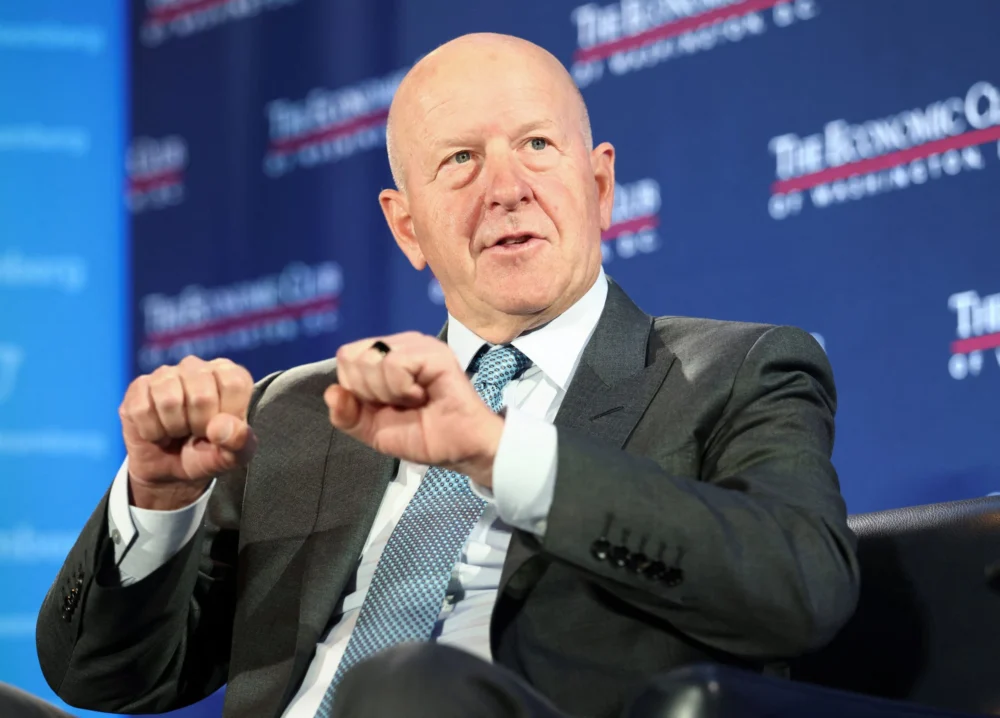
The traditional boundaries of global finance are undergoing a seismic shift as the world’s most prestigious investment banks begin to explore the burgeoning sector of prediction markets, a move that could transform how institutional investors hedge against geopolitical and macroeconomic uncertainty. During a recent discourse on the firm’s strategic trajectory, Goldman Sachs Chief Executive Officer David Solomon revealed that the Wall Street titan is actively investigating how to integrate these emerging platforms into its vast financial ecosystem. This exploration signals a significant pivot for a firm historically rooted in the structured stability of equities, fixed income, and commodities, suggesting that the "financialization of everything" is entering a new, high-stakes chapter where the outcomes of elections, policy decisions, and economic data releases are traded with the same rigor as traditional derivatives.
Solomon’s disclosures, shared during an evaluation of the bank’s fourth-quarter performance, highlighted a proactive engagement with the leadership of the industry’s most prominent platforms. The CEO confirmed he had personally held extensive meetings with the executive teams of two major prediction market entities within a two-week window, dedicating several hours to understanding the operational mechanics and scalability of their business models. Behind the scenes, a dedicated team within Goldman Sachs has been tasked with conducting deep-dive analysis into the sector, signaling that the bank’s interest is far from superficial curiosity. This institutional attention comes at a time when platforms like Kalshi and Polymarket have captured global headlines, driven by massive trading volumes during the most recent U.S. election cycle and a growing appetite for real-time, market-implied probabilities over traditional polling data.
Prediction markets operate on the fundamental principle of the "wisdom of crowds," allowing participants to buy and sell contracts based on the likelihood of specific future events. These "event contracts" pay out a fixed sum—typically one dollar—if the event occurs and zero if it does not. The price of the contract at any given time represents the market’s collective estimate of the probability of that outcome. For decades, these markets existed largely in the academic or offshore periphery, but recent regulatory shifts and technological advancements have pushed them into the financial mainstream. For an institution like Goldman Sachs, the appeal lies in the potential for these markets to serve as a sophisticated tool for price discovery and risk management.
A critical turning point for the sector has been the evolving stance of the Commodity Futures Trading Commission (CFTC) and the subsequent legal precedents established in U.S. courts. Solomon specifically noted that the alignment of some platforms with CFTC regulations makes these instruments look increasingly like traditional derivative contracts. The distinction is vital; for a global bank, the ability to operate within a regulated framework is a prerequisite for any significant capital commitment. By framing prediction markets as a subset of the derivatives industry, Solomon is positioning them as a natural extension of Goldman’s existing FICC (Fixed Income, Currencies, and Commodities) or equities trading desks. This classification allows the bank to apply its existing compliance, risk management, and clearing infrastructure to a new asset class, potentially offering clients a way to hedge against "binary risks" that were previously difficult to price.
The economic implications of institutionalizing prediction markets are profound. In the current global landscape, investors are frequently blindsided by "black swan" events or sudden shifts in government policy. Traditional hedging instruments, such as interest rate swaps or currency futures, provide indirect protection against these shifts. However, a prediction market contract tied directly to a specific legislative vote or a central bank decision offers a "pure play" hedge. If a corporate client is concerned that a proposed change in trade policy could disrupt its supply chain, a prediction market allows that client to take a position that offsets the potential financial loss. For Goldman Sachs, acting as an intermediary or market maker in these transactions could unlock a lucrative new revenue stream while providing clients with unprecedented precision in risk mitigation.
Despite the palpable excitement, Solomon maintained a disciplined stance regarding the timeline for full-scale adoption. While acknowledging the long-term importance and "reality" of these markets, he cautioned that the pace of institutional integration might be more measured than the current hype suggests. This strategic patience reflects the complexities of bringing a retail-heavy, often speculative product into the rigorous environment of institutional finance. Issues such as liquidity depth, potential for market manipulation, and the ethical considerations of "betting" on sensitive social or political outcomes remain at the forefront of the debate. Furthermore, the internal plumbing required to support these trades—ranging from Know Your Customer (KYC) protocols to capital reserve requirements—must be meticulously constructed before a firm of Goldman’s stature can commit its balance sheet.
The rise of prediction markets also challenges the traditional role of economic forecasting and political polling. During recent high-profile events, market-based probabilities often proved more agile and, in some cases, more accurate than conventional data-gathering methods. This is because market participants are incentivized by profit and loss, forcing them to incorporate all available information into their trades instantly. As Goldman Sachs and its peers move into this space, the infusion of institutional capital is likely to increase market efficiency and reduce volatility. The entry of "smart money" could transform these platforms from speculative venues into reliable barometers of global sentiment, providing policymakers and corporate leaders with a real-time feedback loop on the perceived impact of their decisions.
On a global scale, the approach to prediction markets varies significantly, creating a complex patchwork for international banks to navigate. While the United Kingdom has a long-standing history of legalized political betting through traditional bookmakers, the United States has historically been more restrictive, viewing such activities through the lens of gambling rather than finance. However, the recent emergence of platforms that focus strictly on "event contracts" rather than sports or entertainment has carved out a new legal category. In Europe and Asia, regulatory regimes are similarly in flux, with some jurisdictions embracing the transparency these markets offer while others remain wary of the potential for social harm. Goldman’s global footprint means it must develop a strategy that is not only robust in the U.S. but also adaptable to the varying legal landscapes of the world’s financial hubs.
The competitive landscape of Wall Street is also a factor in Goldman’s urgency. As fintech startups and crypto-native platforms gain market share, traditional banks are under pressure to innovate or risk being sidelined in the next generation of trading. By engaging with the leaders of the prediction market space now, Solomon is ensuring that Goldman Sachs remains at the vanguard of financial engineering. The goal is likely twofold: to provide the liquidity that these nascent markets desperately need to attract larger participants, and to develop proprietary analytics that can leverage the data generated by these markets to enhance the bank’s broader investment strategies.
Ultimately, the integration of prediction markets into the fold of Wall Street represents the latest iteration of the industry’s desire to quantify the unquantifiable. From the development of the Black-Scholes model to the rise of credit default swaps, the history of modern finance is a history of turning uncertainty into tradable risk. David Solomon’s interest in these platforms suggests that the next frontier of this evolution lies in the "event space." While the transition from retail speculation to institutional-grade asset class will require significant regulatory navigation and technological development, the commitment of a firm like Goldman Sachs marks a point of no return. As these markets mature, they may become as ubiquitous as the stock exchange, providing a continuous, price-driven narrative of the world’s future, one contract at a time. The era of the "prediction economy" has arrived, and its impact on the global financial system is only beginning to be felt.