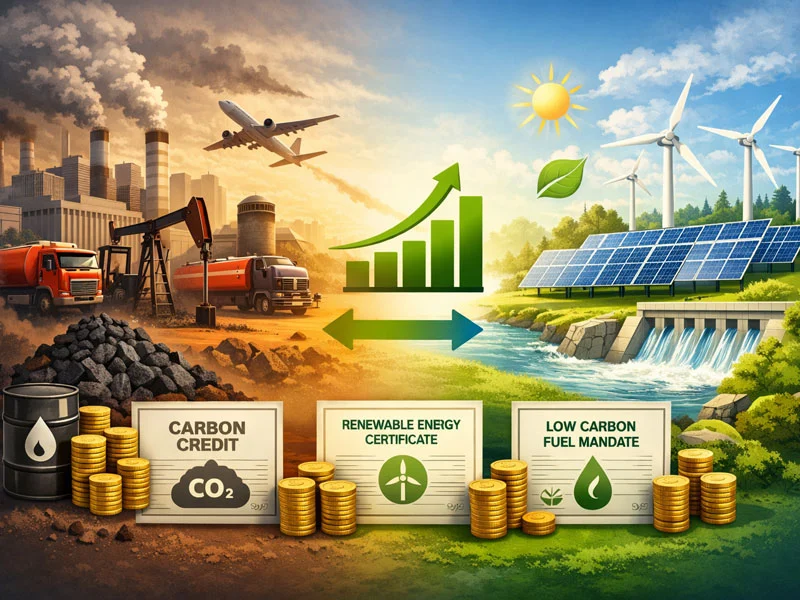
Despite a discernible global shift towards decarbonisation, fossil fuels continue to exert a dominant influence over energy consumption across a vast spectrum of industries. Data from the International Energy Agency (IEA) underscores this persistent reliance, revealing that industrial energy demand remains heavily skewed towards fossil fuels, with coal playing a particularly significant role. Similarly, the transportation sector draws nearly 91 percent of its energy needs from oil-based products. However, a more optimistic narrative is emerging: by the first half of 2025, renewable energy sources have surpassed coal to become the leading contributors to the global energy supply. This pivotal shift is not a serendipitous occurrence but a direct consequence of the sophisticated interplay of market forces, with environmental commodity markets acting as the crucial scaffolding, providing the essential framework and support for the ambitious undertaking of the energy transition.
The fundamental concept of an environmental commodity can be elucidated through a relatable analogy. Imagine an individual residing in an apartment building who aspires to reduce their personal carbon footprint. A direct solution, such as installing solar panels on their own rooftop, might be infeasible due to structural limitations. In such a scenario, they could collaborate with a friend who possesses a suitable rooftop, offering financial assistance for the installation of solar panels. In return, the apartment dweller could claim the carbon emissions offset by these panels as their own, effectively neutralising their flat’s carbon output. This private transaction exemplifies the creation of a marketplace for decarbonisation opportunities, a principle that is being replicated on a grand scale, connecting energy producers, corporations, and major industrial entities. This mechanism empowers entities that are committed to decarbonisation but face practical or financial constraints, enabling them to invest in emissions reduction efforts elsewhere. Concurrently, it provides a vital avenue for those with the capacity and desire to implement green projects but who lack the necessary capital to bring them to fruition.
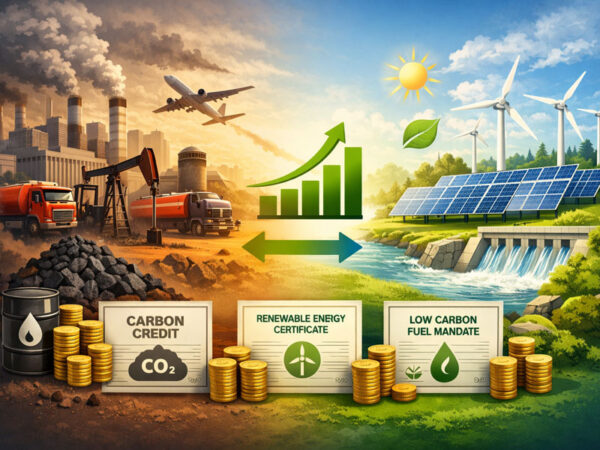
The core drivers propelling the energy transition are multifaceted, encompassing enhanced efficiency, a strategic pivot towards renewable fuels and feedstocks, and the advancement of carbon capture technologies. However, the scalability and efficacy of these drivers are intrinsically linked to their investability, a status achieved when robust market mechanisms are in place. A critical prerequisite for this investability is the accurate pricing of carbon emissions. Encouragingly, carbon is increasingly being assigned a more appropriate economic value, leading to a significant and sustained period of rapid growth within environmental commodity markets over the past two decades. A wave of new regulations, particularly within Europe, is further accelerating this trend across diverse industrial sectors.
In the maritime sector, the FuelEU Maritime initiative is actively reshaping fuel demand patterns. The aviation industry is witnessing the implementation of ReFuelEU mandates, which are effectively stimulating the adoption of sustainable aviation fuels. Within the broader energy landscape, RED III directives are compelling European Union member states to amplify their deployment of renewable energy sources in both power generation and heating. The Carbon Border Adjustment Mechanism (CBAM) is designed to create a more equitable competitive environment for European producers by levelling the playing field with their international counterparts. Collectively, these regulatory frameworks are exerting considerable pressure on European refineries to escalate their production of environmentally conscious energy products. This regulatory impetus, coupled with the escalating integration of renewable energy, is directly translating into heightened demand for environmental certificates. This surge in demand, in turn, renders the energy transition a more financially viable and attractive proposition. Consequently, the future expansion of the "sustainable economy" is being propelled not only by the widening net of regulatory compliance but also by its emergence as a crucial lifeline for energy companies navigating markets that are undergoing a swift and fundamental reorientation towards renewable sources.
While the overall pace of global economic decarbonisation may be considered incremental by some, the substantial volume of emissions that have been effectively capped and mitigated through market-driven schemes, such as Emissions Trading Systems (ETS) and a diverse array of environmental commodities, cannot be overlooked. To illustrate the magnitude of this impact, the global market for Environmental Attribute Certificates (EACs) has expanded to encompass over 2,400 Terawatt-hours (TWh) annually since its formal establishment in the early 2000s. This represents a market size equivalent to more than 60 percent of the European Union’s total electricity demand. These schemes currently address approximately 40 percent of the EU’s total greenhouse gas (GHG) emissions and generated an estimated €38 billion in revenues in 2024.
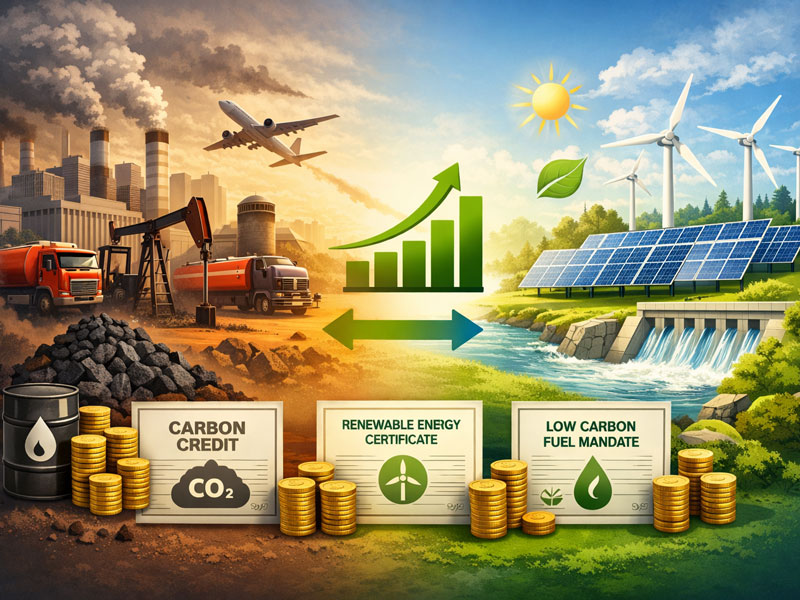
A comprehensive assessment reveals that more than 70 countries worldwide now operate carbon pricing systems. Mechanisms designed to promote clean fuels and related schemes are steadily gaining traction across North America and Asia. In Europe, a confluence of clean energy policies and regulations is progressively embedding the cost of carbon into the balance sheets of major heavy industries, including aviation, shipping, and manufacturing. The landscape is poised for further significant developments in the coming years, with numerous schemes analogous to existing regulations anticipated to exert a substantial impact. These include, but are not limited to, Sustainable Aviation Fuel Certificates (SAFc), white certificates aimed at incentivising energy efficiency improvements, and evolving biofuel mandates. One overarching trend is unequivocally clear: emissions now carry a quantifiable price, and this price is on an upward trajectory.
The author firmly believes that market-based mechanisms represent the most efficient and effective pathway for aligning political aspirations, corporate responsibilities, and consumer demands towards the objective of decarbonisation, all while maintaining affordability. Absent these market forces, the global energy transition risks becoming a protracted, more costly, and ultimately more divisive endeavour. The intricate dance between regulation, innovation, and investment, orchestrated through well-functioning environmental commodity markets, is proving to be the indispensable engine driving humanity towards a sustainable energy future.