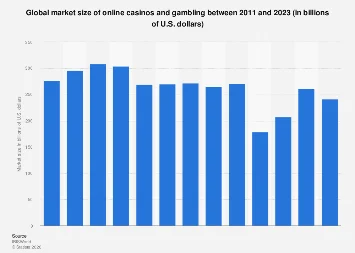
The global online gambling market has experienced a meteoric rise, transforming from a nascent digital curiosity into a multi-billion dollar industry with far-reaching economic implications. Spanning over a decade, from 2011 to 2023, this sector has witnessed a sustained and significant expansion, driven by technological advancements, shifting consumer behaviors, and evolving regulatory landscapes across the world. While specific market size figures are proprietary and require specialized data subscriptions, industry analyses consistently point to a robust upward trend, underscoring the sector’s increasing economic weight.
The early 2010s marked a period of foundational growth for online casinos and sports betting platforms. The widespread adoption of broadband internet and the increasing sophistication of mobile devices laid the groundwork for a more accessible and engaging online gambling experience. Early adopters, often venturing into less regulated markets, demonstrated the latent demand for convenient, 24/7 access to a variety of betting options. This era was characterized by the establishment of key players, the refinement of user interfaces, and the gradual build-out of secure payment infrastructures, all crucial for fostering consumer trust.
As the decade progressed, several key catalysts propelled the market into a higher growth phase. The proliferation of smartphones and tablets made mobile gambling not just a possibility, but a dominant mode of access. This shift democratized the market, allowing individuals to engage with their preferred betting activities anytime, anywhere. Furthermore, innovations in software development led to more immersive gaming experiences, with live dealer games, virtual reality elements, and sophisticated slot machine mechanics becoming increasingly popular. These advancements were not merely about entertainment; they translated directly into increased player engagement and higher spending.
The statistical data available for the period between 2011 and 2023, even in its aggregated form, paints a clear picture of exponential growth. While precise year-on-year figures for the global market size often require access to premium industry reports, reports from reputable market research firms consistently project Compound Annual Growth Rates (CAGRs) in the double digits throughout this period. For instance, it is widely understood that the market has more than doubled, and likely tripled or quadrupled, in value since the early 2010s. This trajectory suggests a market that moved from a valuation in the tens of billions of dollars to well over one hundred billion dollars by the early 2020s, with projections indicating continued expansion.
Several macroeconomic and behavioral factors underpin this remarkable expansion. Firstly, the increasing disposable income in many emerging economies has led to a larger pool of potential consumers with the financial capacity to engage in discretionary spending, including online gambling. Secondly, the cultural acceptance of online entertainment, including gaming and betting, has grown significantly. What was once considered a niche activity has become a mainstream form of leisure for millions globally. The convenience factor cannot be overstated; the ability to place a bet or spin a virtual slot machine without leaving one’s home, coupled with the thrill of potential winnings, offers a potent combination of accessibility and excitement.
The regulatory environment has also played a pivotal, albeit complex, role. While early years saw a patchwork of largely unregulated or loosely regulated markets, the 2010s and early 2020s have been characterized by a global trend towards stricter oversight and the introduction of licensing frameworks. Jurisdictions like the United Kingdom, Malta, and more recently, several US states, have implemented comprehensive licensing regimes. These regulations, while sometimes posing challenges for operators, have ultimately contributed to market maturity and consumer confidence. Legalization and regulation often bring greater transparency, robust player protection measures, and dedicated tax revenues for governments, further legitimizing the industry and attracting more institutional investment. This has been particularly evident in the United States, where the post-PASPA landscape has seen rapid expansion of legal sports betting.
Economically, the online gambling sector’s growth has tangible impacts. It generates substantial tax revenues for governments, which can be reinvested in public services. The industry also creates a significant number of jobs, ranging from software development and cybersecurity to marketing, customer support, and compliance. Furthermore, it stimulates ancillary industries, such as payment processing, affiliate marketing, and content creation. The growth in online gambling has also spurred innovation in areas like artificial intelligence for fraud detection and personalized user experiences, as well as blockchain technology for secure transaction verification.
Looking ahead, the trajectory of the online gambling market remains strongly positive, though subject to evolving trends and challenges. The continued innovation in gaming technology, including the integration of augmented reality (AR) and virtual reality (VR), promises even more immersive experiences. The rise of esports betting represents another significant growth avenue, tapping into a younger demographic and a rapidly expanding competitive gaming scene. Furthermore, the ongoing legalization and regulation of online gambling in new territories, particularly in North America and Asia, are expected to unlock substantial new market potential.
However, the industry also faces headwinds. Increased competition necessitates continuous innovation and customer acquisition strategies. Regulatory bodies are continually scrutinizing issues related to responsible gambling, addiction prevention, and money laundering, requiring operators to invest heavily in compliance and player welfare programs. The potential for market saturation in some established regions also means that growth will increasingly depend on market expansion into less penetrated territories and the development of novel product offerings.
In conclusion, the period between 2011 and 2023 has been a transformative era for the global online gambling market. Driven by technological evolution, changing consumer preferences, and a gradually maturing regulatory framework, the sector has established itself as a significant economic force. Its continued expansion, fueled by innovation and new market opportunities, suggests that the digital frontier of gambling will remain a dynamic and influential segment of the global economy for the foreseeable future, presenting both opportunities and challenges for operators, regulators, and consumers alike.