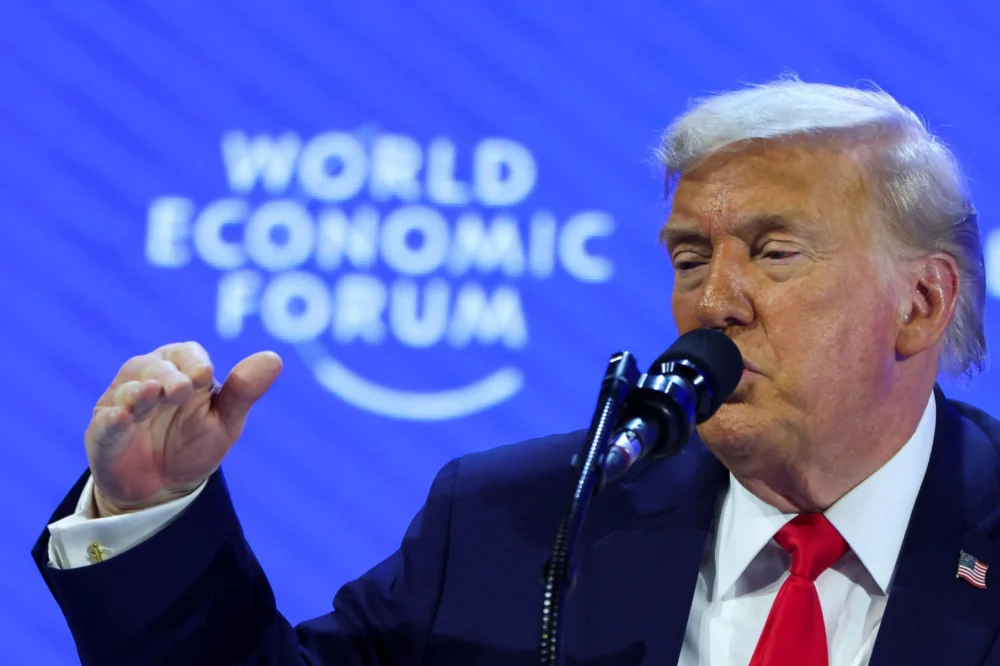
Addressing a global audience of financiers and political leaders at the World Economic Forum in Davos, Switzerland, President Donald Trump has formally called upon Congress to enact a one-year emergency cap on credit card interest rates, set at a maximum of 10%. This proposal, which marks a significant escalation from previous rhetoric urging voluntary compliance from the banking sector, seeks to fundamentally reshape the consumer lending landscape in the United States. By framing the current interest rate environment as a matter of "usury," the administration is positioning itself against the financial establishment in a bid to provide immediate relief to American households struggling with record levels of revolving debt.
The president’s rhetoric in Davos focused heavily on the disparity between the cost of capital for financial institutions and the rates charged to the end consumer. Pointing to annual percentage rates (APRs) that frequently climb into the 28% to 32% range, the president questioned the moral and economic basis of current lending practices. The proposed 10% ceiling is presented not merely as a consumer protection measure, but as a macroeconomic catalyst intended to free up household capital for long-term investments, specifically home ownership. By reducing the "debt service" burden on the average American, the administration argues that the resulting increase in discretionary income would stimulate the broader economy and revitalize the housing market.
In a counterintuitive twist that underscored the complexities of Wall Street’s relationship with Washington, bank stocks rallied immediately following the president’s announcement. The KBW Bank Index saw an uptick of 2.2% in morning trading, while Capital One Financial Corp—a firm with a business model heavily weighted toward credit card revenue—gained 1.9%. This market optimism did not stem from an endorsement of the policy, but rather from a pragmatic assessment of its likelihood of becoming law. Market analysts suggest that by shifting the responsibility to Congress, the president has moved the issue into a legislative arena where gridlock is the historical norm. Investors viewed the "legislative path" as a safer alternative to executive orders or aggressive regulatory maneuvers that could have bypassed the traditional lawmaking process.

The legislative hurdle remains formidable. While the proposal finds an unusual bipartisan echo in the efforts of Senators Josh Hawley and Bernie Sanders—who previously introduced a bill to cap rates at 10% over a five-year period—the broader Republican leadership remains deeply skeptical of price controls. House Speaker Mike Johnson and other prominent GOP figures have expressed concern over the potential for market distortion. For many traditional conservatives, the imposition of a federal ceiling on interest rates represents an unprecedented intervention into the private sector’s ability to price risk. This internal party tension highlights a growing divide between the populist wing of the Republican Party and its more traditional, pro-market wing.
Economic analysts warn that a 10% cap could have profound unintended consequences for the availability of credit. Sanjay Sakhrani, a leading analyst at KBW, noted that the odds of implementation remain low due to fierce opposition from both Republican leadership and adjacent industries. The credit card ecosystem is intricately linked to other sectors; for instance, airlines and retailers rely heavily on co-branded credit cards and the interchange fees and interest they generate to fund loyalty programs and operational costs. A sudden collapse in interest revenue would likely lead to a contraction in these partnership programs, potentially harming the very consumers the policy intends to help.
The banking industry’s defense rests on the mechanics of risk-based pricing. Currently, American credit card debt has surpassed the $1.1 trillion mark, a record high that reflects both inflationary pressures and robust consumer spending. Banks argue that high APRs are a necessary buffer against the risk of default, particularly for "subprime" borrowers with lower credit scores. If a 10% cap were enacted, industry leaders warn that the "unsecured" nature of credit card debt—where there is no collateral to seize in the event of non-payment—would make it mathematically impossible to lend to millions of Americans.
JPMorgan Chase CEO Jamie Dimon, speaking from the same Davos stage, offered a scathing critique of the proposal, characterizing it as a potential "economic disaster." Dimon suggested that such a cap would result in a "drastic reduction" of credit availability for approximately 80% of the population. In a pointed political jab, he challenged the government to pilot the 10% cap in Vermont and Massachusetts—the home states of Senators Sanders and Elizabeth Warren—to observe the inevitable credit crunch. Dimon’s argument is that when price is capped below the cost of risk and operation, the supply of the product—in this case, credit—simply vanishes.

From a global perspective, the United States has historically maintained a more deregulated approach to interest rates compared to some European counterparts. In many EU nations, interest rates are indirectly capped through "usury" laws that tie maximum rates to a multiple of the average market rate or the central bank’s base rate. However, a hard cap of 10% in a high-inflation environment would be an anomaly among developed economies. Critics of the American system point to the "debt trap" created by compounding interest at 30%, while proponents argue that the American model provides the most liquid and accessible credit market in the world, allowing even those with poor financial histories to access funds in emergencies.
The potential impact on the housing market also remains a point of contention. While the president suggests that lower card rates would help Americans save for down payments, some economists argue the opposite. They contend that a contraction in the credit market could lower overall consumer credit scores as "credit utilization" ratios spike due to closed accounts. Since mortgage lenders rely heavily on these scores, a policy intended to help first-time homebuyers could inadvertently disqualify them from the mortgage market entirely. Furthermore, if banks lose interest income, they may compensate by increasing fees for other services, such as checking accounts, or by eliminating the popular rewards and "cash-back" programs that many middle-class consumers use to offset their daily expenses.
Behind closed doors, the lobbying effort against the cap is intensifying. Financial institutions have emphasized that they are already in full compliance with existing laws, such as the CARD Act of 2009, which established transparency requirements and limited certain types of fees. Bankers and their representatives have privately signaled that they will fight any legislative movement on this front, viewing it as an existential threat to the profitability of retail banking. To date, no major credit card issuer has moved to voluntarily lower rates in response to the president’s social media prompts or public speeches, signaling a unified industry front.
As the debate moves from the snow-capped mountains of Davos to the halls of the U.S. Capitol, the central question remains one of economic philosophy: should the government dictate the price of money to protect the vulnerable, or should the market be left to price risk according to its own internal logic? The 10% cap proposal has succeeded in bringing the issue of "usury" back into the national conversation, but the path to implementation is fraught with legislative traps and economic risks. Whether this move represents a genuine shift in policy or a strategic political maneuver aimed at the upcoming election cycle, it has undeniably placed the American banking sector on high alert. For the millions of Americans carrying a balance, the prospect of a 10% cap offers a glimmer of hope for debt relief, but the reality of a tightened credit market may yet prove to be a double-edged sword.