The global financial order, long anchored by the stability of the United States dollar and the perceived safety of Treasury securities, is entering a period of profound structural vulnerability. As political rhetoric shifts toward aggressive protectionism and unconventional territorial ambitions, seasoned observers of the macro-economic landscape are sounding the alarm on a transition from mere trade disputes to what is being termed a "capital war." This shift suggests that the next phase of international friction will not be fought through tariffs on manufactured goods alone, but through the weaponization of financial flows, the strategic dumping of sovereign debt, and the systematic erosion of the dollar’s status as the world’s primary reserve currency.
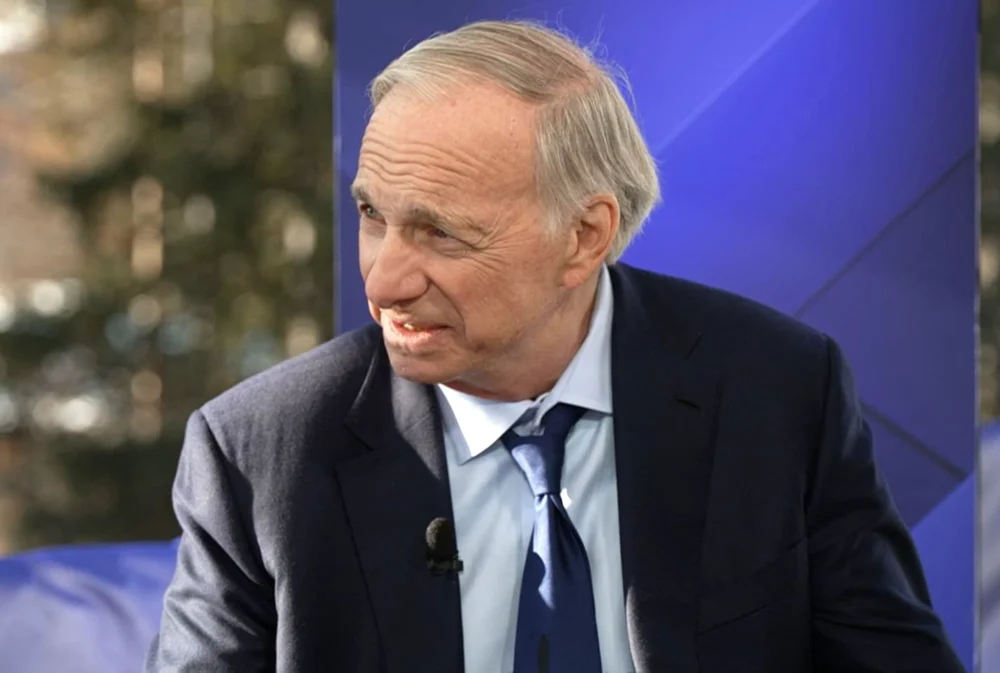
Ray Dalio, the founder of Bridgewater Associates and a prominent voice in global macro-investing, has intensified his warnings regarding this fracturing monetary order. Speaking at the World Economic Forum, Dalio underscored a critical evolution in the current geopolitical climate: the transition from trade-centric conflicts to those involving the very foundations of international capital. According to Dalio, the aggressive political posture currently emanating from Washington—characterized by renewed tariff threats and diplomatic friction over territorial interests—is forcing foreign governments and institutional investors to fundamentally reassess their exposure to American assets.
The core of the concern lies in the delicate relationship between the United States’ massive fiscal deficit and the willingness of international actors to fund it. For decades, the U.S. has relied on a steady appetite for Treasury bonds from surplus nations like China, Japan, and various oil-producing states. However, as geopolitical trust evaporates, the "inclination to buy," as Dalio puts it, is reaching a precarious tipping point. When trade wars escalate into capital wars, the movement of money becomes a tool of statecraft. If foreign entities begin to view U.S. debt not as a safe haven but as a liability or a potential victim of sanctions and political volatility, the resulting sell-off could trigger a liquidity crisis and a sharp spike in borrowing costs for the American government.
This anxiety is not merely theoretical; it is reflected in the immediate reactions of the bond markets. Recent sessions have seen Treasury prices tumble as investors digest the implications of a dual-track conflict. On one hand, the U.S. administration has revived aggressive tariff rhetoric against European allies, potentially reigniting a trans-Atlantic trade war. On the other, the pursuit of unconventional diplomatic objectives—such as the renewed interest in the acquisition of Greenland—has introduced a level of unpredictability that traditional markets find difficult to price. When the U.S. threatens punitive economic measures against countries that oppose its territorial or strategic ambitions, it sends a signal to all holders of U.S. assets that their investments are subject to the whims of political leverage.
History provides a sobering roadmap for these developments. Dalio frequently points to the "Big Cycle" of empires, noting that financial conflict is often the precursor to broader geopolitical decline. In the 1930s, the breakdown of the international trade system was followed by currency devaluations and the freezing of foreign assets. Similarly, the decline of the British Pound as the world’s reserve currency in the mid-20th century was accelerated by the UK’s inability to find foreign buyers for its mounting debt during periods of imperial overstretch. Today, the U.S. faces a similar conundrum: it is producing record amounts of debt at the exact moment its international relationships are under maximum strain.
The mechanics of a capital war involve more than just selling bonds. It encompasses the restriction of capital flows, the implementation of sanctions that block access to the SWIFT payment system, and the freezing of central bank reserves—a move that was notably deployed against Russia following the invasion of Ukraine. While these tools are effective in the short term, they have the unintended consequence of incentivizing other nations to "de-dollarize." If a country fears its dollar reserves could be seized or leveraged against its national interests, it will naturally seek alternatives. This has led to a surge in interest in the BRICS+ alliance and the development of alternative payment architectures that bypass the New York-based financial system.

Amidst this volatility, the concept of "hard currency" is returning to the forefront of investment strategy. Gold, the ultimate historical hedge against currency debasement and geopolitical collapse, has surged to unprecedented levels, recently crossing the $4,600 per ounce threshold. This rally is not merely driven by retail speculation but by a concerted effort by global central banks to diversify their reserves away from the dollar. For the first time in the modern era, the "risk-free rate" associated with U.S. Treasurys is being questioned, leading investors to seek assets that have no counterparty risk. Dalio suggests that in this environment, a diversified portfolio must include a significant allocation to gold—recommending between 5% and 15%—to serve as a stabilizer when traditional debt and equity markets falter.
The economic impact of a sustained capital war would be felt far beyond the trading floors of Wall Street. A significant reduction in foreign demand for U.S. debt would force the Federal Reserve into a difficult position. To prevent interest rates from skyrocketing and crashing the domestic economy, the central bank might be forced to step in as the "buyer of last resort," effectively printing money to purchase government debt. This process, known as debt monetization, is historically a precursor to high inflation and the further devaluation of the currency, creating a feedback loop that drives even more investors away from the dollar.
Furthermore, the "capital war" extends into the realm of technology and equity. We are already seeing the early stages of this through the restriction of venture capital flows into sensitive sectors like semiconductors and artificial intelligence. When the world’s two largest economies—the U.S. and China—begin to decouple their financial markets, the resulting loss of efficiency and shared innovation acts as a drag on global GDP growth. The "peace dividend" that followed the Cold War, characterized by integrated markets and low-cost capital, is effectively being liquidated to pay for a new era of strategic competition.
For the private sector, the implications are profound. Multinationals that once operated with the assumption of seamless global capital mobility must now navigate a "minefield" of compliance, sanctions, and currency risk. The cost of hedging against political instability is rising, and the premium on "neutral" jurisdictions is growing. Countries that can remain outside the direct line of fire in a capital war—such as Switzerland, Singapore, or parts of the Middle East—may see a surge in capital inflows, though even they are not immune to the systemic shocks that a U.S.-led financial crisis would produce.
Ultimately, the warning of a capital war is a warning about the fragility of trust. The global monetary order is a social construct built on the belief that rules will be followed and that assets will be protected regardless of political disagreements. When that trust is traded for short-term political leverage, the foundation of the system begins to crack. As the U.S. continues to issue high volumes of debt to fund its fiscal requirements, it finds itself in a paradoxical position: it is more dependent on foreign capital than ever before, yet its actions are making that capital more hesitant to stay.
In this environment, the traditional "60/40" portfolio (60% stocks, 40% bonds) appears increasingly obsolete. Investors are being forced to look toward "real" assets—commodities, productive land, and precious metals—while maintaining a geographic footprint that avoids over-concentration in any single political jurisdiction. The transition to a multipolar financial world will likely be characterized by higher volatility, lower liquidity, and a persistent search for safety in an era where the old safe havens no longer provide the security they once promised. As the rhetoric of conflict intensifies, the transition from trade friction to a full-scale capital war remains the single greatest tail risk for the global economy in the coming decade.