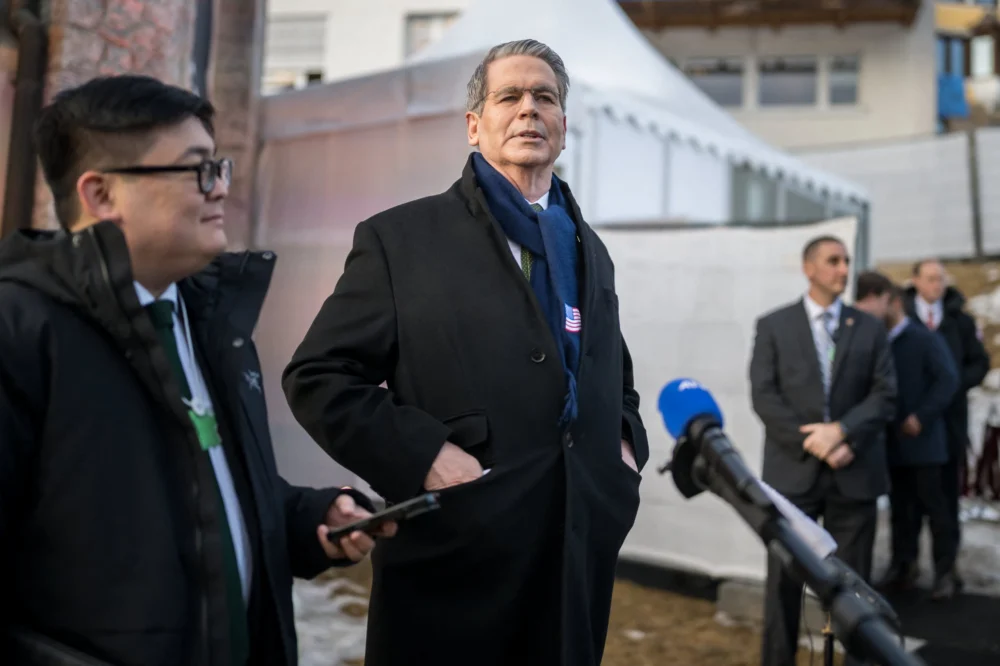
The global financial community is bracing for a definitive shift in American monetary leadership as the White House nears a decision on the future of the Federal Reserve. Speaking from the sidelines of the World Economic Forum in Davos, Switzerland, Treasury Secretary Scott Bessent signaled that President Donald Trump is poised to announce his nominee for the next Chair of the Federal Reserve as early as next week. This announcement marks the culmination of a rigorous vetting process that began in September, aimed at identifying a leader capable of navigating a complex landscape of persistent fiscal deficits, evolving labor dynamics, and the administration’s ambitious "America First" economic agenda.
According to Bessent, the search committee has narrowed a preliminary list of 11 high-profile candidates down to a final four. While the Treasury Secretary declined to explicitly name the finalists, the selection process has been characterized by high-level interviews and a focus on candidates who balance deep market expertise with a commitment to institutional reform. The impending nomination is not merely a routine administrative transition; it represents a fundamental debate over the boundary between central bank independence and democratic accountability.
The front-runners for the position represent a diverse cross-section of economic thought. Market participants and prediction platforms have focused heavily on Kevin Warsh, a former Federal Reserve Governor known for his critiques of the Fed’s expanded balance sheet and his advocacy for a more "rules-based" approach to monetary policy. Joining him in the top tier of candidates is Christopher Waller, a current member of the Board of Governors who has earned respect for his data-driven approach and skepticism regarding "mission creep" within the central bank. Other names frequently cited in the final deliberations include Rick Rieder, BlackRock’s chief fixed income strategist, whose appointment would bring a seasoned Wall Street perspective to the Eccles Building, and Michelle Bowman, a current Fed Governor who has consistently championed the interests of community banks and expressed caution regarding rapid rate cuts.
While Kevin Hassett, the current director of the National Economic Council, was initially considered a leading contender, recent signals from the White House suggest the President prefers Hassett to remain in his current role as a primary architect of domestic economic policy. This strategic placement underscores the administration’s desire to maintain a cohesive bridge between fiscal policy and monetary oversight.
The transition comes at a period of heightened friction between the executive branch and the current Federal Reserve leadership. President Trump has been a vocal critic of Chair Jerome Powell, whom he originally nominated in 2017 but has since lambasted for what he perceives as delayed reactions to shifting economic cycles. The tension has recently escalated beyond policy disagreements into the realm of institutional integrity. The Department of Justice has reportedly issued subpoenas to Powell concerning a multi-million dollar renovation project at the Federal Reserve’s Washington headquarters, an investigation that critics of the Fed suggest points to broader issues of administrative oversight.
Secretary Bessent’s comments in Davos highlighted a growing concern within the administration regarding the Fed’s internal culture. He noted that during Powell’s tenure, nearly a third of the Fed’s top leadership—including several regional presidents and governors—have been forced to resign or retire following ethics controversies related to personal investment disclosures. "Independence does not mean a lack of accountability," Bessent emphasized, drawing a sharp contrast between the autonomy required to set interest rates and the transparency required to lead a public institution. He argued that if a major Wall Street firm faced a similar rate of executive turnover due to ethical lapses, the CEO would have been removed long ago.
The stakes for the next Fed Chair are historically high. The U.S. economy is currently navigating a "soft landing" phase, but structural challenges remain. Inflation, while cooling from its 2022 peaks, remains sensitive to supply chain shifts and the potential inflationary impact of proposed tariffs. The next Chair will inherit the task of managing the Fed’s massive $7 trillion balance sheet while ensuring that the cost of borrowing does not stifle the administration’s goals for industrial revitalization and domestic manufacturing growth.

Global markets are watching the nomination process with intense scrutiny. The Federal Reserve’s decisions dictate the strength of the U.S. dollar, which serves as the world’s primary reserve currency. A shift toward a more "hawkish" chair could attract foreign capital to U.S. Treasuries but might also put immense pressure on emerging markets burdened with dollar-denominated debt. Conversely, a chair seen as too closely aligned with political interests could risk undermining the credibility of the dollar, potentially leading to higher long-term yields as investors demand a "risk premium" for political uncertainty.
Economists are also debating the concept of "monetary-fiscal coordination." In recent decades, the prevailing orthodoxy has insisted on a total separation between the Treasury and the Fed. However, the Trump administration has signaled an interest in a more collaborative relationship to ensure that monetary policy does not work at cross-purposes with tax cuts and deregulation. Some proponents of this shift argue that the Fed’s focus on "transitory" inflation in 2021 proved that the current model of independence is not a guarantee of institutional wisdom.
The legal timeline for the transition provides the President with a window of opportunity. While Jerome Powell’s term as Chair officially concludes in May, his term as a member of the Board of Governors extends until 2028. Historically, outgoing chairs have resigned from the board entirely once their successor is confirmed, allowing the sitting President to fill the vacancy. If Powell chooses to stay on as a governor, it could create a unique dynamic of internal dissent, though most analysts expect a traditional departure to preserve the institution’s stability.
The selection of the next Fed Chair will also influence the regulatory environment for the banking sector. Under the current leadership, the Fed has moved toward stricter capital requirements, such as those proposed in the "Basel III Endgame" framework. Several of the candidates on the President’s shortlist, particularly those with backgrounds in private finance or community banking, have expressed skepticism toward these stringent regulations, suggesting that a change at the top could lead to a significant period of financial deregulation.
As the decision nears, the focus remains on whether the President will prioritize a "reformer" who seeks to overhaul the Fed’s mandate or a "stabilizer" who will reassure global markets of continuity. The four finalists have been personally interviewed by the President, a process Bessent described as thorough and deliberate. The Treasury Secretary’s role in screening these candidates suggests that the next Chair will be expected to work in closer harmony with the Treasury Department than has been the case in recent years.
The choice of the next Federal Reserve Chair will ultimately serve as a litmus test for the administration’s broader economic philosophy. It is a decision that will reverberate through the halls of the World Bank and the IMF, across the trading floors of New York and London, and into the households of millions of Americans whose mortgages and car loans are dictated by the federal funds rate. By framing the appointment around the themes of accountability and institutional renewal, the administration is signaling that the era of the "untouchable" central banker may be coming to an end, replaced by a new model of governance that seeks to align monetary policy with the broader national interest.
With the announcement expected as soon as next week, the financial world is on high alert. The transition from the Powell era to a new leadership regime represents one of the most significant pivots in U.S. economic policy in a generation. As Secretary Bessent concluded in his remarks, the Federal Reserve has a "special obligation" to the public, and the next leader of the institution will be tasked with reclaiming that trust while steering the world’s largest economy through an era of profound geopolitical and technological change.