The global financial markets are bracing for a seismic shift in liquidity as Wall Street approaches a historic convergence of derivatives expirations that promises to redefine trading volumes for the 2025 calendar year. According to the latest data from leading investment banks, Friday is slated to host the largest options expiration event on record, with a staggering $7.1 trillion in notional exposure set to lapse. This phenomenon, colloquially known in trading circles as "quadruple witching," occurs only four times a year, but the scale of this December’s event has caught the attention of institutional desks and retail investors alike, signaling a potential period of intense price discovery and structural volatility.
Quadruple witching represents the simultaneous expiration of four distinct classes of financial contracts: market index options, single-stock options, index futures, and options on index futures. While these expirations are a standard feature of market mechanics, the sheer magnitude of the current cycle is unprecedented. Of the $7.1 trillion in total exposure, approximately $5 trillion is directly tied to the S&P 500, the primary benchmark for American equity performance. An additional $880 billion is linked to individual corporate equities. To contextualize the scale of this event, the notional value of the contracts expiring on Friday represents roughly 10.2% of the total market capitalization of the Russell 3000 index—a metric that underscores the potential for systemic movement.
The timing of this expiration is particularly sensitive given the broader economic backdrop of 2025. The S&P 500 has maintained a robust trajectory throughout the year, posting gains of approximately 15% and trading in the vicinity of the 6,770 mark as the week progressed. However, the presence of such massive derivatives exposure creates a "tail wags the dog" scenario, where the activity in the options market dictates the movement of the underlying stocks rather than the other way around. This is largely due to the hedging requirements of market makers—the large financial institutions that sell these options to investors and must balance their own books by buying or selling the underlying assets.
Market analysts suggest that the 6,800 level on the S&P 500 serves as a critical psychological and technical battleground. This specific strike price holds a massive concentration of open interest. If the index approaches this level, the resulting "gamma" effects—where market makers must rapidly adjust their hedges—could lead to erratic price swings. Traders are closely watching to see if bullish momentum can sustain the market above this threshold or if the gravity of the expiration will pull the index into a downward spiral as profits are crystallized and hedges are unwound.
The surge in options activity over the past several years has fundamentally altered the DNA of Wall Street. The rise of short-dated options, including zero-day-to-expiration (0DTE) contracts, has introduced a layer of intraday complexity that did not exist a decade ago. While the $7.1 trillion figure primarily concerns monthly and quarterly expirations, the interplay between these long-term positions and short-term speculative bets can create a "perfect storm" of liquidity demands. During previous quadruple witching events, trading volumes on the New York Stock Exchange and Nasdaq have frequently seen spikes of 30% to 50% above the 30-day moving average, particularly during the "marching orders" of the final hour of trading, often called the "witching hour."
However, high volume does not always equate to a market crash. In many instances, the expiration of a vast number of contracts can lead to a phenomenon known as "pinning." This occurs when a stock’s price becomes magnetically attracted to a specific strike price where a large amount of options interest is concentrated. For market makers, the most efficient way to manage their risk as an option nears expiration is to see the stock close exactly at the strike price, rendering the option neutral. This can lead to a paradoxical situation where the broader market is volatile, but individual high-volume stocks remain eerily still, "pinned" to a specific dollar amount until the closing bell.
According to institutional research, several high-profile equities are prime candidates for this pinning effect on Friday. Stocks such as GameStop, which continues to see significant retail-driven options activity, and Avis Budget Group are among those with options exposure representing a disproportionately large share of their average daily trading volume. Other companies, including GeneDx Holdings and BILL Holdings, are also on the radar of analysts who expect their share prices to be heavily influenced by derivatives-related gravity. For large-scale institutional investors, these pinning events can actually provide a window of stability to enter or exit large positions without significantly moving the market price.
The global context of this expiration also warrants scrutiny. While the American markets dominate the headlines, the interconnectedness of global finance means that European and Asian markets often feel the ripples of a U.S. quadruple witching. The Euro Stoxx 50 and the Nikkei 225 often see correlated volatility as global fund managers rebalance their portfolios in tandem with the U.S. close. Furthermore, the expiration of index futures requires many funds to "roll" their positions into the next quarter. This involves selling the expiring contract and buying the new one, a process that necessitates massive shifts in capital and can lead to temporary dislocations in the "basis"—the difference between the spot price of an index and its futures price.
From a macroeconomic perspective, the end-of-year expiration often serves as a clearinghouse for the year’s investment themes. In 2025, investors have navigated a complex landscape of fluctuating interest rates and evolving corporate earnings. As the $7.1 trillion in contracts expires, it effectively wipes the slate clean for 2026. This allows institutional desks to reset their risk parameters and establish new hedges for the coming year. The repositioning that occurs on Friday is not merely about closing old bets; it is about the foundational setup for the first quarter of the new year.
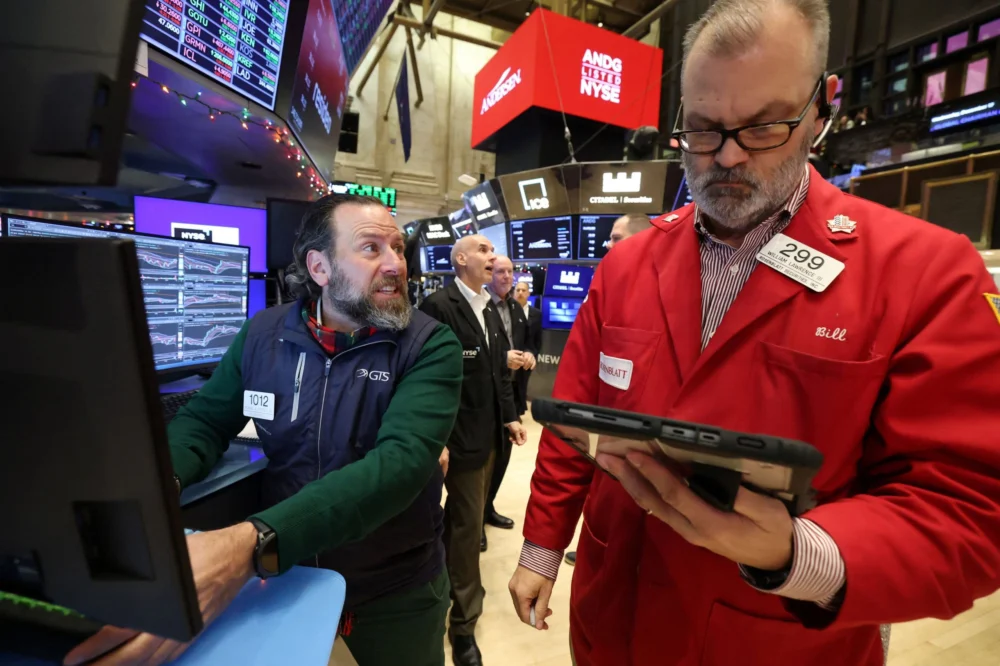
Experts emphasize that while the "quadruple witching" label sounds ominous, it is a sign of a highly sophisticated and liquid financial ecosystem. The ability of the market to absorb $7.1 trillion in expiring notional value is a testament to the depth of modern electronic trading platforms. Nevertheless, for the average retail investor, the advice remains one of caution. The "choppiness" predicted by seasoned floor traders suggests that stop-loss orders may be triggered by temporary price spikes, and the bid-ask spreads on options themselves may widen significantly as the 4:00 PM ET deadline approaches.
In the final analysis, Friday’s trading session will be a masterclass in market mechanics. Whether the S&P 500 bulls can defend the 6,800 level or the weight of $5 trillion in index-linked contracts pulls the market into a consolidation phase, the sheer scale of the event ensures it will be recorded in the annals of financial history. As the "witches" of the derivatives market conclude their quarterly dance, the dust will settle on a year that has seen the options market evolve from a secondary hedging tool into the primary engine of Wall Street’s price action. The implications of this shift will likely be studied by economists and regulators for years to come, as they seek to understand the risks and rewards of a global economy increasingly driven by the complexities of the derivatives trade.