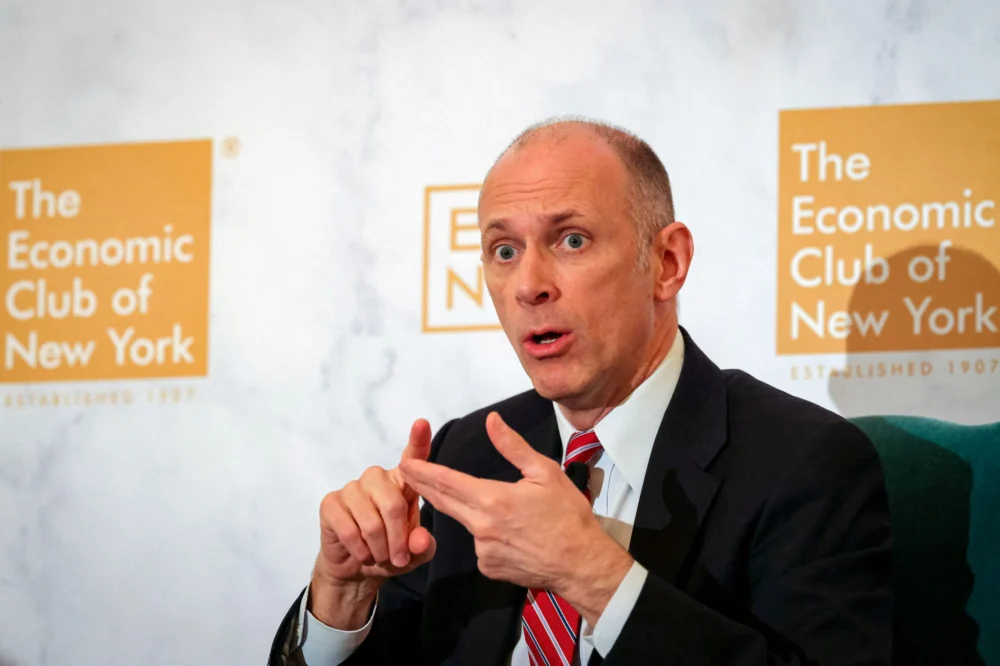
The institutional firewall separating the Federal Reserve from the executive branch is facing its most significant stress test in decades, prompting high-ranking central bank officials to issue dire warnings about the future of the American economy. Austan Goolsbee, President of the Federal Reserve Bank of Chicago, recently sounded an alarm that resonates through the halls of global finance: any successful attempt to strip the central bank of its autonomy could trigger a catastrophic resurgence of inflation. Speaking with a bluntness rarely seen in the measured world of monetary policy, Goolsbee cautioned that the politicization of interest rate decisions would move the United States toward an economic model more commonly associated with failing states than with the world’s leading financial superpower.
The catalyst for this heightened rhetoric is a burgeoning legal and political conflict involving Federal Reserve Chair Jerome Powell and the Department of Justice. The investigation centers on the multi-billion-dollar renovation of the Federal Reserve’s headquarters in Washington, D.C., a project that has seen significant cost overruns. While the White House frames the DOJ subpoena of Powell as a matter of fiscal accountability and administrative oversight, the timing and tone of the investigation have led many—including Powell himself—to suggest that the legal pressure is a "pretext." The concern is that the executive branch is utilizing administrative grievances to exert leverage over a Chair who has resisted calls for aggressive, politically motivated interest rate cuts.
The Inflationary Peril of Political Overreach
The core of Goolsbee’s argument rests on the historical and theoretical foundation of "time-inconsistency" in monetary policy. Politicians, who operate on short-term election cycles, are naturally incentivized to demand lower interest rates to stimulate growth, lower unemployment, and boost asset prices in the immediate future. However, if a central bank bows to these pressures, the resulting excess liquidity often leads to overheating and a subsequent spike in consumer prices. Once inflation expectations become "de-anchored"—meaning the public no longer believes the central bank is committed to price stability—it becomes exponentially more difficult and painful to bring prices back under control.
"Anything that’s infringing or attacking the independence of the central bank is a mess," Goolsbee remarked, emphasizing that the erosion of this boundary is a recipe for economic volatility. He warned that if the Fed’s decision-making process is subsumed by the White House, the U.S. could see inflation come "roaring back." This is not merely a theoretical concern; it is a lesson learned from the "Great Inflation" of the 1970s. During that era, President Richard Nixon famously pressured Fed Chair Arthur Burns to maintain an expansionary policy to support his re-election bid. The result was a decade of double-digit inflation that was only broken by the draconian, recession-inducing interest rate hikes of Paul Volcker in the early 1980s.
A Subpoena as a Political Instrument
The current friction has been exacerbated by the Department of Justice’s decision to subpoena Powell regarding the Eccles Building renovation. The project, originally estimated at a fraction of its current projected cost, has become a lightning rod for critics of the Fed’s autonomy. However, the Federal Reserve operates as an independent agency within the government, funded by its own earnings rather than congressional appropriations. This financial independence is a crucial component of its ability to make unpopular decisions, such as raising rates during an election year to curb inflation.
Chair Powell has signaled that he views the investigation not as a standard audit, but as a tactical maneuver by the Trump administration to influence the trajectory of the federal funds rate. President Trump has been a relentless critic of Powell, frequently labeling him "Too Late" and demanding that the Fed move toward zero or even negative interest rates to compete with other global economies. Despite the Fed having implemented three rate cuts since late 2025 in response to cooling inflation data, the administration has maintained that the central bank is moving too slowly and hindering national prosperity.

Global Comparisons and the Risk to the Dollar
Goolsbee’s warnings included a sharp comparison to nations where central bank independence has been discarded. He noted that criminal investigations or direct executive control over monetary authorities are hallmarks of economies like Zimbabwe, Russia, and Turkey. In Turkey, for instance, President Recep Tayyip Erdoğan’s long-standing interference in the central bank—including the firing of multiple governors who refused to lower rates—led to a currency collapse and inflation rates that peaked at over 80%.
For the United States, the stakes are even higher. The U.S. dollar serves as the world’s primary reserve currency, a status predicated on the perceived stability of American institutions and the predictability of its monetary policy. If global investors begin to view the Federal Reserve as a political arm of the White House, the "exorbitant privilege" of the dollar could be threatened. A loss of confidence in the Fed’s independence could lead to a higher risk premium on U.S. Treasuries, driving up borrowing costs for the government, businesses, and consumers alike, regardless of where the nominal federal funds rate is set.
The Mechanics of Credibility
The Federal Reserve’s "dual mandate"—to promote maximum employment and stable prices—requires a delicate balancing act that often necessitates making choices that are politically unpalatable. Economists generally agree that an independent central bank is more effective because it can take a long-term view of the economy. When a central bank is independent, its commitment to a 2% inflation target is credible. Businesses can set prices and workers can negotiate wages with the expectation that the value of the dollar will remain relatively stable.
If that credibility is shattered, the "inflation tax" becomes a permanent fixture of the economy. Goolsbee’s assertion that inflation would come "roaring back" reflects the fear that once the political seal is broken, there is no easy way to restore the public’s trust. Markets would likely price in future political interference, leading to higher long-term interest rates even if the Fed tries to keep short-term rates low. This phenomenon, known as a "steepening yield curve," can paradoxically make mortgages and corporate loans more expensive even as the central bank tries to make money "cheaper."
The Road Ahead for the Powell Fed
As Jerome Powell’s term as Chair nears its conclusion in May, the debate over the Fed’s future leadership and its degree of autonomy will only intensify. While Powell’s term as a member of the Board of Governors extends until 2028, the Chairmanship is a presidential appointment that requires Senate confirmation. The current administration has hinted at a desire to appoint a successor who is more "aligned" with executive economic goals—a prospect that has led to discussions of a "Shadow Fed" or a more subservient central bank structure.
The legal battle over the headquarters renovation serves as a proxy for this larger struggle. If the DOJ’s investigation moves toward a criminal prosecution, it would mark an unprecedented escalation in executive-branch pressure on the Fed. Goolsbee and his colleagues are effectively arguing that the cost of the renovation, no matter how high, is negligible compared to the cost of destroying the Fed’s reputation for impartiality.
The coming months will be a critical period for the American economy. As the Fed continues to navigate the "last mile" of its fight against the post-pandemic inflation surge, the added weight of political and legal scrutiny complicates an already difficult task. The consensus among mainstream economists remains clear: the independence of the central bank is not a luxury, but a necessity for a functioning market economy. Without it, the "roaring" inflation Goolsbee fears may become an unavoidable reality, reshaping the American economic landscape for a generation.