For nearly two decades, the Federal Reserve operated on a philosophy of "the more, the better" when it came to communicating its intentions to the global financial markets. From the post-2008 era of Ben Bernanke to the meticulous transparency of Jerome Powell, the central bank’s "forward guidance" became a pillar of modern monetary policy, designed to suppress volatility and anchor market expectations. However, the inauguration of Kevin Warsh as Chairman in May has signaled an abrupt and jarring departure from this tradition. As the "Great Silence" descends upon Constitution Avenue, the financial industry is undergoing a radical technological pivot, utilizing generative artificial intelligence to fill the vacuum left by a central bank that has suddenly stopped talking.
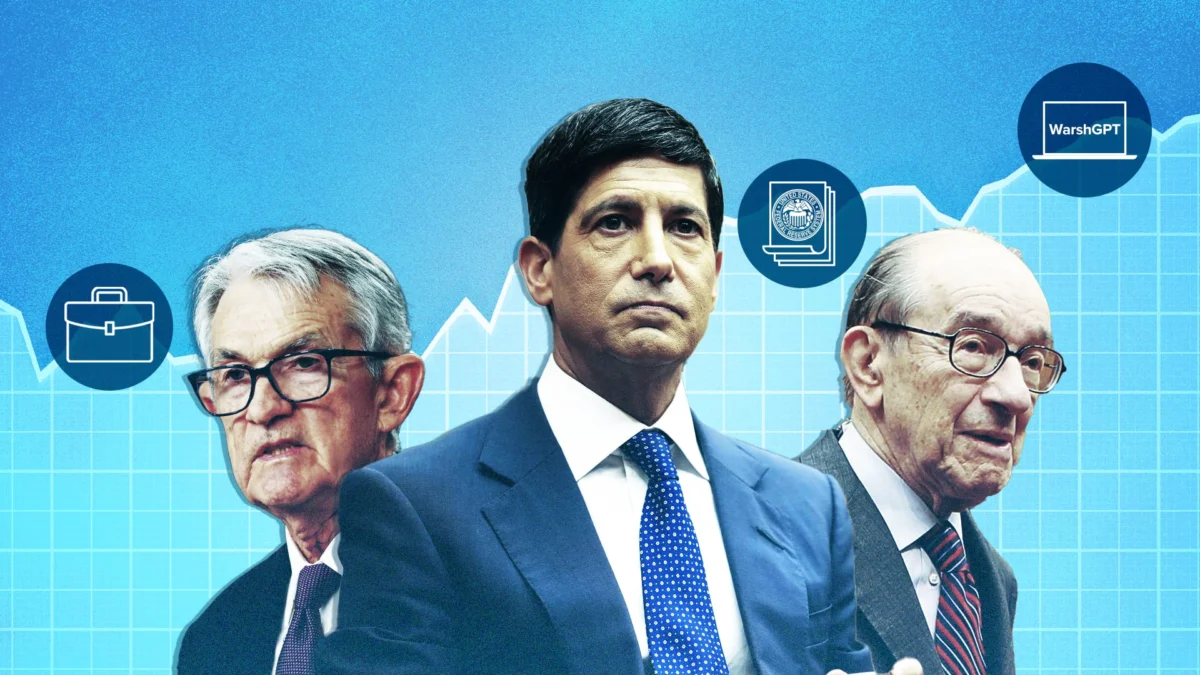
The shift is perhaps most visible at F/m Investments, a Washington-based firm situated just blocks from the Fed’s headquarters. Under the previous regime, the distance was purely physical; intellectually, the firm was in lockstep with the central bank’s frequent speeches and detailed projections. Today, CEO Alexander Morris describes a landscape where the Fed has effectively "gone dark." To combat this, his firm has launched "WarshGPT," an AI-powered tool built on Anthropic’s Claude model. By ingesting nearly 1,800 documents, speeches, and transcripts from Warsh’s career, the tool attempts to simulate the Chairman’s cognitive framework. It is a high-tech solution to an old-school problem: how to trade when the referee refuses to explain the rules.
The transition from the Powell era to the Warsh era is not merely a change in tone; it is a quantifiable retrenchment of information. A recent analysis of the Federal Reserve’s June meeting statement—the first under Warsh’s leadership—revealed a document of roughly 130 words. This represents a staggering reduction from the 300-plus word missives common under his predecessor. More telling is the content of his press conferences. Data from UBS indicates that during Warsh’s debut post-decision briefing, only 5% of his sentences were directly relevant to future policy paths. Under Powell, that figure averaged 27%. By design, Warsh is stripping away the "forward" from forward guidance, forcing markets to focus on current data rather than future promises.
This return to ambiguity evokes memories of the Alan Greenspan era, where the "Maestro" was famously celebrated for his "mumbled" syntax and cryptic delivery. During the 1990s, market participants resorted to the "briefcase indicator," a theory suggesting that the thickness of Greenspan’s briefcase on meeting days correlated with the likelihood of a rate change. While the briefcase has been replaced by large language models, the underlying anxiety remains the same. Gary Richardson, a former Fed historian and current economics professor at the University of California, Irvine, notes that when official channels of information dry up, the market does not stop seeking signals; it simply turns to more speculative and expensive methods to find them.
The economic implications of this "communication blackout" are profound. Forward guidance was originally conceived as a tool to lower long-term interest rates by promising to keep short-term rates low for an extended period. By removing this tool, Warsh is effectively reintroducing a "term premium"—the extra compensation investors demand for the uncertainty of holding long-term debt. For the global economy, this could mean higher borrowing costs for corporations and homeowners, even if the Fed’s benchmark rate remains unchanged. The lack of clarity increases the "reaction function" of the market, where every single release of the Consumer Price Index (CPI) or employment data triggers massive swings in asset prices because the Fed has not pre-emptively "smoothed" the market’s expectations.
Wall Street’s giants are responding by building proprietary analytical engines. UBS now maintains an interactive dashboard for institutional clients to track the hawkish or dovish tilt of Warsh’s limited public comments. Elena Amoruso, a strategist at the bank, argues that in an era of scarcity, every word becomes exponentially more valuable. "One word can move billions of dollars," she observed, noting that Warsh’s debut was perceived as "overwhelmingly hawkish," not because of a specific rate hike, but because of his refusal to rule them out in the face of a tightening labor market.

At JPMorgan Asset Management, the strategy is one of diversification and observation. David Kelly, the firm’s chief global strategist, is preparing for the possibility that the Fed may eventually scrap the "dot plot"—the quarterly chart showing where individual officials expect interest rates to be in the future. If the dot plot vanishes, the focus will shift to "bellwether" officials like Governor Christopher Waller. Analysts believe that as the Chairman goes silent, the speeches of other Federal Open Market Committee (FOMC) members will become the new proxy for the committee’s consensus. Waller, for instance, recently warned that while the Fed should not "fight the last war" regarding inflation, further hikes remain a possibility—a statement that sent ripples through the futures markets.
The rise of tools like WarshGPT also highlights a growing divide in the investing world. While institutional players can spend thousands—or in the case of larger firms, millions—on AI models and Fed-whisperer consultants, retail investors are left in the lurch. Richardson warns that the democratized access to information seen over the last decade is being reversed. Without clear guidance, the "cost of complexity" rises, potentially favoring high-frequency traders and macro hedge funds over long-term individual savers.
From a global perspective, the Fed’s pivot contrasts sharply with other major central banks. The European Central Bank (ECB) under Christine Lagarde and the Bank of England under Andrew Bailey have largely maintained their commitment to transparency, even as they struggle with similar inflationary pressures. If the Fed continues on its path toward opacity, it could lead to increased volatility in the U.S. dollar, as foreign investors struggle to price the risk of American monetary policy. This "transparency gap" could shift capital flows toward markets where the policy path is more predictable, though the sheer size and liquidity of the U.S. Treasury market ensure it will remain the global anchor, albeit a more volatile one.
The debate within economic circles is whether Warsh’s approach is a necessary correction or a dangerous gamble. Proponents argue that forward guidance created a "Fed Put," where markets became too reliant on the central bank to bail them out of downturns, leading to asset bubbles and a misallocation of capital. By being less predictable, the Fed forces the market to perform its own price discovery based on economic fundamentals. Critics, however, argue that in a world of instantaneous communication and high-leverage trading, a "silent Fed" increases the risk of a "policy error"—a situation where the Fed moves in a way that the market hasn’t prepared for, leading to a sudden liquidity crunch or a flash crash.
Currently, the disconnect in market expectations is palpable. Fed funds futures traders are pricing in a roughly 59% probability of a rate hike in September, driven by recent hawkish signals. Conversely, prediction markets like Kalshi show a majority of traders betting on a "hold" scenario. In the Powell era, such a wide divergence would have been addressed by a "leak" to the press or a carefully timed speech to narrow the gap before the meeting. In the Warsh era, the Fed appears content to let the market guess.
As F/m Investments’ Alexander Morris points out, the creation of WarshGPT took only two weeks and cost less than $1,000 to develop. This suggests that while the Fed may choose to be less communicative, the "decoding" of the central bank is becoming an automated, algorithmic arms race. In this new epoch, the winners will not be those who listen the loudest, but those who can most accurately model the silence. The era of the "Fed-whisperer" is being replaced by the era of the "Fed-coder," and the implications for global finance are only beginning to be understood. For now, the message from Constitution Avenue is clear, even if it is delivered through its absence: the age of hand-holding is over.