
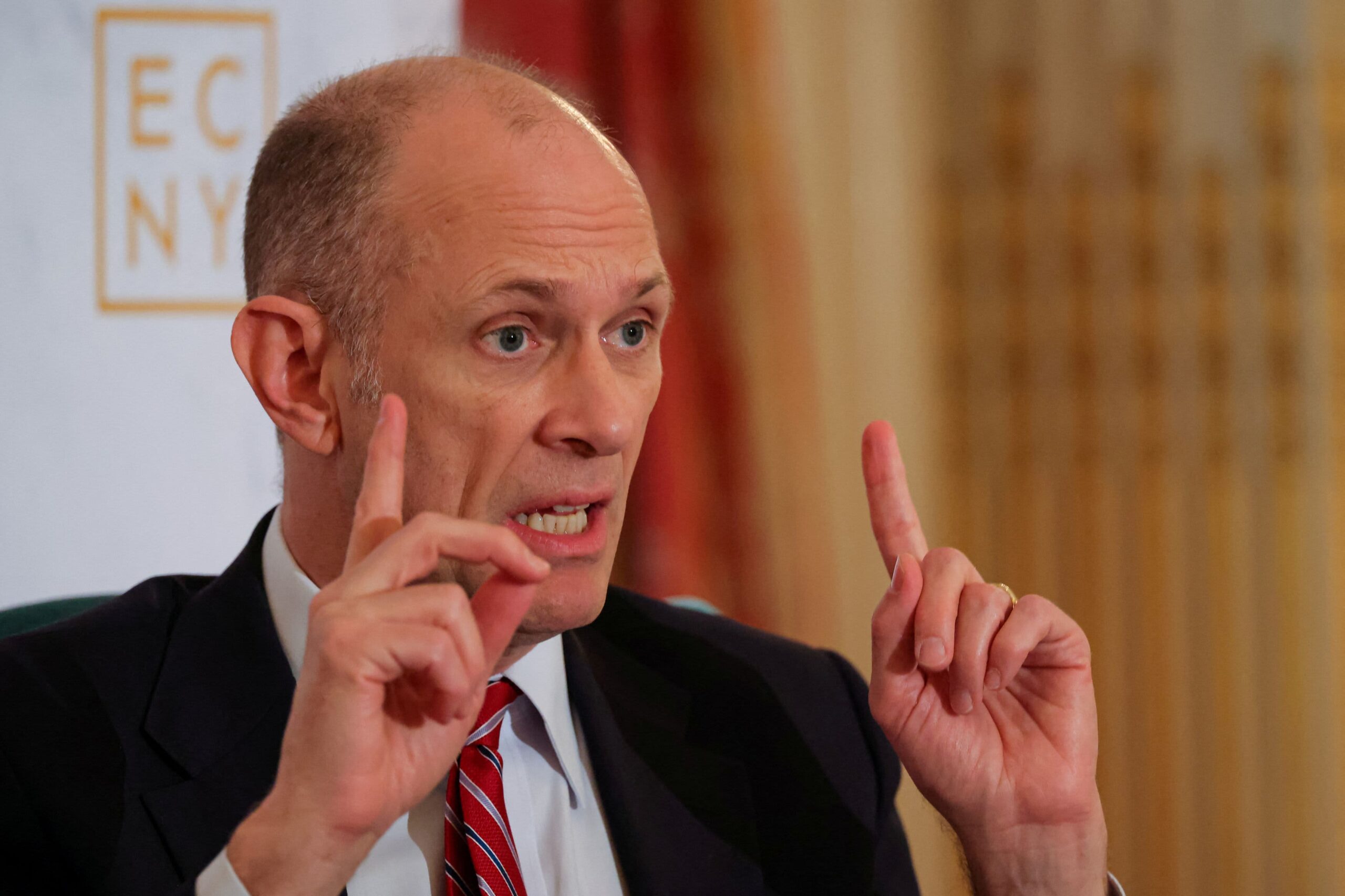
The path toward price stability in the United States has hit a significant psychological and statistical plateau, prompting top Federal Reserve officials to recalibrate their expectations for the timing of future interest rate reductions. Austan Goolsbee, President and CEO of the Federal Reserve Bank of Chicago, delivered a sobering assessment of the current economic landscape on Tuesday, suggesting that the "last mile" of the inflation fight is proving more arduous than initially anticipated. Speaking before the National Association for Business Economics (NABE) in Washington, D.C., Goolsbee emphasized that the central bank must remain steadfast, arguing that current inflationary trends do not yet justify further monetary easing.
The core of the concern lies in a stubborn disconnect between the Federal Reserve’s stated 2% target and the reality of recent data. While the dramatic price surges seen in the immediate post-pandemic era have largely subsided, the descent has stalled. According to the most recent Personal Consumption Expenditures (PCE) price index—the Federal Reserve’s preferred metric for tracking inflation—core prices, which exclude the volatile categories of food and energy, rose at an annual rate of 3% in December. This represented a 0.2 percentage point increase from the previous month, a move in the wrong direction for a central bank seeking a "sustainable" return to its target.
Goolsbee’s rhetoric signaled a shift from the cautious optimism that characterized the latter half of 2025, when the Fed enacted three consecutive quarter-percentage-point cuts. "A 3% inflation rate is not good enough," Goolsbee told the gathering of economists. "It is not what we promised when the Federal Reserve committed to the 2% target. Stalling out at 3% is not a safe place to be for a myriad of reasons we know all too well." His comments reflect a growing consensus among policymakers that the risks of cutting rates too early—thereby reigniting inflationary pressures—outweigh the risks of keeping rates restrictive for slightly too long.
This "wait-and-see" approach is deeply rooted in recent institutional memory. Goolsbee noted that the Federal Open Market Committee (FOMC) has been "burned" in the past by the assumption that inflation was merely "transitory." In 2021, many economists and central bankers believed that supply chain disruptions would resolve quickly, naturally bringing prices down. Instead, inflation surged to 40-year highs, forcing the Fed into one of the most aggressive tightening cycles in its history. To avoid a repeat of that policy error, Goolsbee argued against "front-loading" rate cuts without definitive evidence that the downward trajectory has resumed.
The composition of current inflation remains a primary source of anxiety for the Fed. While some of the recent uptick in the PCE index can be attributed to the implementation of new tariffs—which are generally viewed as one-time shocks to the price level rather than a sustained inflationary trend—underlying pressures remain robust. Goolsbee specifically pointed to the service sector and housing as areas of persistent concern. Unlike manufactured goods, which have benefited from healed global supply chains, service-sector inflation is often tied more closely to domestic wage growth and consumer demand.
Housing inflation, in particular, continues to defy the Fed’s restrictive policy. Despite mortgage rates remaining significantly higher than their pre-2022 levels, the supply of homes remains constrained, keeping both rents and home prices elevated. Goolsbee emphasized that housing costs are not driven by external factors like tariffs, making them a more accurate barometer of internal economic overheating. For the Fed to reach its 2% goal, a significant cooling in the "shelter" component of inflation indices is considered a non-negotiable prerequisite.
The shift in tone from the Chicago Fed President has had an immediate impact on market expectations. Financial markets, which at the start of the year were aggressively pricing in a series of cuts beginning in the spring, have been forced to push their timelines back. According to the CME Group’s FedWatch tool, futures traders now see only a 50-50 chance of a rate cut in June, with the probability of a July move sitting at approximately 71%. This "higher-for-longer" narrative has contributed to a tightening of financial conditions, as bond yields adjust to the reality that the Fed is not yet ready to declare victory.
Goolsbee is not alone in his cautious stance. Federal Reserve Governor Christopher Waller, who has historically been more open to the possibility of easing, also adopted a measured tone at the NABE conference. Waller suggested that while policymakers might "look through" the temporary impacts of tariffs on price data, the broader strength of the U.S. economy gives the Fed room to be patient. Specifically, the labor market continues to exhibit remarkable resilience. January’s nonfarm payrolls data showed continued hiring strength, which, if sustained, would mitigate the immediate need for the Fed to stimulate the economy through lower rates.
The dilemma facing the Fed is part of a broader global narrative. While the European Central Bank (ECB) and the Bank of England are facing similar "sticky" inflation in their respective service sectors, the U.S. economy’s relative strength—driven by robust consumer spending and a tight labor market—sets it apart. This "American exceptionalism" in economic growth complicates the Fed’s task; as long as the U.S. consumer continues to spend, businesses have less incentive to lower prices, creating a floor for inflation that sits uncomfortably above the 2% target.
From a broader economic perspective, the decision to hold rates steady has far-reaching consequences. For American households, it means that the cost of borrowing—from credit cards to auto loans—will remain elevated for the foreseeable future. For the corporate sector, a prolonged period of high rates increases the cost of refinancing debt and may lead to a slowdown in capital expenditure (CAPEX) as companies prioritize balance sheet stability over expansion. However, the Fed views these short-term pressures as a necessary price to pay for long-term price stability. History has shown that "unanchored" inflation expectations can lead to a wage-price spiral that is far more damaging to the economy than a period of high interest rates.
As the FOMC prepares for its upcoming meetings, the focus will remain squarely on the "data-dependent" approach that Chairman Jerome Powell has championed. Beyond the PCE index, officials will be looking for signs that wage growth is moderating to a level consistent with 2% inflation and that the "excess savings" accumulated by households during the pandemic are finally being depleted. Goolsbee’s comments serve as a reminder that the central bank’s primary mandate remains the preservation of the dollar’s purchasing power, even if that means defying market hopes for a quick return to cheap credit.
The upcoming testimony from other Fed governors, including Lisa Cook, will be scrutinized for further clues on whether Goolsbee’s hawkish lean is shared by the broader committee. For now, the message from the Chicago Fed is clear: the mission is not yet accomplished. Until the data provides an unambiguous signal that the 2% target is within reach, the Federal Reserve appears prepared to maintain its restrictive stance, prioritizing the credibility of its inflation target over the short-term desires of Wall Street. The "last mile" may indeed be the hardest, and the Fed is signaling that it is in no rush to cross the finish line prematurely.