

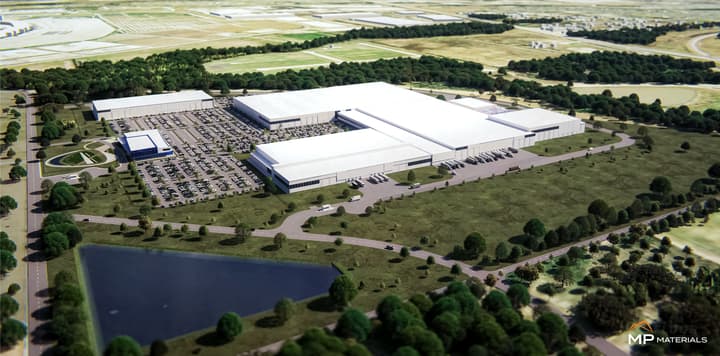
The global race to secure critical mineral supply chains reached a definitive milestone this week as MP Materials announced the selection of Northlake, Texas, as the site for its new $1.25 billion rare earth magnet manufacturing campus. This massive industrial undertaking, dubbed the "10X" facility, represents a pivotal shift in the United States’ effort to decouple its high-tech and defense industries from a long-standing reliance on Chinese processing and manufacturing. As the transition to electric vehicles (EVs), renewable energy, and advanced defense systems accelerates, the Texas facility is positioned to become the cornerstone of a fully domestic "mine-to-magnet" supply chain, a feat that has eluded Western economies for decades.
The Northlake campus is not merely an expansion of existing capacity but a strategic escalation of MP Materials’ industrial footprint. Once fully operational, the 10X facility is expected to produce approximately 7,000 metric tons of finished rare earth magnets annually. When combined with the company’s existing facility in nearby Fort Worth—which commenced commercial production earlier in 2025 with a 3,000-ton capacity—MP Materials will command a total production output of 10,000 metric tons per year. This scale is significant; it positions the company as a global heavyweight capable of meeting a substantial portion of the domestic demand that has historically been satisfied by overseas imports.
Rare earth magnets, particularly those made from neodymium-praseodymium (NdPr), are the silent engines of the modern world. They are essential components in the traction motors of electric vehicles, the generators within wind turbines, the actuators in robotics, and the guidance systems of precision-targeted missiles. For years, the vulnerability of this supply chain has been a point of contention for economic planners in Washington. While the U.S. possesses significant raw mineral deposits, the specialized knowledge and infrastructure required to refine these minerals and forge them into high-performance magnets have resided almost exclusively in China. By establishing the 10X facility, MP Materials is effectively attempting to close the "processing gap" that has left the U.S. industrially exposed.
The economic logic of the Northlake selection is rooted in vertical integration. The facility will be fed by raw materials sourced and processed at MP Materials’ Mountain Pass mine in California. Mountain Pass holds the distinction of being the only commercial-scale rare earths mine in the United States, providing a secure, domestic upstream source that is insulated from the geopolitical whims of foreign adversaries. This internal synergy allows the company to maintain a closed-loop system, ensuring quality control and environmental compliance while eliminating the logistical complexities and carbon footprint associated with shipping raw ore across the Pacific for refining.

The geopolitical backdrop of this investment cannot be overstated. China currently dominates the critical minerals landscape with an iron grip, controlling more than 90% of the world’s rare earth processing, separation capacity, and magnet manufacturing. In recent years, Beijing has demonstrated a willingness to use this dominance as a tool of economic statecraft. Last year’s implementation of export curbs on certain critical minerals sent shockwaves through global markets, highlighting the fragility of supply chains for Western tech giants and defense contractors. The "weaponization" of these materials has catalyzed a bipartisan consensus in the U.S. toward "friend-shoring" and domestic reshoring, with the 10X facility serving as the most visible manifestation of this new industrial policy.
The financial and strategic weight behind the 10X project is bolstered by an unprecedented partnership with the U.S. government. In a move that signals the return of proactive industrial intervention, the Department of Defense (DOD) took a $400 million equity stake in MP Materials last year. This investment was accompanied by a ten-year price guarantee for neodymium-praseodymium oxide, set at a minimum of $110 per kilogram. This price floor is a critical buffer for the company, protecting it against the predatory pricing and market volatility often utilized by state-backed competitors to stifle Western market entrants.
Under the terms of this public-private partnership, the entire output of the 10X facility is currently committed to the Pentagon for a decade. This ensures that the next generation of American military hardware—from F-35 fighter jets to Virginia-class submarines—will be powered by magnets born of American soil and forged by American labor. However, the agreement does leave room for flexibility; with the DOD’s consent, MP Materials can divert material to commercial customers, ensuring that the civilian economy also benefits from this surge in domestic production capacity.
The commercial implications are already being felt across the private sector. MP Materials’ existing Fort Worth facility already lists industry titans such as General Motors and Apple among its primary customers. For the automotive industry, the ability to source magnets domestically is a hedge against the supply chain disruptions that plagued the sector during the post-pandemic era. As GM pivots toward an all-electric future, the reliability of its motor supply chain becomes a competitive advantage. Similarly, for consumer electronics firms like Apple, domestic sourcing aligns with broader corporate goals of supply chain transparency and carbon neutrality.
Beyond the strategic and corporate benefits, the 10X facility is poised to be a major economic engine for North Texas. The project is expected to create approximately 1,500 direct manufacturing and engineering jobs at the Northlake site. These are high-skill, high-wage positions that contribute to the region’s growing reputation as a hub for advanced manufacturing and aerospace technology. The selection of Texas is no coincidence; the state’s business-friendly regulatory environment, robust energy infrastructure, and deep pool of engineering talent from nearby universities make it an ideal theater for large-scale industrial projects.

The broader market data underscores the urgency of this expansion. In 2025, U.S. imports of rare earth magnets fell to roughly 6,000 tons, largely due to tightening export controls and global trade tensions. While MP Materials’ 10,000-ton total capacity could theoretically end direct import dependence, the reality of the demand curve is more complex. When accounting for the "embedded" rare earths found in imported finished products—such as smartphones, laptops, and foreign-made vehicles—the total U.S. demand for these materials is significantly higher than what raw magnet imports suggest. This indicates that while 10X is a massive leap forward, it is likely only the beginning of a broader domestic industrial build-out.
James Litinsky, the founder and CEO of MP Materials, has framed the project as an "uncompromising focus on speed, execution, and delivery." His rhetoric reflects a sense of mission that goes beyond traditional quarterly earnings. By positioning the company as a defender of national security, Litinsky has successfully navigated the complexities of federal funding and defense contracts, securing a level of stability that is rare in the volatile mining and minerals sector.
However, the path to 2028—the projected start date for production at the 10X site—is not without its challenges. The rare earth industry is notoriously capital-intensive and technically demanding. The chemical processes required to separate rare earth elements are complex and have historically carried significant environmental risks. MP Materials has committed to using modern, sustainable processing techniques, but scaling these technologies to meet the 7,000-ton target will require flawless execution. Furthermore, the company must continue to navigate the global pricing environment, where Chinese producers still hold the power to influence market rates through supply adjustments.
Political support for the project remains robust, particularly within the state of Texas. Senator Ted Cruz has been a vocal advocate for the project, characterizing the dependence on the Chinese Communist Party for critical minerals as an "acute national security threat." This political alignment ensures that the project will likely enjoy continued support at both the state and federal levels, regardless of shifts in the executive branch. The 10X facility is viewed by many in Washington as a test case for whether the United States can truly rebuild its industrial base in a sector it had all but abandoned thirty years ago.
As the 10X facility moves from the blueprint phase to construction, it stands as a symbol of a new era in global economics—one defined by resilience over efficiency and sovereignty over globalization. By the end of the decade, the Northlake campus will not just be a collection of factories; it will be a critical node in the defense of the American economy, ensuring that the technologies of the future are built on a foundation of domestic strength. For the residents of North Texas and the broader American industrial landscape, the investment by MP Materials is a billion-dollar bet that the future of high-tech manufacturing is coming home.