

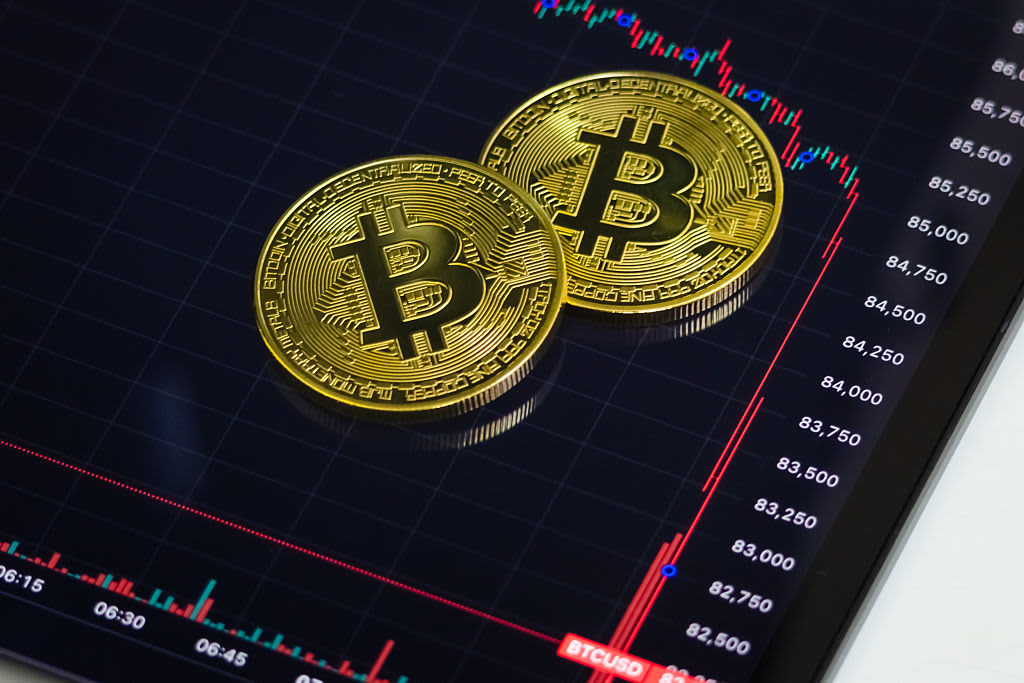
The digital asset market is currently navigating one of its most turbulent phases in recent history, as Bitcoin’s dramatic retreat from its all-time highs sends ripples through the broader financial ecosystem. After reaching a pinnacle of $126,279 in October, the world’s premier cryptocurrency has undergone a sharp correction, recently sliding below the $61,000 threshold—a level not seen in nearly a year and a half. While retail investors often scramble for a singular catalyst to explain such volatility, seasoned market analysts point to a confluence of structural, technological, and macroeconomic factors. Chief among these is the "four-year cycle," a recurring pattern of boom and bust that has defined the crypto-economy since its inception, now colliding with a shift in global capital toward artificial intelligence and traditional safe havens like gold.
The concept of the four-year cycle is deeply rooted in the programmatic nature of Bitcoin itself, specifically the "halving" events that occur roughly every four years. These events reduce the reward for mining new blocks by half, effectively tightening the supply of new Bitcoin entering the market. Historically, these halvings have preceded massive bull runs followed by significant "retracements" or cooling-off periods. According to Matt Hougan, Chief Investment Officer at Bitwise Asset Management, the current market downturn is not an anomaly but rather the fourth iteration of this established rhythm. This cyclicality creates a psychological framework for the market, where periods of exponential growth inevitably lead to a phase of exhaustion as early adopters take profits and the "hype cycle" reaches a saturation point.
However, the current retracement is more complex than a simple repeat of history. Unlike the 2017 or 2021 cycles, the 2024–2025 market is deeply integrated into the traditional financial system. The "financialization" of Bitcoin, primarily through the advent of spot exchange-traded funds (ETFs), has introduced a new layer of institutional dynamics. While these vehicles were expected to provide a floor for the price by opening the gates to trillions of dollars in managed wealth, they have also tethered Bitcoin more closely to global liquidity trends. When institutional investors feel the squeeze of rising interest rates or geopolitical uncertainty, they now treat Bitcoin as a high-beta risk asset, selling it alongside tech stocks to preserve capital or pivot to more defensive positions.
This pivot is particularly evident in the current competition for "narrative dominance." Over the past year, the investment community’s fascination has shifted away from the decentralized finance (DeFi) revolution toward the tangible, transformative potential of artificial intelligence (AI). Stocks like NVIDIA and other semiconductor giants have captured the "growth" portion of investor portfolios that might have previously been allocated to cryptocurrencies. Simultaneously, gold has seen a resurgence, hitting record highs as a hedge against inflation and currency debasement. For many institutional players, the "digital gold" thesis for Bitcoin is being tested against the proven reliability of physical gold, especially as central banks around the world increase their bullion reserves in response to a fragmenting global order.
Macroeconomic policy uncertainty further complicates the outlook. The potential appointment of figures like Kevin Warsh to influential roles within the Federal Reserve has sparked concern among crypto enthusiasts. Warsh, known for a more nuanced and sometimes hawkish view on monetary policy, represents a shift toward a more disciplined fiscal environment. In a "higher-for-longer" interest rate regime, the opportunity cost of holding non-yielding assets like Bitcoin increases. When the cost of borrowing is high, the speculative fervor that fuels crypto rallies often dissipates, leading to the "amplified" bear market conditions currently being observed.
Technological anxieties are also weighing on the market sentiment, specifically the looming shadow of quantum computing. While the practical application of quantum computers capable of breaking Bitcoin’s SHA-256 encryption remains years, if not decades, away, the mere "quantum risk" is beginning to factor into long-term valuation models. This existential concern, combined with a broader regulatory crackdown on "staking" and decentralized protocols, has created a "fear-driven" environment where negative news is magnified while positive developments are largely ignored.

The impact of this downturn is perhaps most visible in the altcoin market, which typically experiences more extreme volatility than Bitcoin. Solana, once hailed as the "Ethereum killer" due to its high transaction speeds and low costs, has faced significant headwinds. The launch of specialized investment vehicles, such as the Bitwise Solana Staking ETF, was intended to signal the asset’s maturation. Instead, the fund’s value has plummeted by more than 50% since its late October debut, reflecting a broader 30% decline in the underlying cryptocurrency this year. This highlights a critical lesson for the current era: the availability of an ETF does not guarantee price stability if the underlying market sentiment remains bearish.
Despite the prevailing gloom, many industry veterans argue that the fundamental value proposition of Bitcoin remains unchanged. The core of the "scarcity argument" rests on the immutable fact that there will only ever be 21 million Bitcoins in existence. While derivatives, ETFs, and short-term trading dynamics can influence intraday price movements and create "self-fulfilling prophecies" of decline, they cannot alter the underlying supply-and-demand mathematics. The current "financialization" phase is seen by some as a necessary, albeit painful, transition period where the asset class is being stress-tested by the same forces that govern the global equity and bond markets.
The "slow-to-materialize" good news that many analysts refer to includes the ongoing development of the Lightning Network for faster payments and the increasing adoption of Bitcoin by sovereign states as a reserve asset. Furthermore, the integration of blockchain technology into the plumbing of traditional finance—often referred to as Real World Asset (RWA) tokenization—continues to move forward despite the price fluctuations of individual coins. This suggests that while the "currency" aspect of crypto is in a cyclical trough, the "infrastructure" aspect is still in a secular growth phase.
Comparing the current environment to previous crashes, such as the 2014 Mt. Gox collapse or the 2022 FTX insolvency, provides some perspective. Unlike those instances, the current decline is not driven by a singular systemic failure or a massive fraud within the crypto ecosystem itself. Instead, it appears to be a standard market correction exacerbated by a shift in global liquidity and a rotation into other high-performing sectors. In previous cycles, Bitcoin has lost as much as 80% of its value before consolidating and reaching new heights. A drop from $126,000 to $60,000, while painful, is mathematically consistent with the volatility profiles of the past.
As the market looks toward the remainder of the year, the focus will remain on the Federal Reserve’s trajectory and the potential for a "soft landing" in the U.S. economy. If inflation remains sticky and interest rates stay elevated, the pressure on Bitcoin may persist. However, if the Fed begins a more aggressive cutting cycle, the resulting influx of liquidity could provide the "spark" needed to end the current retracement. For now, the crypto market is in a waiting game, caught between the gravity of the four-year cycle and the evolving demands of a new class of institutional owners.
Ultimately, the current plunge serves as a reminder that the path to becoming a mainstream asset class is rarely linear. The "financialization" of Bitcoin has brought it into the big leagues of global finance, but that membership comes with exposure to the same macro winds that buffet the S&P 500 and the gold markets. While the four-year cycle remains a dominant psychological and structural force, the future of the digital asset market will increasingly be defined by how it competes with AI, how it survives the scrutiny of central bankers, and whether its promise of decentralized scarcity can hold its own against the age-old allure of gold and the new-age potential of silicon. For those who view Bitcoin through a multi-decade lens, the current volatility is merely "noise" in a larger signal; for those trading the daily charts, it is a stark lesson in the inherent risks of the digital frontier.