

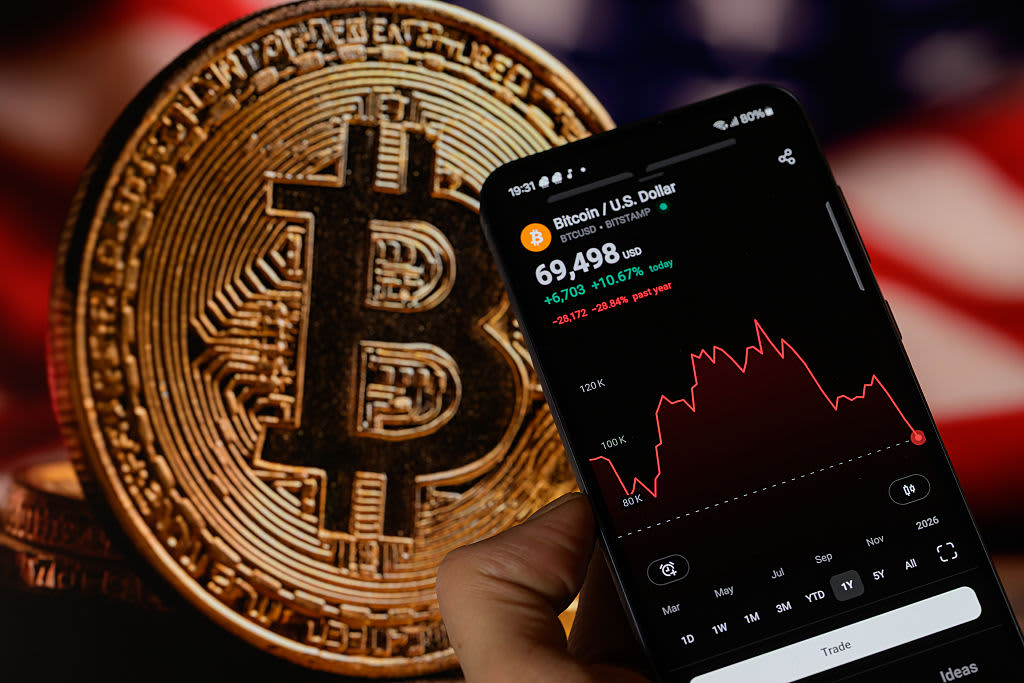
The digital asset market faced a significant retrenchment during Monday’s trading session as Bitcoin, the world’s largest cryptocurrency by market capitalization, descended below the critical $65,000 threshold. Investors, increasingly wary of a darkening macroeconomic horizon, initiated a broad sell-off that saw the token trade as low as $64,830 in the early hours. This downward trajectory follows a turbulent weekend where the asset bottomed out at $64,324, marking its most precarious valuation since early February. As the 2026 fiscal year continues to be defined by high-stakes brinkmanship in both international trade and military diplomacy, the "risk-on" appetite that previously fueled the crypto sector appears to be evaporating in favor of traditional safe-haven preserves.
The current price action represents a nearly 5% slide over a 48-hour window, with Bitcoin eventually stabilizing slightly to trade around $66,699.60, though it remains down approximately 4% on the day. This volatility is not an isolated technical correction but rather a symptom of a much larger shift in global investor sentiment. Since the start of the year, Bitcoin has shed roughly 24% of its value, a staggering contraction that has forced analysts to re-evaluate the "digital gold" narrative that dominated the previous bull cycle. While proponents of decentralized finance once argued that Bitcoin would serve as a hedge against systemic instability, the current climate suggests that when geopolitical tensions reach a boiling point, capital flows back toward the tangible security of precious metals and sovereign debt.
The primary catalyst for this latest bout of market anxiety is the escalating friction between the United States and Iran. President Donald Trump recently issued a high-stakes ultimatum, indicating that a decision on whether to launch military strikes against Tehran would be made within the next ten days. This announcement followed reports of Iran’s continued resistance toward a restructured nuclear agreement, a stance that has prompted the U.S. to aggressively reposition military assets throughout the Middle East. For global markets, the prospect of an open conflict in one of the world’s most vital energy-producing regions has immediate and dire consequences. An escalation would likely lead to a surge in crude oil prices, further complicating the global inflationary outlook and putting downward pressure on discretionary investment classes like cryptocurrencies.
Simultaneously, the landscape of international commerce has been upended by a sudden and aggressive pivot in U.S. trade policy. In a move that caught many market participants off guard, the Trump administration announced the immediate implementation of a 15% retaliatory tariff against a wide array of foreign trading partners. This executive action came just 24 hours after the U.S. Supreme Court struck down a previous iteration of trade taxes, signaling a determined effort by the executive branch to bypass judicial hurdles in pursuit of protectionist economic goals. The introduction of these tariffs has reignited fears of a global trade war, which could disrupt supply chains, increase the cost of consumer goods, and lead to a more fragmented global economy.
Economic analysts point out that the 15% tariff is particularly damaging to the crypto sector’s growth prospects because it strengthens the U.S. Dollar in the short term while simultaneously heightening fears of a global recession. Historically, Bitcoin has maintained an inverse correlation with the U.S. Dollar Index (DXY). As the dollar strengthens due to its status as a reserve currency during times of trade strife, Bitcoin often faces stiff headwinds. Furthermore, the uncertainty surrounding the legality and longevity of these tariffs adds a layer of "policy volatility" that institutional investors—who were instrumental in Bitcoin’s 2025 rally—are typically keen to avoid.
The divergence between digital assets and physical commodities has never been more pronounced than in the first quarter of 2026. While Bitcoin has cratered by nearly a quarter of its value, gold and silver have entered a blistering bull market. Year-to-date, gold has surged by 20%, while silver has outperformed even the yellow metal with a 23% gain. This 44-percentage-point swing between Bitcoin and gold highlights a fundamental shift in how "safety" is defined in the current era. In a world of potential kinetic warfare and shattered trade agreements, the anonymity and portability of Bitcoin are being outweighed by the historical reliability of physical bullion.
The technical outlook for Bitcoin remains precarious. Market analysts are closely watching the $60,062 support level, which served as a floor during the volatility of February 6. Should the current geopolitical rhetoric intensify, many fear that a breach of the $60,000 mark could trigger a cascade of automated liquidations, potentially dragging the asset toward the $55,000 range. The "fear and greed" index for the crypto sector has firmly shifted into the "fear" zone, reflecting a cautious stance among retail traders who are also grappling with higher borrowing costs and a tightening credit environment.
From a broader economic perspective, the struggle of Bitcoin is indicative of a general "de-risking" trend across all financial markets. The S&P 500 and Nasdaq have also shown signs of strain, though their losses have been moderated by strong earnings in the defense and energy sectors. The crypto market, lacking these industrial anchors, is more susceptible to the whims of sentiment and liquidity. As central banks around the world monitor the inflationary impact of the new U.S. tariffs, the likelihood of interest rate cuts—which would typically provide a tailwind for Bitcoin—remains low. High-for-longer interest rates continue to make the "risk-free" yield of government bonds more attractive than the volatile returns of the blockchain space.
The institutional landscape, which saw a massive influx of capital following the approval of various spot ETFs in previous years, is now facing its most significant test. Large-scale asset managers are being forced to justify the inclusion of Bitcoin in diversified portfolios at a time when its correlation with traditional "risk assets" like high-growth tech stocks has hit an all-time high. If Bitcoin cannot decouple from the volatility of the equity markets and prove its mettle as an independent store of value, institutional outflows could accelerate, further depressing prices.
In the Middle East, the ten-day window provided by the U.S. administration has created a "waiting game" that is paralyzing long-term capital commitments. Energy markets are already pricing in a "war premium," and the knock-on effects are being felt in everything from shipping rates to semiconductor manufacturing costs. For the cryptocurrency industry, which is heavily reliant on affordable electricity for mining operations, a spike in global energy prices could also raise the "floor price" of production, potentially squeezing the profit margins of major mining firms and leading to further sell-side pressure as these companies liquidate holdings to cover operational costs.
As the week progresses, the focus of the financial world will remain squarely on the White House and the potential for a diplomatic resolution—or a military escalation—in the Gulf. Simultaneously, the global reaction to the 15% retaliatory tariffs will determine whether the world is entering a new era of fragmented trade blocs. For Bitcoin to regain its footing, it will likely require a stabilization of the geopolitical climate and a clearer signal that the current wave of protectionism will not lead to a full-scale global downturn. Until then, the digital asset remains at the mercy of a world that is increasingly turning its back on risk in favor of the tried-and-true security of the past. The road back to the $70,000 level appears steep, paved with the complexities of 21st-century statecraft and the harsh realities of a changing global economic order.