

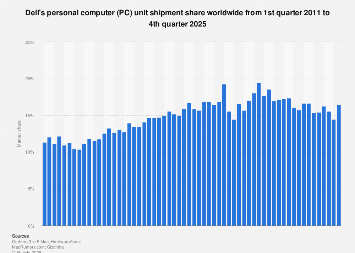
Dell Technologies has solidified its standing as the third-largest global personal computer vendor, capturing a notable percentage of worldwide PC unit shipments in the fourth quarter of 2025. This performance marks an incremental gain from the preceding quarter, underscoring the company’s resilience in a highly competitive and evolving technology market. While the precise figures, representing a crucial benchmark for market share, indicate growth, Dell continues to trail behind industry giants Lenovo and HP in terms of overall unit volume. This sustained position highlights Dell’s strategic importance and its ability to maintain a significant footprint, even as the broader PC industry navigates complex economic currents and technological transformations.
Dell Technologies, a titan in the information technology sector, offers a comprehensive suite of hardware, software, and service solutions designed to meet the diverse needs of consumers and enterprises alike. The company’s expansive portfolio is organized under the umbrella of Dell Technologies, which encompasses several distinct entities, including Dell, Dell EMC, Alienware, Secureworks, and Virtustream. This multifaceted structure allows Dell to address a wide spectrum of technological demands, from consumer-grade computing and gaming to enterprise-level data infrastructure and cybersecurity. A pivotal strategic move in recent years was the completion of the spin-off of VMware in November 2021. This divestiture allowed Dell Technologies to streamline its operations and sharpen its focus on core areas of growth. The company’s operational structure is primarily divided into two key business units: the Infrastructure Solutions Group (ISG) and the Client Solutions Group (CSG). The ISG is dedicated to providing robust data center solutions, cloud infrastructure, and digital transformation services, while the CSG is responsible for the design, manufacturing, and distribution of personal computers, laptops, and related peripherals.
Looking ahead, Dell Technologies is strategically pivoting its business focus to address the burgeoning demands of its enterprise clientele, particularly concerning data management within the dynamic realm of hybrid cloud services. This strategic realignment reflects a significant shift in the market, moving away from traditional, hardware-centric enterprise storage solutions towards more agile and scalable cloud-based offerings. The ascendancy of hybrid and multi-cloud environments presents both challenges and opportunities for PC vendors. Dell’s proactive engagement in this area is crucial for its sustained competitiveness. The company’s historical acquisition of VMware during the broader EMC acquisition was a prescient move, equipping Dell with a deep understanding and advanced capabilities in cloud computing and software virtualization. VMware, a recognized leader in these domains, provides the foundational technology for hybrid and multi-cloud strategies, as well as innovations in networking and security, all of which are critical for businesses seeking to optimize their IT infrastructure in an increasingly interconnected world.
The global PC market, while mature, continues to be a significant economic driver, with fluctuating demand influenced by several macroeconomic factors. Inflationary pressures, rising interest rates, and geopolitical uncertainties have all contributed to a more cautious spending environment for both consumers and businesses. Despite these headwinds, the ongoing digital transformation across industries necessitates robust computing power and sophisticated IT infrastructure. Companies are increasingly investing in upgrades to enhance productivity, support remote workforces, and leverage data analytics for competitive advantage. This sustained demand for computing power, coupled with the cyclical nature of hardware refresh cycles, creates a complex but ultimately opportunity-rich environment for established players like Dell.
Dell’s market share, while placing it third globally, is a testament to its strong brand recognition, extensive distribution network, and commitment to innovation. The company’s diversified product portfolio, ranging from high-performance gaming rigs under the Alienware brand to reliable business-class laptops and workstations, allows it to cater to a broad spectrum of customer needs. Furthermore, Dell’s direct-to-customer sales model, historically a key differentiator, continues to provide valuable insights into customer preferences and allows for greater customization and flexibility. However, competition remains fierce. Lenovo, consistently at the top, benefits from its vast manufacturing capabilities and strong presence in emerging markets. HP, another formidable competitor, excels in enterprise solutions and has a strong foothold in the printing and imaging sector, which often complements its PC offerings.
The strategic emphasis on hybrid cloud solutions by Dell is not merely a response to market trends but a fundamental reorientation of its value proposition. As businesses grapple with the complexities of managing data across on-premises data centers, private clouds, and public cloud platforms, Dell aims to position itself as a trusted partner in navigating this intricate landscape. This involves offering integrated solutions that encompass not only the necessary hardware and software but also the professional services required for seamless deployment and ongoing management. The spin-off of VMware, while significant, allows Dell to focus its resources on developing and integrating solutions that leverage VMware’s capabilities without the complexities of direct ownership. This could involve strategic partnerships and deeper collaboration to ensure its hardware and software offerings are optimized for multi-cloud environments.
The economic impact of the PC market extends far beyond the direct sales of devices. It fuels innovation in related industries, supports a vast ecosystem of software developers, and underpins the productivity of workforces globally. For Dell, maintaining and growing its market share is crucial for its financial health, its ability to invest in research and development, and its capacity to retain its position as a technology leader. The company’s ability to adapt to emerging trends, such as the increasing demand for AI-powered computing, sustainable technology, and enhanced cybersecurity, will be critical in shaping its future trajectory. The ongoing evolution of the PC market, characterized by the convergence of hardware, software, and cloud services, demands a strategic vision that embraces flexibility and innovation. Dell’s current positioning and strategic adjustments suggest a company poised to navigate these changes, aiming to secure its long-term relevance and profitability in an ever-evolving digital economy. The performance in Q4 2025, while a snapshot, provides a valuable indicator of Dell’s momentum and its capacity to compete effectively in the global technology arena.