

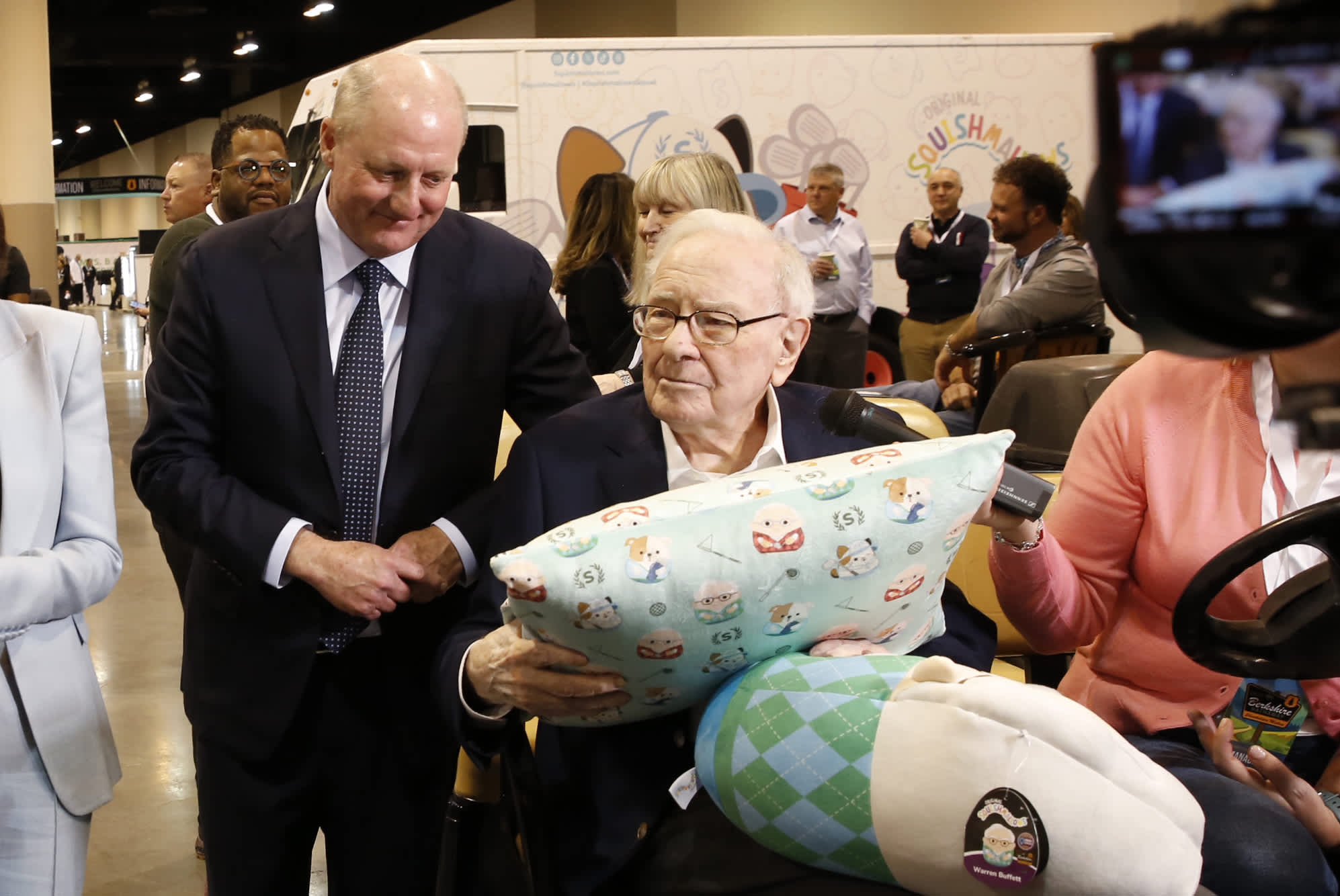
The transition of power at Berkshire Hathaway reached its formal conclusion this week as Greg Abel officially assumed the mantle of Chief Executive Officer, marking the end of Warren Buffett’s legendary six-decade tenure at the helm of the world’s most famous investment vehicle. On Friday, market participants offered a measured, if slightly cautious, reception to the new leadership, with Berkshire’s Class A shares retreating by 1.4%. While a modest dip in isolation, the movement reflects the profound psychological shift occurring within the global investment community as it reconciles with the departure of "The Oracle of Omaha" from day-to-day operations. At 95, Buffett remains the company’s chairman, but the operational "decider" is now Abel, a veteran executive tasked with maintaining the momentum of a conglomerate that has become a cornerstone of the American economy.
The leadership handoff is far more than a simple change in personnel; it is a stress test for a unique corporate culture built on decentralization, long-termism, and a rigorous adherence to value investing. For over half a century, Buffett transformed a failing New England textile mill into a diversified behemoth with a market capitalization that rivals the sovereign wealth funds of major nations. From 1964 through the end of 2024, Berkshire delivered a staggering compounded annual gain of 19.9%, nearly doubling the 10.4% return of the S&P 500 over the same period. The cumulative return of more than 5.5 million percent has turned early investors into billionaires and established a standard for wealth creation that remains unmatched in modern financial history.
Greg Abel, who previously oversaw Berkshire’s vast energy and non-insurance operations, inherits a company that is both a fortress and a challenge. He steps into the role as Berkshire sits on a record-breaking cash pile of $381.6 billion. This mountain of liquidity, accumulated during a period where Buffett found few attractive large-scale acquisitions, represents both Abel’s greatest asset and his most significant hurdle. In a market characterized by high valuations and intense competition from private equity and sovereign wealth, the pressure to deploy this capital effectively is immense. Buffett has been explicit in his confidence in Abel’s abilities, noting that his successor’s capacity for work and operational oversight exceeds his own. "Greg will be the decider," Buffett recently stated, emphasizing that Abel will have final authority over capital allocation—the very heart of Berkshire’s value engine.
The market’s immediate reaction—a 1.4% decline—likely stems from the "key man" risk that has hovered over Berkshire for decades. Investors have long paid a premium for Buffett’s personal touch, his ability to negotiate "sweetheart" deals during times of crisis, and his uncanny knack for identifying "moats" in business models. As Abel takes the reins, the market is reassessing whether that "Buffett Premium" should persist or if Berkshire will begin to be valued more like a traditional industrial and financial conglomerate. In 2025, Berkshire’s shares rose by 10.9%, a respectable performance but one that lagged the S&P 500’s 16.4% gain. This underperformance in a bull market underscores the difficulty of moving the needle for a company of Berkshire’s massive size.
Abel’s leadership style is expected to be more operationally focused than Buffett’s. While Buffett was primarily a capital allocator and a public face of American capitalism, Abel is known as a meticulous manager who understands the granular details of Berkshire’s diverse subsidiaries. These include the Burlington Northern Santa Fe (BNSF) railroad, Geico insurance, and a massive energy portfolio, alongside dozens of manufacturing, service, and retailing businesses. The challenge for Abel will be to maintain the decentralized "hands-off" approach that Buffett championed—where subsidiary CEOs are given nearly total autonomy—while ensuring that the conglomerate’s culture of integrity and efficiency remains intact without the presence of its founding architect.
The economic impact of Berkshire Hathaway extends far beyond its stock price. As a primary indicator of American industrial and consumer health, the company’s performance is often viewed as a proxy for the broader economy. Its insurance operations, led by the brilliant Ajit Jain, provide the "float"—the premiums held before claims are paid—that has historically funded Berkshire’s investment activities. The stability of this float is critical, particularly in a volatile interest rate environment. Furthermore, Berkshire’s massive equity portfolio, which includes significant stakes in Apple, American Express, and Coca-Cola, means that Abel’s decisions will have ripple effects across the entire global equity market.
Global comparisons illustrate the unique position Berkshire occupies. Unlike the Japanese "Sogo Shosha" trading houses—in which Berkshire itself has invested heavily—or European family-led conglomerates like Exor, Berkshire operates with a skeletal corporate staff in Omaha. This lean structure is designed to minimize bureaucracy and maximize speed. However, as the company enters this new era, some analysts question if a more robust corporate framework will be necessary to manage the $381 billion cash reserve. The transition also comes at a time of shifting global trade dynamics and energy transitions, areas where Abel’s specific expertise in the energy sector could prove to be a strategic advantage.
Buffett’s departure from the CEO role also marks a turning point for shareholder activism and corporate governance. For years, Buffett’s stature and massive voting power insulated Berkshire from the pressures that typically face large public companies, such as demands for dividends, share buybacks, or environmental, social, and governance (ESG) disclosures. While Berkshire has increased its share repurchases in recent years, it has famously never paid a dividend under Buffett. Abel may face renewed calls from institutional investors to return more capital to shareholders if large-scale acquisitions continue to be elusive.
The long-term viability of the Berkshire model is a subject of intense debate among economists. Buffett himself has remained an optimist, asserting that the company has a better chance of thriving for another century than almost any other entity. This optimism is rooted in the "Berkshire System"—a combination of permanent capital, a diverse earnings stream, and a reputation as a "home of choice" for family-owned businesses looking to sell without being dismantled by private equity. Abel’s primary task is to preserve this reputation. If he can prove that the Berkshire culture is institutionalized rather than tied to a single individual, the "Buffett Premium" may eventually be replaced by an "Abel Stability Premium."
As the first day of the new era concludes, the dip in share price serves as a reminder that the market hates uncertainty. However, the fundamentals of the Omaha-based giant remain formidable. With a balance sheet that is arguably the strongest in corporate history and a portfolio of businesses that are deeply embedded in the infrastructure of global commerce, Berkshire Hathaway is well-positioned to weather the transition. The "Oracle" may be stepping back, but the machine he built is designed to run long after the handoff. Greg Abel’s tenure will be defined not by whether he can replicate Buffett’s specific investment genius, but by whether he can steer this massive ship through the complexities of the 21st-century economy while keeping its foundational principles unshakable. The world is watching, and the stakes for the global financial ecosystem could not be higher.