
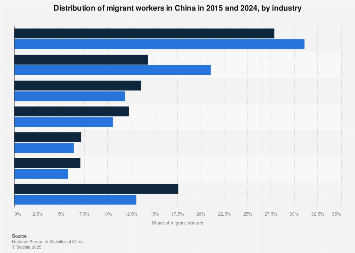
The sheer scale of China’s industrial and economic engine is intrinsically linked to its vast and dynamic migrant workforce. As the nation navigates its 2024 economic trajectory, understanding the distribution of these crucial laborers across various sectors offers a vital lens through which to view domestic development, consumption patterns, and global supply chain resilience. While precise, granular data often requires specialized access, broader trends and analyses provide significant insights into the ongoing evolution of China’s labor market, particularly concerning the millions who journey from rural hinterlands to urban centers in search of opportunity.
Historically, China’s economic miracle has been powered by an unprecedented rural-to-urban migration, a phenomenon that has reshaped both its demographics and its industrial output. Migrant workers, often referred to as "mingong" (农民工), have been the bedrock of manufacturing, construction, and a growing service sector. Their contributions are not merely about providing labor; they represent a significant component of domestic consumption, remittances that bolster rural economies, and a key factor in China’s ability to maintain competitive production costs on the global stage. The year 2024 finds this demographic group not static, but rather adapting to changing economic realities, technological advancements, and evolving government policies aimed at integrating them more fully into urban social and economic structures.
The construction sector has long been a primary destination for migrant workers, absorbing a substantial portion of the mobile labor force. This industry, characterized by its labor-intensive nature and its direct correlation with infrastructure development and urbanization, relies heavily on the physical prowess and willingness of migrant laborers. From the towering skyscrapers of Shanghai to the sprawling high-speed rail networks connecting the nation, construction projects are a testament to their efforts. While the pace of new large-scale infrastructure projects may fluctuate with economic cycles and policy shifts, the ongoing need for maintenance, renovation, and continued urbanization ensures that construction remains a significant employer of migrant workers. Data from previous years consistently placed construction as one of the top sectors, and while specific 2024 figures are proprietary, anecdotal evidence and broader economic indicators suggest its continued prominence, albeit potentially with an increasing emphasis on skilled trades within the sector.
Manufacturing, another cornerstone of China’s export-driven economy, also continues to be a major employer of migrant labor. Factories producing everything from electronics and textiles to machinery and consumer goods have historically drawn heavily from the migrant population. These workers form the backbone of assembly lines and production facilities that serve both domestic and international markets. However, the manufacturing landscape in 2024 is undergoing a significant transformation. Increased automation, the rise of "intelligent manufacturing," and a strategic push towards higher-value production are reshaping the demand for labor. While the overall demand for manufacturing workers may not diminish, the types of skills required are evolving. This suggests a potential shift, with a greater demand for workers with technical proficiency and adaptability, and perhaps a recalibration of the sheer volume of low-skilled manual labor needed in some sub-sectors. Nevertheless, China’s position as the "world’s factory" means that manufacturing will undoubtedly continue to absorb a considerable segment of the migrant workforce.
The burgeoning service sector presents a more nuanced picture, reflecting China’s ongoing transition towards a consumption-driven economy. Migrant workers are increasingly finding opportunities in areas such as retail, hospitality, logistics, and personal services. As urbanization progresses and disposable incomes rise for a segment of the population, demand for services intensifies. This includes everything from delivery drivers and restaurant staff to domestic helpers and care providers. This trend is particularly noteworthy as it signifies a move away from purely industrial roles towards positions that are more directly tied to domestic demand and urban lifestyles. The growth of e-commerce, for instance, has fueled a massive demand for logistics and delivery personnel, many of whom are drawn from the migrant population. Furthermore, an aging population and a growing middle class are also likely to increase demand for services in healthcare, elder care, and education, sectors that are increasingly reliant on accessible and often mobile labor.
The impact of government policies on migrant worker distribution is also a critical consideration. For decades, China’s household registration system, the "hukou," created significant disparities in access to social services and opportunities for migrant workers in urban areas. Recent reforms have aimed at easing these restrictions, encouraging greater integration and providing more equitable access to education, healthcare, and social welfare. The success of these policies can influence where migrant workers choose to settle and in which industries they seek employment. For instance, improved access to urban schooling for their children might encourage longer-term settlement and a greater focus on stable employment in sectors that offer better social benefits. Conversely, continued challenges in accessing these services could lead to a more transient workforce, primarily concentrated in sectors with immediate and high labor demand, such as construction and certain manufacturing segments.
Analyzing the economic implications of this labor distribution is paramount. The concentration of migrant workers in sectors like construction and manufacturing has historically contributed to China’s low production costs, making its exports highly competitive. However, as wages in these sectors gradually rise, driven by both market forces and policy interventions, this cost advantage may diminish. The shift towards higher-value manufacturing and a more robust service economy, supported by migrant labor, signals a maturing economic model. This transition could lead to higher domestic consumption, a more diversified economic base, and potentially a more balanced global trade dynamic. The remittances sent by migrant workers back to their rural hometowns also play a crucial role in poverty alleviation and rural development, creating a vital economic feedback loop.
Looking ahead, the distribution of migrant workers across industries will continue to be shaped by several key factors. Technological advancements, particularly in automation and artificial intelligence, will undoubtedly alter the demand for certain types of labor. The ongoing urbanization process, though potentially slowing in pace, will continue to create demand for services and infrastructure. Government policies aimed at rural revitalization, regional development, and social integration will also play a significant role in influencing migration patterns and labor choices. Furthermore, global economic trends, including trade relations and the resilience of international supply chains, will continue to impact the demand for labor in China’s export-oriented manufacturing sectors.
In conclusion, while precise, up-to-the-minute statistics on migrant worker distribution by industry in China for 2024 are often held within proprietary databases, the overarching trends paint a clear picture. The construction and manufacturing sectors remain vital, absorbing a significant portion of this essential workforce. However, the ascendance of the service sector, driven by evolving consumption patterns and urbanization, indicates a diversification of opportunities. As China continues its economic evolution, the adaptability and evolving skill sets of its migrant labor force will be a critical determinant of its sustained growth and its role in the global economy. Understanding these dynamics is not just an exercise in labor market analysis; it is fundamental to comprehending the very engine of China’s economic present and its future trajectory.