

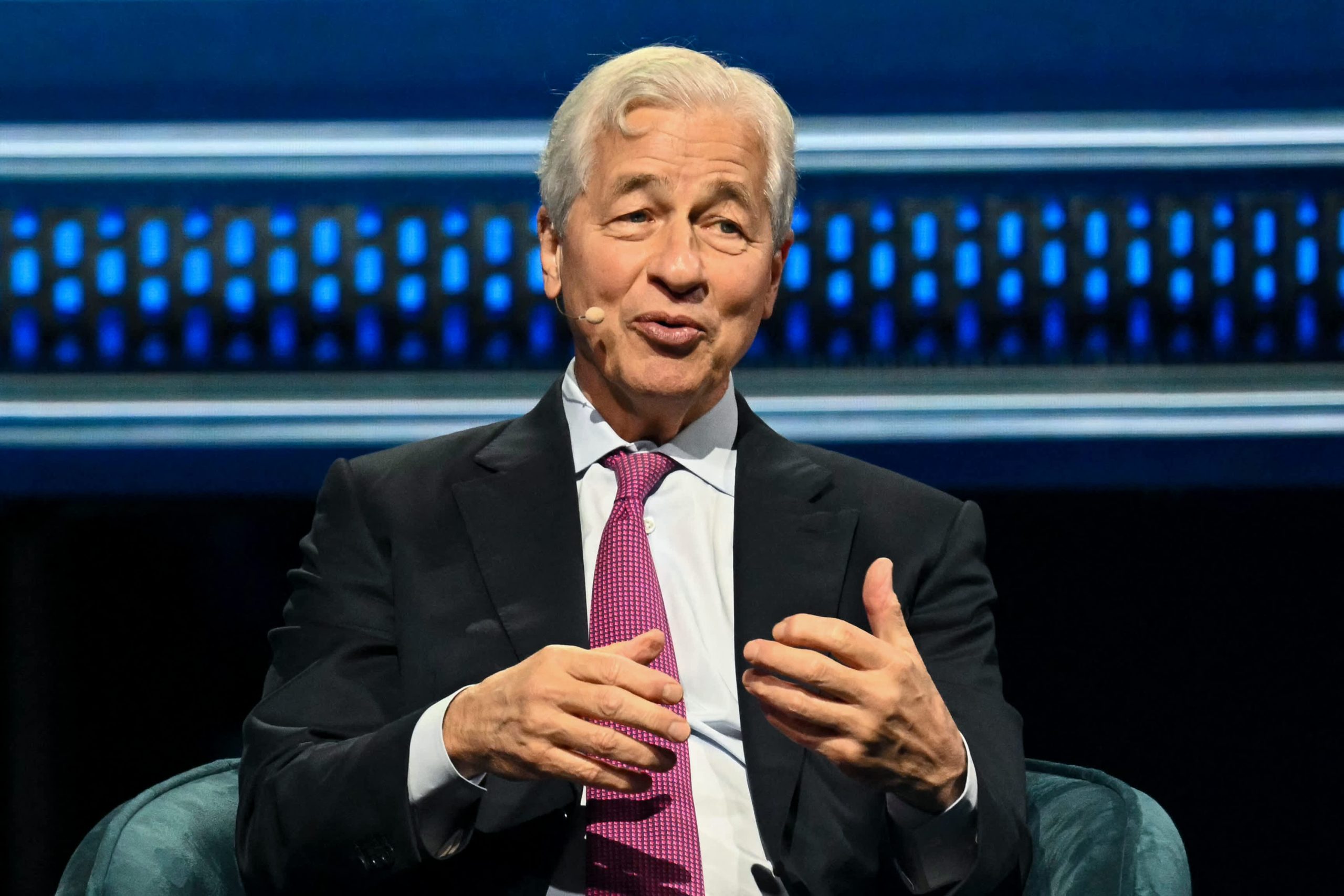
The annual gathering of the global financial elite in Davos, Switzerland, has long served as a theater for the clashing ideologies of free-market capitalism and government intervention. However, the 2026 World Economic Forum witnessed a particularly sharp escalation in the brewing conflict between Wall Street and Washington. Jamie Dimon, the Chairman and CEO of JPMorgan Chase, used the international stage to issue a blistering critique of a proposed 10% federal cap on credit card interest rates, framing the policy as a potential catalyst for a systemic "economic disaster." In a provocative rhetorical turn, Dimon suggested that if the federal government is intent on pursuing price controls, it should first conduct a localized experiment in the home states of the policy’s most vocal legislative supporters: Vermont and Massachusetts.
The proposal at the center of this controversy, championed by President Donald Trump, calls for a voluntary—and potentially legislated—ceiling on the annual percentage rates (APR) that banks can charge consumers. With average credit card interest rates currently hovering between 21% and 25% across the United States, a mandated drop to 10% would represent a fundamental restructuring of the consumer credit market. While the administration has framed the move as a necessary reprieve for American families struggling with inflationary pressures and record-high household debt, the banking sector views it as an existential threat to the viability of unsecured lending.
Dimon’s suggestion to "test" the policy in Vermont and Massachusetts was a direct jab at Senators Bernie Sanders and Elizabeth Warren, both of whom have long advocated for aggressive usury laws. By proposing that the government force banks to implement the 10% cap exclusively in these jurisdictions, Dimon argued that the resulting "lesson" would demonstrate the unintended consequences of price controls. According to Dimon, the immediate fallout would not be limited to the balance sheets of major lenders like JPMorgan Chase, Citigroup, or Bank of America. Instead, he predicted a cascading failure of liquidity that would hit small businesses, municipalities, and the very consumers the policy intends to protect.
The economic logic behind Dimon’s warning is rooted in the principle of risk-based pricing. In a free-market credit system, interest rates are calculated based on the probability of default. Higher-risk borrowers—often those with lower credit scores or limited financial cushions—are charged higher rates to offset the likelihood that a portion of those loans will never be repaid. If the government imposes a hard cap that falls below the cost of capital and the risk premium required for these individuals, banks argue they will have no choice but to stop lending to them entirely. Estimates from banking analysts suggest that a 10% cap could lead to a "credit crunch" for up to 80% of current cardholders, as institutions tighten their lending standards to exclude anyone without a near-perfect credit profile.
The implications of such a contraction would be felt across the entire American retail ecosystem. Credit cards are not merely tools for debt; they are the primary engines of transaction velocity in the modern economy. Dimon noted that the sudden withdrawal of credit would stifle spending at restaurants, retailers, and travel companies. More critically, he warned of a breakdown in essential services. "The people crying the most won’t be the credit card companies," Dimon told the Davos audience. "It’ll be the… municipalities, because people miss their water payments." This highlights the role of credit cards as a short-term liquidity bridge for families managing monthly cash flows; without that bridge, the rate of delinquency on utility bills, rent, and other essential obligations could skyrocket.

The political response to Dimon’s comments was swift and reflected the deep partisan divide over financial regulation. Senator Elizabeth Warren, responding from Washington, dismissed the concerns of the "Davos crowd," characterizing the resistance of big banks as a predictable defense of corporate profits. Warren pointed out the irony of billionaire executives flying private jets to a luxury Swiss resort to argue against relief for working-class families. She reiterated her call for formal legislation, arguing that the voluntary nature of the President’s request had already proven ineffective, as no major lender had moved to lower rates by the administration’s self-imposed Tuesday deadline.
From a historical perspective, the debate over interest rate caps, or usury laws, is one of the oldest in economic history. For much of the 20th century, individual U.S. states maintained their own usury ceilings. However, a landmark 1978 Supreme Court decision, Marquette National Bank of Minneapolis v. First of Omaha Service Corp., effectively deregulated the industry by allowing national banks to "export" the interest rates of their home states to customers across the country. This led to a concentration of the credit card industry in states like South Dakota and Delaware, which had eliminated or significantly raised their interest rate ceilings to attract banking business. Re-imposing a federal cap would essentially reverse nearly 50 years of judicial and economic precedent.
Global comparisons further complicate the narrative. Many European nations, such as France and Germany, maintain "usury" thresholds that are adjusted periodically based on market averages. However, these caps are rarely as low as 10% in an environment where central bank benchmark rates are elevated. In the United Kingdom, the Financial Conduct Authority (FCA) has implemented "cost caps" on high-cost short-term credit (payday loans), but has generally avoided hard ceilings on mainstream credit cards, opting instead for rules that require lenders to intervene when customers fall into "persistent debt." The American proposal is unique in its severity and its broad application across all tiers of consumer credit.
Market analysts are currently weighing the potential impact on bank earnings and stock valuations. If a 10% cap were enacted, it is estimated that the U.S. banking industry could lose tens of billions of dollars in annual revenue. This loss would likely be offset by a combination of new fees—such as higher annual participation fees or the return of per-transaction charges—and a significant reduction in rewards programs. The "cash back" and "travel points" economy, which millions of Americans utilize to subsidize their lifestyles, is largely funded by the interest income and interchange fees generated by the current system. Under a 10% cap, these perks would likely vanish, as the margins required to sustain them would be erased.
Furthermore, there is the question of executive authority versus legislative mandate. While the Trump administration has used the "bully pulpit" to demand voluntary compliance, constitutional experts and House Speaker Mike Johnson have signaled that a permanent, nationwide cap would require an act of Congress. Given the current composition of the House and Senate, the passage of such a bill remains a formidable challenge. Many Republican lawmakers, traditionally aligned with free-market principles, find themselves torn between the President’s populist agenda and the warnings from the financial sector regarding market stability.
As JPMorgan Chase prepares to submit a formal impact analysis to the administration, the standoff underscores a fundamental question about the role of government in a modern economy: is it the state’s responsibility to lower the cost of debt through fiat, or does such intervention ultimately hurt the very people it aims to help by destroying their access to credit? Dimon’s proposal to use Vermont and Massachusetts as a "canary in the coal mine" may have been intended as a sarcastic provocation, but it has succeeded in focusing the national conversation on the mathematical realities of the credit market. For now, the "economic disaster" Dimon predicted remains a theoretical warning, but as the rhetoric between Davos and Washington intensifies, the future of the American consumer’s wallet hangs in the balance.