
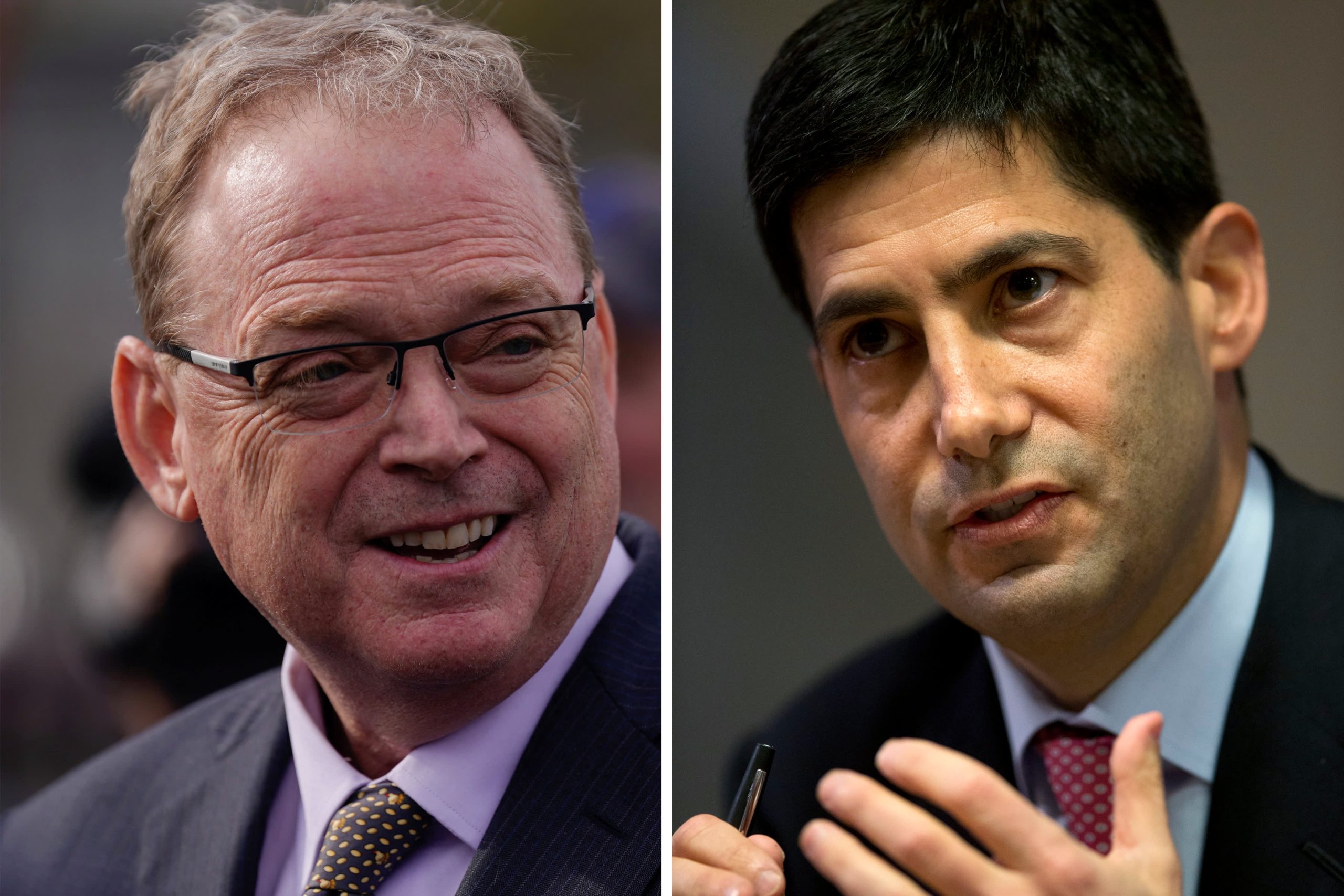
The high-stakes competition to lead the world’s most influential financial institution has entered a period of intense volatility, mirroring the very markets the Federal Reserve seeks to stabilize. Kevin Hassett, currently the director of the National Economic Council and a long-time economic advisor to the administration, has surged back to the top of prediction markets, reclaiming his position as the most likely successor to Jerome Powell. This shift comes after a brief but significant period where former Federal Reserve Governor Kevin Warsh appeared to gain the upper hand, highlighting the fluid nature of the selection process and the competing philosophies currently vying for dominance within the White House.
Data from Kalshi, a leading regulated prediction market, showed a dramatic swing in sentiment on Tuesday. Traders assigned Hassett a roughly 53% probability of securing the nomination, a sharp rebound from a low of 39% earlier in the day. Conversely, Kevin Warsh, who had briefly eclipsed Hassett in the eyes of bettors, saw his implied probability retreat to approximately 33%, down from a peak of 46%. These fluctuations are more than mere gambling metrics; they serve as a real-time barometer for the internal political tensions and the shifting preferences of a president who has historically placed a high premium on personal loyalty and televised performance.
The catalyst for Hassett’s resurgence appears to be a calculated and strategic public appearance. Speaking on CNBC, Hassett addressed one of the most significant concerns held by institutional investors and international central bankers: the preservation of the Federal Reserve’s independence. By asserting that the central bank’s autonomy is "really, really important" and emphasizing the need for a consensus-based approach to interest rate policy, Hassett sought to distance himself from the perception that he would act as a direct instrument of the executive branch. His insistence that the Federal Open Market Committee (FOMC) must operate based on "the facts and the data" was widely interpreted as an attempt to reassure the bond market, which remains sensitive to any hint of political interference in monetary policy.
The debate over the next Fed Chair is unfolding against a backdrop of significant economic transition. While the U.S. economy has shown remarkable resilience, with labor markets remaining tight and GDP growth outperforming many G7 peers, the long-term outlook is clouded by concerns over structural inflation and the sustainability of the national debt. The next Chair will inherit a "soft landing" that is still in its nascent stages, tasked with navigating the delicate balance of returning inflation to the 2% target without triggering a recession. In this context, the choice between Hassett and Warsh represents a choice between two distinct visions of Republican economic stewardship.
Kevin Hassett’s candidacy is deeply rooted in his role as a supply-side architect. As a former chairman of the Council of Economic Advisers, he was a primary designer of the 2017 Tax Cuts and Jobs Act, arguing that corporate tax reductions would spur domestic investment and long-term growth. His proximity to the President is his greatest asset and his most significant liability. While his deep understanding of the administration’s "America First" economic agenda ensures ideological alignment, high-level figures close to the President have reportedly raised concerns that this very closeness could undermine the Fed’s institutional standing. Critics argue that a Fed Chair perceived as a political appointee could lead to a "politicization premium" on U.S. Treasury yields, as investors demand higher returns to compensate for the risk of inflation-biased monetary policy.
In contrast, Kevin Warsh represents the traditional "institutionalist" wing of the Republican financial establishment. Having served as a Fed Governor from 2006 to 2011, Warsh is a veteran of the global financial crisis, a period during which he served as a key liaison between the central bank and Wall Street. His deep knowledge of the "plumbing" of the financial system and his skepticism of unconventional monetary policies, such as large-scale quantitative easing, have made him a favorite among many conservative economists and market participants. Trump’s recent comments to the Wall Street Journal, in which he suggested Warsh had risen to the "top tier" of contenders, briefly upended the race and signaled that the President is seriously considering a candidate who might offer more conventional credibility to global markets.
The implications of this choice extend far beyond the borders of the United States. As the issuer of the world’s primary reserve currency, the Federal Reserve’s leadership is a matter of global security. Central banks in Europe, Japan, and emerging markets closely monitor the Fed’s trajectory, as U.S. interest rate decisions dictate capital flows and exchange rate stability worldwide. A move toward a more "political" Fed could accelerate global efforts toward de-dollarization, as foreign governments seek to reduce their exposure to a currency managed by an institution perceived to be under the thumb of the White House. Conversely, a traditionalist pick like Warsh might signal a commitment to the status quo, providing a sense of continuity that could stabilize the U.S. dollar in a period of geopolitical uncertainty.
The internal pushback against Hassett highlights the delicate balancing act the administration must perform. Advisers who have cautioned against Hassett’s nomination point to the historical precedent of the 1970s, when President Richard Nixon’s pressure on Fed Chair Arthur Burns contributed to a decade of runaway inflation. They argue that to maintain the "inflation-fighting" credibility that Paul Volcker established in the 1980s, the next Chair must be beyond reproach regarding their independence. This internal friction suggests that while the President values loyalty, he is also cognizant of the market chaos that could ensue if the Federal Reserve is seen as losing its "inflation hawk" credentials.
Market data suggests that investors are currently pricing in a "wait-and-see" approach. The 10-year Treasury yield has remained sensitive to news regarding the Fed nomination, with yields typically edging higher when candidates perceived as "dovish" or "political" gain traction. The prospect of a Fed Chair who might prioritize short-term economic growth over long-term price stability is a primary concern for the fixed-income market. Furthermore, the equity markets, which have thrived on the "Trump Trade" of deregulation and tax cuts, are also wary of the volatility that a contested or controversial Fed nomination could trigger.
The selection process is further complicated by the impending expiration of Jerome Powell’s term in 2026. While the President has expressed a desire to move in a new direction, the transition must be managed with surgical precision to avoid a "taper tantrum" or a sudden tightening of financial conditions. The "shadow chair" concept—where a nominee is named well in advance to influence policy before officially taking the reins—has been floated in some circles, though such a move would be unprecedented and potentially legally fraught.
As the race enters its final stages, the focus remains on how the candidates will manage the Fed’s dual mandate of maximum employment and stable prices. Hassett’s recent pivot toward the rhetoric of independence and consensus-building suggests he is aware of the institutional hurdles he faces. By emphasizing the importance of the FOMC’s collective wisdom, he is attempting to rebrand himself not just as a loyal advisor, but as a statesman capable of leading a complex, technocratic organization. Whether this rebranding will be enough to overcome the concerns of the "establishment" wing of the party remains to be seen.
Ultimately, the choice of the next Federal Reserve Chair will be one of the most consequential decisions of this administration. It will signal to the world whether the United States remains committed to the post-Volcker era of independent monetary policy or whether it is moving toward a new model where the central bank is more closely integrated with the fiscal and political goals of the executive branch. With Hassett and Warsh representing these two divergent paths, the volatility in the prediction markets is likely to continue until a formal announcement is made, reflecting the profound uncertainty of the global economic order.