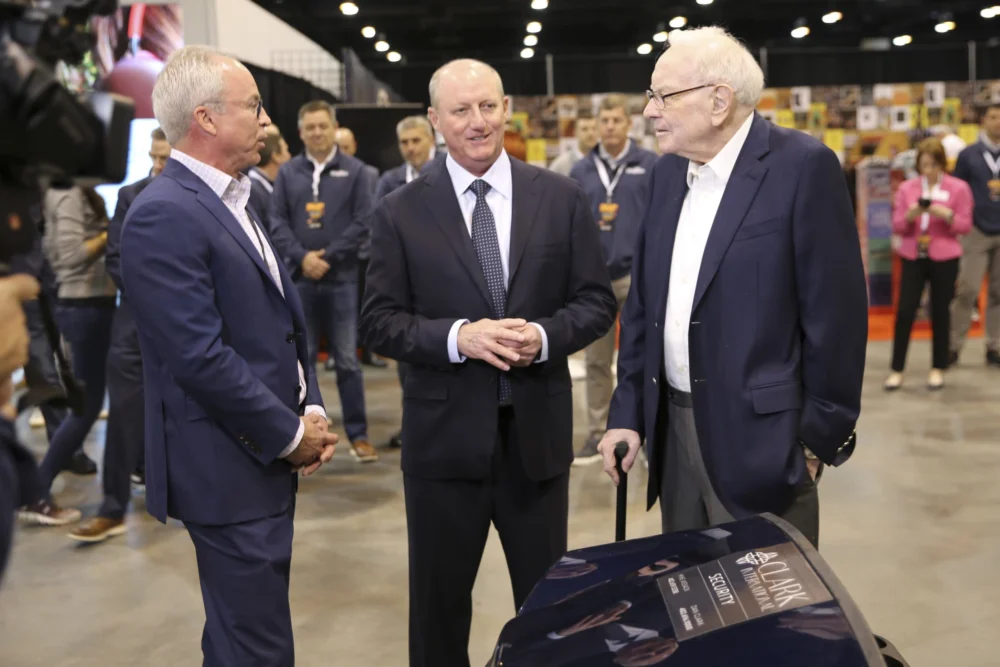
The transition of leadership at Berkshire Hathaway marks more than just a change in the corporate directory of an American multinational; it signifies the conclusion of the most prolific era of capital allocation in the history of modern finance. As Warren Buffett officially relinquishes the role of Chief Executive Officer to Greg Abel, the investment community is forced to reckon with a legacy defined by a nearly incomprehensible 5.5 million percent return over sixty years. While Buffett remains as Chairman, the elevation of Abel to the helm of the Omaha-based conglomerate signals the end of a singular epoch where a single individual’s intuition and discipline served as the primary barometer for global value investing.
The statistical reality of Buffett’s tenure is often cited but rarely fully internalized in its magnitude. When Buffett first seized control of Berkshire Hathaway in the mid-1960s, the company was a struggling textile mill in New England, with shares trading at approximately $19. By the close of 2025, a single Class A share had breached the $750,000 threshold. To put this in perspective, a $10,000 investment in Berkshire at the dawn of the Buffett era would have theoretically blossomed into a fortune exceeding $550 million today. This trajectory was fueled by a compounded annual gain of 19.9% from 1964 through 2024—a figure that nearly doubles the 10.4% annualized return of the S&P 500 over the same period. Even in the twilight of his executive tenure, the engine showed no signs of stalling, with shares adding another 10% in value throughout 2025.
The mechanics of this wealth creation were built upon a deceptively simple, yet rigorously executed, economic blueprint. Central to the Berkshire model is the concept of "insurance float." By acquiring insurance giants like GEICO and General Re, Buffett gained access to billions of dollars in premiums paid by policyholders before claims were settled. This "float" essentially functioned as a source of zero-cost, or even negative-cost, capital. Unlike traditional investment firms that must pay interest on debt or management fees to partners, Berkshire utilized this steady stream of liquidity to acquire high-quality businesses with "durable competitive advantages" or "moats."
This strategy facilitated the acquisition of iconic American brands, including long-held stakes in Coca-Cola and American Express, alongside the wholesale purchase of massive industrial entities such as the BNSF Railway and Berkshire Hathaway Energy. The result was a diversified fortress that functioned as a proxy for the broader American economy. This "American Tailwind," as Buffett often termed it, allowed the conglomerate to withstand inflationary cycles, interest rate hikes, and geopolitical upheavals that decimated more fragile portfolios.
However, the success of Berkshire Hathaway was never a solitary endeavor. The partnership between Warren Buffett and the late Charlie Munger is widely regarded as the most successful intellectual collaboration in business history. Munger is credited with pivoting Buffett away from the "cigar-butt" style of value investing—buying mediocre companies at a deep discount—toward the philosophy of buying "wonderful businesses at a fair price." This shift allowed Berkshire to scale its operations to a level where it could deploy tens of billions of dollars at a time, a necessity as the company grew too large to move the needle with small-cap investments. As Bill Stone, Chief Investment Officer at Glenview Trust Company, noted, the unique synergy between Buffett and Munger created a cultural and intellectual bedrock that is unlikely to be replicated in the modern era of high-frequency trading and algorithmic speculation.
As Greg Abel assumes the CEO role, he inherits a balance sheet of unprecedented strength, but also one that reflects a growing challenge for the firm. At the end of September 2024, Berkshire held a record-breaking $381.6 billion in cash and cash equivalents. This mountain of liquidity serves as a testament to Buffett’s legendary discipline, but also highlights the difficulty of finding attractive valuations in a market characterized by high price-to-earnings ratios and intense competition from private equity firms. For twelve consecutive quarters, Berkshire has been a net seller of equities, a sustained retreat that suggests the "Oracle of Omaha" found little to buy in an era of technological exuberance.

The succession plan, while carefully telegraphed for years, leaves several critical questions unanswered for the global market. While Greg Abel has proven himself as a formidable operator—having successfully managed Berkshire’s sprawling energy and utility divisions—the management of the firm’s $300 billion equity portfolio remains a point of intense scrutiny. The portfolio, which remains heavily concentrated in names like Apple and American Express, has historically benefited from Buffett’s personal relationships and his ability to act as a "lender of last resort" during financial crises, such as his pivotal interventions during the 2008 Great Recession. Whether Abel, alongside investment managers Todd Combs and Ted Weschler, can maintain this level of opportunistic capital deployment without Buffett’s unique brand of "soft power" is a central concern for institutional shareholders.
Furthermore, the transition marks a shift in the way Berkshire communicates with the world. For six decades, Buffett’s annual shareholder letters served as the unofficial "Bible of Capitalism," offering plainspoken wisdom on everything from accounting integrity to the follies of Wall Street "helpers" who charge high fees for subpar performance. While Buffett intends to continue writing a Thanksgiving message, the primary responsibility for the annual letter—and the stewardship of the "Woodstock for Capitalists" in Omaha—will now fall to Abel. This represents a move toward a more conventional, perhaps more institutionalized, form of corporate governance, potentially moving away from the cult of personality that has defined the company for half a century.
One of the most enduring aspects of the Buffett era was his steadfast refusal to adhere to Wall Street conventions. Berkshire famously never split its Class A stock, a decision designed to discourage short-term speculation and attract a shareholder base with a multi-decade time horizon. The company also declined to provide quarterly earnings guidance, arguing that such forecasts encourage management to "cook the books" or sacrifice long-term health for short-term targets. This culture of extreme autonomy for subsidiary managers, paired with centralized capital allocation in Omaha, created a decentralized empire that many business school professors consider an anomaly in the age of micromanagement.
Ann Winblad, managing director at Hummer Winblad Venture Partners, suggests that while the face of the company is changing, the "cultural anchor" will remain. The strategy of being "patient, long-term, careful, and decisive" is baked into the DNA of the subsidiary managers who run the railroads, the utilities, and the manufacturing plants. Yet, the sheer scale of Berkshire now presents a mathematical hurdle often called the "Law of Large Numbers." To double its value from here, Berkshire would need to add nearly $1 trillion in market capitalization, a feat that becomes increasingly difficult as the pool of potential acquisition targets shrinks to only the largest global corporations.
Buffett himself has long prepared his "partners"—his preferred term for shareholders—for the eventual volatility that comes with a transition of this magnitude. He has frequently reminded investors that Berkshire’s stock has experienced 50% drawdowns three times in its history, emphasizing that such fluctuations are the price of admission for long-term outperformance. His parting advice has remained consistent: do not bet against the resilience of the American economy, and do not mistake temporary market "caprice" for a loss of intrinsic value.
As the "Buffett Era" transitions into the "Abel Era," the global financial community is watching to see if the principles of value, discipline, and compounding can survive the departure of their most famous practitioner. The $381 billion cash pile represents both a safety net and a challenge; it is a war chest waiting for a market correction that would allow Abel to make his first definitive mark on the company’s history. Regardless of the immediate market reaction, the legacy of the last sixty years stands as a monument to the power of deferred gratification and the relentless math of compounding. In an industry often obsessed with the next minute, Warren Buffett proved that the greatest returns belong to those who can think in terms of the next century.