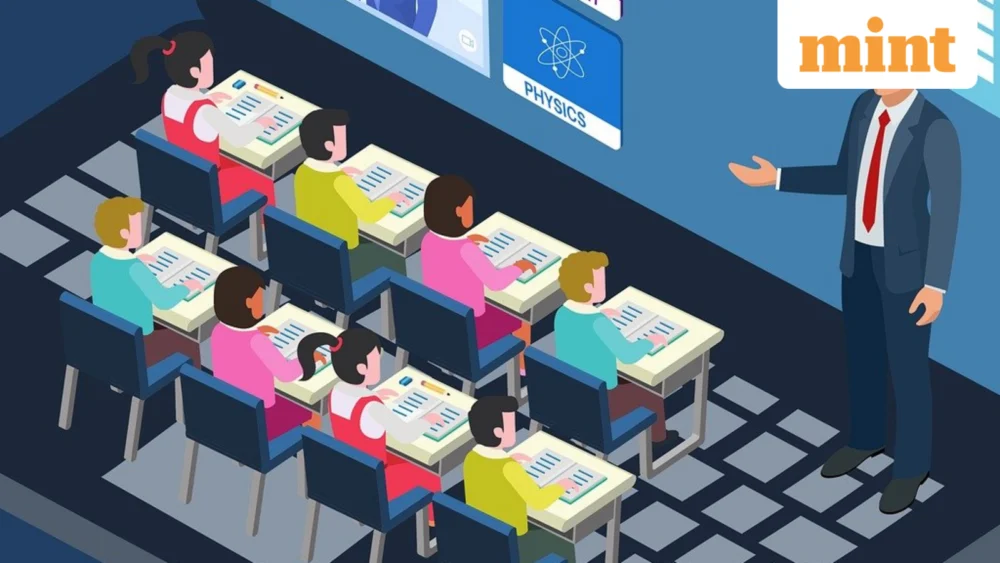
A profound transformation is sweeping through India’s higher education landscape, as online skilling firms, once content with leveraging the established credibility of traditional institutions through co-branded courses, are now aggressively pursuing full university status. This strategic pivot is driven by a confluence of factors: the nation’s burgeoning youth population, an ambitious governmental push for enhanced educational attainment, and increasingly restrictive global mobility for Indian students. Several prominent platforms, including Master’s Union and Scaler, which have championed industry-ready skills outside conventional degree frameworks, are actively evaluating or have initiated the process of acquiring university licenses. PhysicsWallah, another significant player, has also articulated plans to establish an innovation-centric university in Andhra Pradesh, signaling a broader industry-wide movement towards deeper academic integration.
The economic impetus for this shift is undeniable. India, with approximately half of its 1.4 billion citizens under the age of 25, possesses the largest population eligible for higher education in its history. This demographic dividend presents an unprecedented market opportunity. Grand View Research projects the Indian higher education market’s revenue to nearly triple, escalating from $19.4 billion in 2023 to an impressive $54.4 billion by 2030, reflecting an annualized growth rate of 15.8%. Narayanan Ramaswamy, partner and national leader for education and skill development at KPMG, underscores the unique nature of this demand, stating, "There have never been so many people wanting to enter higher education in a single geography." He characterizes the next quarter-century as a rare window of opportunity for institutions prepared to make long-term commitments, aligning perfectly with policymakers’ goals to significantly elevate the Gross Enrolment Ratio (GER) over the coming decade.
This domestic surge in demand is further amplified by a changing global environment. For years, a significant proportion of India’s aspirational student cohort looked towards international destinations for higher education, particularly the United States, the United Kingdom, Canada, and Australia. However, this avenue is progressively narrowing. Stricter visa regulations, coupled with diminishing post-study work opportunities and a general tightening of immigration policies in these key host nations, are effectively redirecting a substantial portion of this demand back to India. This shift necessitates a robust and credible domestic higher education infrastructure capable of absorbing and adequately preparing millions of young people for the global workforce.
The journey of these online skilling platforms has evolved significantly. The initial edtech boom of 2020-2021, spurred by pandemic-induced lockdowns, saw online learning solutions surge in popularity. However, as classrooms reopened in 2022, the initial momentum of purely online skilling began to wane. Many platforms adapted by forging co-branded degrees and campus partnerships with established Indian institutions. Companies like PhysicsWallah, Simplilearn, and upGrad collaborated with prestigious entities such as the Indian Institutes of Technology (IITs), Indian Institutes of Management (IIMs), and various private universities. While these collaborations allowed for growth and leveraged existing academic prestige without requiring the edtech firms to award degrees directly, they came with inherent limitations. Founders across the sector acknowledge that an independent skilling model, particularly in undergraduate programs where degree recognition carries significant weight, often constrains long-term growth and institutional autonomy.
The pursuit of full university status is a strategic imperative to overcome these limitations. Pratham Mittal, founder of Master’s Union, articulated this clearly, stating their long-standing ambition to attain university status and highlighting that "Governments do not look favourably in many situations until and unless you are a licensed player." Licensing is not merely a formality; it opens doors to crucial academic recognition and integration. It allows institutions to be included in prestigious national frameworks such as the National Institutional Ranking Framework (NIRF) and the Association of Indian Universities (AIU), and enables participation in national academic and youth festivals. A recent PwC-Assocham report emphasized that government policy and licensing frameworks form the bedrock of higher education reform in India, dictating access to rankings, research funding, collaborative opportunities, and curriculum standardization—areas largely inaccessible to non-licensed entities.
Pioneering this path, upGrad became the first edtech company to establish a university in 2021, securing approval under a Maharashtra state law and recognition from the University Grants Commission (UGC). Its subsequent accreditation from the National Assessment and Accreditation Council (NAAC) in 2025 further solidified its standing, providing a benchmark of quality and operational excellence. Scaler, another key player, is actively engaging with regulatory bodies, exploring formal accreditation pathways rather than relying solely on traditional university tie-ups. Abhimanyu Sharma, co-founder and CEO of Scaler, noted that "The partnership model works up to a point, but it also comes with limitations," particularly citing that "Traditional universities often lack the governance structures and operational clarity that a venture-backed education company requires." The Scaler School of Technology, launched in early 2024, witnessed exceptional demand, receiving nearly 30,000 paid applications and over 200,000 registrations for its technology programs in 2025. To support its ambitious expansion, Scaler is evaluating a substantial 20-acre site for a new campus.
However, the path to establishing a university is not without significant entry barriers. State regulations for private universities typically mandate the ownership or long-term lease of substantial land parcels, often ranging from 10 to 30 acres. Such requirements can be a deterrent for smaller, agile players. For instance, Prateek Shukla, co-founder and CEO of Masai, acknowledges that while an independent university license is a strategic option, their immediate focus remains on building strong partnerships with top-tier institutions. Similarly, Ankit Agarwal, co-founder of Elevation Capital-backed Mesa School, notes that the postgraduate segment, where their company operates, often has a limited need for formal degrees, thus keeping them out of the university licensing race for now. Agarwal points out a historical parallel, stating, "A number of private universities were formed back in the day to fulfil the employment requirements of IT services companies. Now, with the startup industry creating just as many opportunities, there is a need for new-age institutions to be formed." This highlights a fundamental shift in the demand for skilled professionals across India’s evolving economic landscape.
The government’s stance on higher education is notably evolving, with senior education experts observing that the UGC is increasingly open to greater private sector participation, concurrently stepping back from establishing new public universities. This aligns with the overarching goals of the National Education Policy (NEP) 2020, which aims to overhaul higher education by phasing out the affiliating college model, granting universities enhanced autonomy, facilitating flexible entry and exit through academic credit banks, and promoting multidisciplinary learning, research, and global partnerships. A core objective of the NEP 2020 is to elevate the Gross Enrolment Ratio (GER) to 50% by 2035, a significant leap from the 28.4% recorded in 2021-22.
Yet, this invitation for private capital and innovation is not a "free pass." Regulatory filters have become more stringent, encompassing rigorous land requirements, accreditation processes, and thorough screening committees. As KPMG’s Ramaswamy explains, this reflects a deliberate strategy to invite investment and expand capacity without compromising quality control. "They want more players, but not everyone," he asserts. While universities are legally structured as not-for-profit entities in India, a growing trend sees investors backing the ecosystem around them. This includes operating platforms, marketing arms, and various service entities that, in effect, control the economic levers of these campuses. This sophisticated financial engineering indicates that "a lot of money is being spent on higher education, even if it doesn’t always show up as a straight acquisition," reflecting the significant capital inflows into this rapidly expanding sector.
The economic impact of this trend is multifaceted. It represents a crucial step towards addressing India’s persistent skill gap, aligning educational output with the dynamic demands of a rapidly evolving job market. By integrating industry-focused skilling with formal academic accreditation, these new-age universities aim to produce a workforce that is not only qualified but also immediately employable. This could significantly boost India’s human capital development, enhance its global competitiveness, and, crucially, help realize the full potential of its demographic dividend. As India navigates its future, the strategic pursuit of university status by its online skilling giants signals a powerful convergence of market forces, national policy, and an urgent need to educate and empower its vast youth population for the 21st century economy.