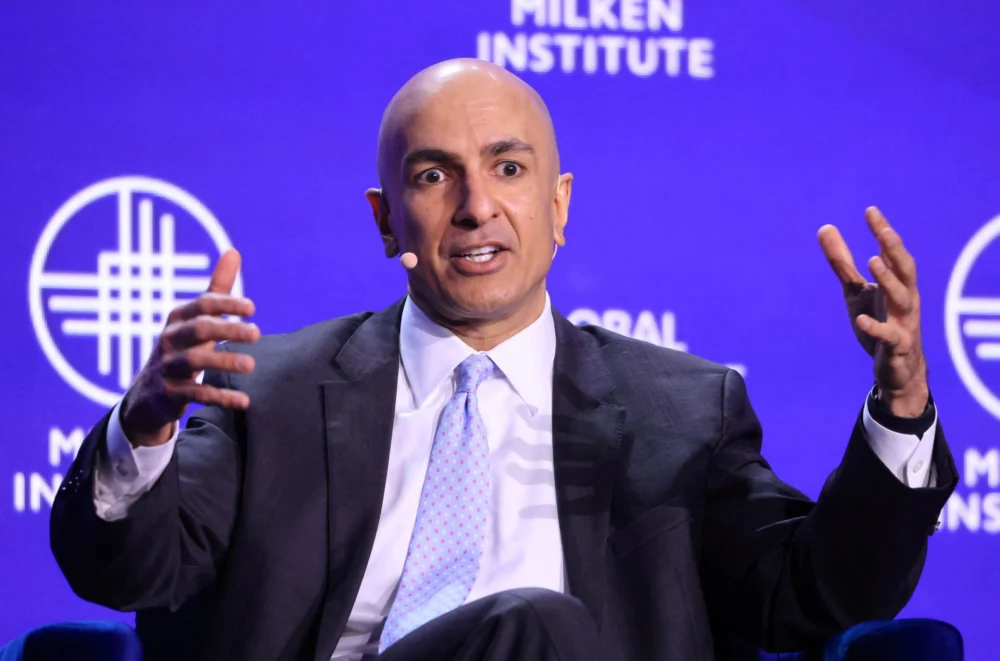
The trajectory of American monetary policy stands at a critical crossroads as central bankers grapple with a resilient economy that refuses to follow the traditional script of a post-tightening slowdown. Minneapolis Federal Reserve President Neel Kashkari, a prominent voice within the Federal Open Market Committee (FOMC), recently signaled that the window for further interest rate reductions may be closing more rapidly than markets had previously anticipated. His assessment, which suggests the U.S. central bank is nearing the elusive "neutral rate," marks a significant shift in the narrative that has dominated financial markets since the Fed began its easing cycle in late 2024.
As the Federal Reserve navigates the complex transition from a restrictive stance to one of stabilization, the debate over the "neutral" rate of interest—the theoretical level at which monetary policy neither stimulates nor restrains economic growth—has moved to the forefront of the global economic discourse. With the federal funds rate currently targeted in a range between 3.5% and 3.75%, Kashkari’s recent commentary suggests that the margin for error is thinning. According to internal projections from the Fed’s December meeting, the current rate sits a mere 50 basis points above the committee’s consensus for neutral. This narrow buffer leaves policymakers with a difficult choice: continue the momentum of recent cuts or pause to evaluate the delayed effects of previous policy shifts.
Kashkari’s perspective is particularly salient as he prepares to take on a more influential role in 2026 when he becomes a voting member of the FOMC. His recent "hawkish" tilt—a term used to describe policymakers more concerned with inflation than growth—reflects a growing anxiety within the central bank regarding the "last mile" of the inflation fight. While the Fed has successfully brought inflation down from its 2022 peaks, the preferred gauge of price pressures, the core Personal Consumption Expenditures (PCE) price index, remains stubbornly perched at 2.8%. This figure sits uncomfortably above the Fed’s 2% symmetric target, leading some officials to question whether the current policy is as restrictive as they once believed.
The resilience of the U.S. economy has been a recurring theme of the post-pandemic era, defying the prognostications of dozens of Wall Street analysts who predicted a recession in 2023 or 2024. Kashkari acknowledged this phenomenon, noting that despite a cycle of aggressive hikes followed by strategic cuts, the downward pressure on economic activity has been less pronounced than expected. Consumer spending remains robust, fueled by a labor market that, while cooling, has not buckled. This durability suggests that the "neutral rate" may actually be higher than it was in the decade following the 2008 financial crisis, a possibility that would necessitate keeping interest rates higher for a longer duration.

However, the labor market presents a divergent set of risks. The unemployment rate has gradually drifted upward to 4.6%, a level that historically has signaled the early stages of a broader downturn. The challenge for the Fed is compounded by recent volatility in economic data. A recent government shutdown has cast a shadow over the accuracy of employment figures, with some economists suggesting that job growth may be systemically overcounted. If the labor market is actually weaker than the headline numbers suggest, the Fed’s hesitation to cut further could inadvertently trigger a sharper spike in unemployment. Kashkari described this tension as a choice between the risk of "persistence" in inflation and the risk of a "pop" in the unemployment rate.
Adding a layer of geopolitical and fiscal complexity to the Fed’s calculus is the incoming administration’s proposed trade agenda. President-elect Donald Trump’s promise of sweeping tariffs has introduced a new variable into the inflation equation. Tariffs, while intended to protect domestic industry, often function as a tax on consumers and can lead to supply-chain disruptions that drive prices higher. Kashkari noted that the inflationary effects of tariffs could take years to fully permeate the economy, creating a persistent upward pressure that would make it nearly impossible for the Fed to justify further rate cuts. This "supply-side" inflation is particularly difficult for central banks to manage, as raising rates to combat price hikes caused by tariffs can further dampen economic growth without necessarily addressing the underlying cause of the price increases.
The global context further complicates the Federal Reserve’s path. While the European Central Bank (ECB) and the Bank of England have also moved toward easing, the U.S. dollar’s continued strength and the unique resilience of the American consumer have created a "U.S. exceptionalism" that limits how far the Fed can deviate from a restrictive stance without risking a resurgence in inflation. If the Fed cuts rates too deeply while other major economies remain stagnant, it could lead to a further strengthening of the dollar, impacting international trade balances and emerging market debt.
Internal leadership transitions at the Federal Reserve also loom large over these policy decisions. Jerome Powell’s term as Chair is set to expire in May, and the political landscape suggests a change in leadership is imminent. While President-elect Trump is expected to name a successor in early 2025, Powell’s term as a member of the Board of Governors extends until 2028. Kashkari expressed a desire to see Powell remain as a colleague on the board, praising his leadership during a period of unprecedented economic volatility. The transition of the Chairmanship will be a pivotal moment for markets, as investors look for continuity in the Fed’s commitment to its dual mandate of price stability and maximum employment.
The debate over the "neutral rate" is not merely academic; it has profound implications for mortgage rates, corporate borrowing costs, and the valuation of global equities. If the Fed signals a definitive end to the easing cycle at 3.5%, it would represent a "higher-for-longer" reality that many investors had hoped to avoid. For the average American, this means that the era of ultra-low interest rates seen in the 2010s is unlikely to return. Mortgage rates, which have hovered significantly higher than their pre-pandemic levels, may stabilize rather than fall further, keeping the housing market in a state of relative paralysis.

Furthermore, the Fed must contend with the "wealth effect" created by a record-breaking stock market. High asset prices can boost consumer confidence and spending, effectively counteracting the Fed’s attempts to cool the economy. If the central bank cuts rates too aggressively in the face of a booming market, it risks inflating asset bubbles that could eventually lead to financial instability. This concern is likely a factor in Kashkari’s cautious stance, as he weighs the benefits of supporting the labor market against the risks of reigniting inflationary fires.
As 2026 approaches, the FOMC will likely find itself divided. The "doves" on the committee will point to the 4.6% unemployment rate as a clarion call for more stimulus to prevent a recession. The "hawks," led by voices like Kashkari, will look at the 2.8% core PCE and the looming threat of tariff-induced inflation as reasons to hold steady. The data-dependent approach that Chair Powell has championed will be put to its ultimate test in the coming months.
In the final analysis, the Federal Reserve’s current position is one of strategic patience. By signaling that they are "pretty close to neutral," officials like Kashkari are preparing the markets for a potential pause in the rate-cutting cycle. This pause would allow the committee to observe how the cumulative effects of previous cuts filter through the economy and how the new administration’s fiscal policies take shape. The margin for maneuver has narrowed, and the stakes for the global economy have rarely been higher. Whether the Fed can successfully engineer a "soft landing"—taming inflation without triggering a significant rise in unemployment—remains the defining question of this economic era. For now, the message from the Minneapolis Fed is clear: the period of rapid policy easing is likely over, and the era of careful calibration has begun.