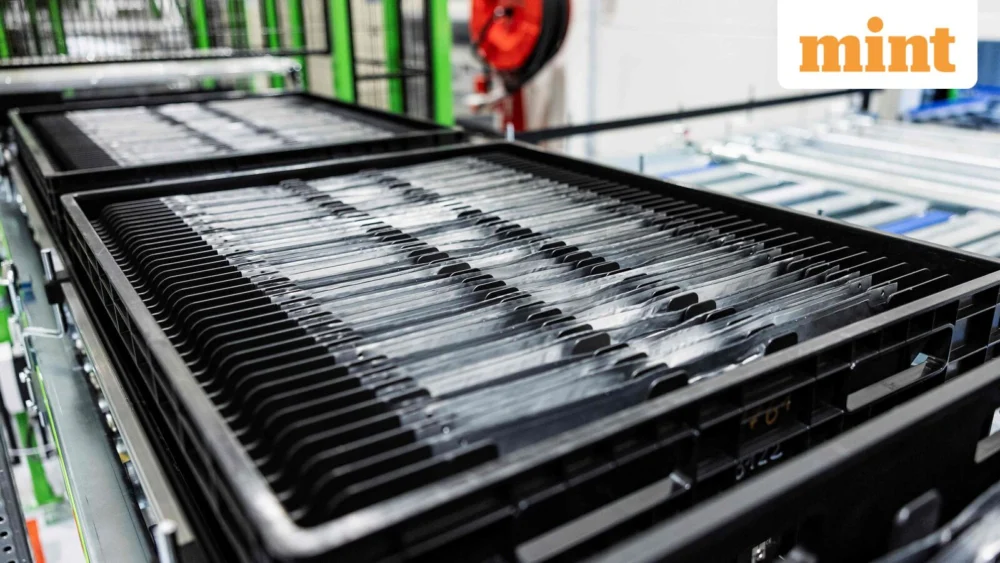
India stands at a pivotal juncture in its energy transition, navigating the formidable challenge of integrating burgeoning renewable energy capacity while ensuring grid stability and energy security. The nation’s ambitious climate targets – including achieving net-zero emissions by 2070 and establishing 500 gigawatts (GW) of non-fossil fuel electricity generation capacity by 2030 – hinge critically on the robust development of advanced energy storage solutions. Against this backdrop, Waaree Energy Storage Services Pvt. Ltd. (WESS), a key subsidiary of the prominent clean-energy conglomerate Waaree Energies Ltd, has announced a significant capital raise of ₹1,003 crore. This substantial investment marks a crucial step within the company’s broader ₹10,000 crore capital expenditure strategy aimed at establishing a colossal 20-gigawatt-hour (GWh) lithium-ion battery and battery pack manufacturing facility, a move poised to reshape India’s domestic energy landscape.
This strategic financial infusion is designed to accelerate the commissioning of the state-of-the-art 20 GWh facility, bolstering India’s nascent yet rapidly expanding energy storage ecosystem. Ankit Doshi, Director at Waaree Energy Storage Services, emphasized that these resources are instrumental in strengthening domestic supply chains and contributing significantly to the nation’s overall energy storage capacity. The initiative transcends mere commercial expansion; it aligns directly with national sustainable energy objectives, simultaneously fostering local manufacturing capabilities, generating skilled employment opportunities, and driving technological innovation within the critical energy storage sector. The forthcoming plant is slated to produce a diverse range of batteries and battery packs, catering to both large-scale grid storage systems – essential for stabilizing the national power infrastructure – and the rapidly growing electric vehicle (EV) market across various segments. This strategic duality positions Waaree as a versatile player in the evolving energy paradigm.
The Waaree Group’s evolution underscores a broader industry trend towards integrated energy solutions. By expanding its portfolio to encompass solar modules, inverters, batteries, comprehensive energy storage systems, and other emerging clean energy technologies, the group is transitioning into a fully integrated energy transition player. This vertical integration not only enhances operational efficiencies and cost control but also allows for a holistic approach to energy management, from generation to consumption, critical for navigating the complexities of modern energy grids. Such a comprehensive strategy positions the company to capture value across multiple segments of the clean energy value chain, from utility-scale solar farms to residential battery backup solutions.
India’s current energy storage market, despite its immense potential, grapples with significant import dependency. The nation remains almost entirely reliant on external sources for its lithium-ion cell requirements, a vulnerability reflected in the escalating import figures. Data indicates a sharp rise in Li-ion cell imports, soaring from approximately $1.8 billion in the fiscal year 2021-22 to an estimated $3 billion in 2024-25. This escalating import bill not only exerts pressure on foreign exchange reserves but also exposes the country to global supply chain disruptions and geopolitical risks inherent in sourcing critical raw materials. The ‘Make in India’ and ‘Atmanirbhar Bharat’ (Self-Reliant India) initiatives, championed by the government, directly address this vulnerability, aiming to foster domestic manufacturing capabilities and reduce reliance on imports for strategic sectors like advanced chemistry cells.
The imperative for localized manufacturing is further amplified by the projected exponential surge in India’s energy storage demand. Forecasts suggest a dramatic increase to nearly three terawatt-hours (3,000 GWh) by 2047, a monumental leap from the current estimated capacity of around 490 megawatt-hours (MWh). This burgeoning demand is primarily driven by several synergistic factors: the aggressive targets for EV adoption, which necessitate robust charging infrastructure and battery production; the continuous expansion of renewable energy generation, requiring flexible storage to manage intermittency; and the broader modernization of the grid through smart technologies and industrial electrification initiatives. The sheer scale of this projected demand underscores the urgent need for substantial domestic manufacturing capacity, making Waaree’s 20 GWh plant a timely and strategic intervention.
Market indicators vividly illustrate this escalating demand. Tendering for battery energy storage systems (BESS) capacity has witnessed an unprecedented acceleration, escalating from a mere 4 GWh in 2023 to a projected 60 GWh by 2025, according to industry reports. This exponential growth in tendering activity, often spearheaded by central agencies like the Solar Energy Corporation of India (SECI) and state-level utilities, signals a decisive shift towards integrating large-scale storage into the national grid. Furthermore, at least ten Indian states, including Assam, Maharashtra, Andhra Pradesh, and Madhya Pradesh, have proactively rolled out policy interventions or set ambitious targets for BESS capacity. These state-level initiatives are critical, as they provide localized incentives, regulatory frameworks, and procurement mandates that collectively drive investment and deployment at the grassroots level, tailoring solutions to regional grid requirements and renewable energy profiles.
The central government’s commitment to fostering a domestic battery manufacturing ecosystem is epitomized by the Production-Linked Incentive (PLI) scheme for Advanced Chemistry Cell (ACC) manufacturing, a significant initiative with an outlay of ₹18,100 crore. The scheme aims to attract large-scale investment into the manufacturing of ACCs, reducing import dependency, and positioning India as a global manufacturing hub. Under this scheme, a total of 40 GWh of battery manufacturing capacity, out of the total 50 GWh, has already been awarded to major industrial players such as Ola Electric, Reliance Industries, and Rajesh Exports. However, a notable segment of the scheme – specifically 10 GWh earmarked for energy storage systems – remains unawarded. This gap highlights potential challenges, perhaps related to the specific technological readiness, capital intensity, or risk perception associated with dedicated grid-scale ESS manufacturing compared to the more mature EV battery segment. Addressing this will be crucial for fully realizing India’s storage ambitions.
The strategic importance of BESS extends beyond merely balancing supply and demand; it is fundamental to enhancing grid stability and reliability, especially as renewable energy penetration continues its upward trajectory. A report from FICCI and EY on critical technologies underscores this, noting that energy storage investments have dramatically increased from just 1% of deal volume in 2017 to 9% by 2024, with lithium-ion batteries dominating this growth. BESS acts as a critical enabler for grid flexibility, offering essential services such as frequency regulation, voltage support, and peak shaving. Crucially, it facilitates renewable energy time-shifting, allowing excess solar or wind power generated during peak production hours to be stored and discharged when demand is high or renewable output is low. This capability directly addresses the inherent intermittency of solar and wind generation, mitigating curtailment and optimizing the utilization of clean energy assets.
Globally, countries are vying for leadership in the battery manufacturing domain, recognizing its strategic importance for economic competitiveness and energy independence. India’s efforts, exemplified by Waaree’s investment and the government’s PLI scheme, position it as a significant contender in this global race, alongside established players like China, South Korea, and emerging hubs in the US and Europe. The economic impact of such investments is multifaceted: it promises the creation of thousands of direct and indirect jobs across manufacturing, research and development, and deployment; it fosters a robust ecosystem for ancillary industries; and it stimulates technological innovation, positioning India at the forefront of advanced energy solutions. Furthermore, by localizing battery production, India not only strengthens its energy security but also contributes significantly to its decarbonization efforts, aligning with global climate action.
Despite the impressive strides, the path ahead is not without its challenges. Ensuring a stable and ethical supply chain for critical raw materials like lithium, cobalt, and nickel remains a global concern. Continuous investment in research and development is imperative to keep pace with evolving battery technologies, including solid-state and flow batteries, which promise enhanced performance and safety. Scaling up financing for large-scale projects, developing a highly skilled workforce, and navigating competitive pressures from established international players will also be crucial. However, with sustained policy support, strategic private sector investment like Waaree’s, and a clear vision for self-reliance, India is well-positioned to transform itself from an importer of energy storage technologies into a global hub for manufacturing and innovation, powering its transition to a sustainable and secure energy future.