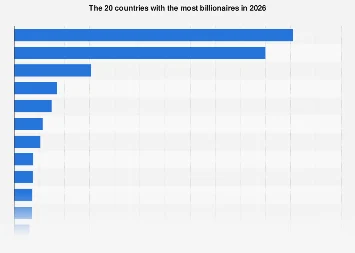
In a significant recalibration of the global economic landscape, China has officially claimed the mantle of the nation with the most billionaires, according to comprehensive data compiled for the year 2026. This seismic shift marks a pivotal moment, signaling a potential long-term trend in wealth creation and concentration that could reshape international economic dynamics for decades to come. The latest figures reveal a substantial number of ultra-high-net-worth individuals (UHNWIs) calling China home, surpassing the long-standing dominance of the United States. While the exact figures remain proprietary and subject to the methodologies of various wealth trackers, preliminary analysis indicates a considerable margin in China’s favor.
Historically, the United States has been synonymous with entrepreneurial success and the creation of immense fortunes, a testament to its pioneering role in the development of consumer capitalism and its robust financial markets. For many years, North America, spearheaded by the U.S., has consistently led in the number of UHNWIs – individuals possessing a net worth exceeding $1 billion. This prominence has been a direct reflection of the advanced economic development, technological innovation, and deep capital markets that have characterized these regions. However, the rapid ascent of China, fueled by its burgeoning technological sector, expanding consumer base, and strategic investments, has fundamentally altered this established order.
The implications of this wealth redistribution are far-reaching. For China, it represents not just an accumulation of individual fortunes but also a broader validation of its economic model and its growing influence on the global stage. This concentration of wealth within China has the potential to further stimulate domestic investment, drive innovation, and bolster its position in international trade and finance. Conversely, the United States now faces the challenge of understanding and adapting to this new reality. While still a powerhouse of wealth creation, the shift in leadership underscores the increasing competitiveness of emerging economies and the need for the U.S. to continually foster an environment conducive to sustained wealth generation and innovation.
Beyond the top two contenders, other economic powerhouses continue to host significant populations of billionaires. India, Germany, and the United Kingdom also feature prominently on the global rich list, each representing distinct economic engines and wealth-creation narratives. India’s burgeoning startup ecosystem and a growing middle class are contributing to its increasing number of UHNWIs. Germany, a cornerstone of European manufacturing and engineering, demonstrates the enduring strength of traditional industrial wealth. The United Kingdom, with its robust financial services sector and global connectivity, remains a significant hub for accumulated wealth. The continued presence of these nations highlights the diverse pathways to extreme wealth and the varied economic structures that support it.
The global distribution of wealth, however, remains a topic of intense scrutiny, particularly when examining the gender composition of the billionaire class. The data consistently reveals a stark imbalance, with women representing a disproportionately small fraction of the world’s wealthiest individuals. In 2026, the number of female billionaires on the global rich lists remained strikingly low. This disparity has amplified discussions about systemic inequalities, access to capital, and the historical barriers that women have faced in achieving the highest echelons of economic power. Critics argue that this underrepresentation is not merely a statistical anomaly but a reflection of deeper societal and economic structures that favor male-dominated entrepreneurial paths and investment opportunities.
Recent political discourse and economic analysis have increasingly focused on the concentration of wealth among the super-rich. The stark realities of global wealth distribution reveal an intensely unequal landscape, where a minuscule percentage of the population controls a vast proportion of the world’s assets. This growing awareness has spurred debates around wealth taxes, income inequality, and the social responsibilities of the ultra-wealthy. The concentration of billionaire wealth in specific nations, such as China and the United States, further accentuates these discussions, raising questions about the sustainability of such extreme disparities and their potential impact on social cohesion and economic stability.
The economic development trajectory of nations is a key determinant in their capacity to generate and sustain billionaire wealth. Regions with mature economies, well-established financial infrastructures, and a high degree of innovation have traditionally been fertile ground for wealth accumulation. However, the rapid economic expansion seen in many emerging markets, particularly in Asia, is demonstrably challenging this paradigm. As these economies mature, their integration into the global financial system deepens, and their domestic markets expand, they are increasingly becoming magnets for capital and catalysts for the creation of immense fortunes. This ongoing evolution suggests that the future landscape of global wealth may see a continued diversification of its epicenters, moving beyond the established Western hubs.
The implications of this shift extend beyond mere rankings. It signifies a changing global economic order, where the sources of innovation and capital are becoming more geographically dispersed. For multinational corporations, this means a re-evaluation of market strategies, investment priorities, and supply chain dynamics. For governments, it necessitates a nuanced understanding of how to foster inclusive growth, attract and retain talent, and manage the economic and social consequences of wealth concentration. The rise of China to the forefront of billionaire numbers is not just a headline-grabbing statistic; it is a profound indicator of evolving global economic power and the ongoing transformation of the world’s financial architecture. Understanding the drivers behind this shift, the potential future trends, and the societal implications will be crucial for policymakers, business leaders, and individuals navigating the complex global economy of the 21st century. The era of undisputed Western dominance in wealth creation may be drawing to a close, ushering in a new chapter defined by increased competition and a more multipolar distribution of global economic influence.