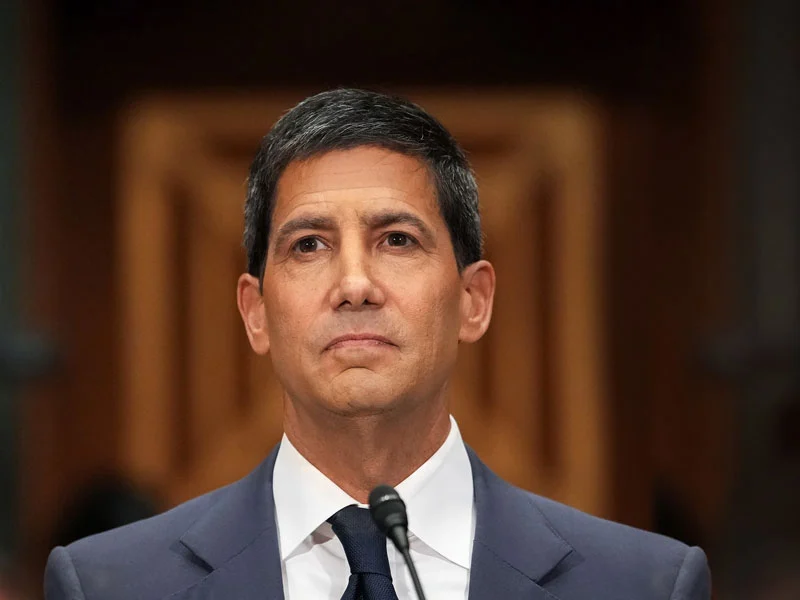
The tenure of a new Federal Reserve chair, Kevin Warsh, arrives amidst a period of intense scrutiny and unprecedented political pressure on the world’s most influential central bank, raising profound questions about its operational independence and long-term credibility. While Warsh’s background as a former Fed governor from 2006 to 2011 and his considerable personal wealth, estimated at over $130 million, might typically reassure financial markets, his confirmation process was far from smooth. Senators vigorously questioned him regarding undisclosed assets, transforming routine hearings into adversarial confrontations. The Department of Justice’s dropping of a criminal probe into his predecessor, Jerome Powell, widely perceived as a maneuver to encourage Powell’s departure, further underscored the volatile political landscape in which Warsh now operates. Powell himself, despite considering stepping down, has committed to remaining on the Fed’s board of governors, a move intended to provide a semblance of continuity amidst this turbulence.
Warsh’s close ties to the current administration have become a central concern for critics. The apprehension is that his perceived alignment with the White House could irrevocably blur the lines between political expediency and sound monetary policy. Preceding his appointment, Warsh appeared to moderate his previously hawkish stance on inflation, a shift many interpret as a calculated political accommodation. His familial connections, notably his father-in-law Ronald Lauder, a prominent Trump ally and donor, further fuel these anxieties. Proponents, however, argue that while Fed chairs are political appointees, their professional integrity and adherence to economic principles ultimately prevail once they assume office. Warsh himself has sought to allay these fears during his Senate confirmation, dismissing speculation about a wholesale replacement of regional Fed leadership with loyalists. His term, extending to 2030, is long enough to encompass multiple future administrations, offering a potential buffer against immediate political winds.
The Federal Reserve’s institutional structure inherently provides a degree of insulation. Monetary policy is formulated collectively by the Federal Open Market Committee (FOMC), where critical decisions, particularly those concerning interest rates, require broad consensus or at least a simple majority. As chair, Warsh holds only one vote among his peers and must persuade other committee members to his viewpoint. Historically, FOMC governors have largely eschewed public dissent, prioritizing a united front. However, should they perceive an infringement upon the Fed’s autonomy, they possess the capacity to assert their independence through decisive votes or public pronouncements. Nonetheless, leadership remains a critical factor. The chair sets the institution’s tone, shapes its public communication strategy, and influences its internal culture. A chair perceived as politically beholden could significantly alter market expectations regarding the decision-making process of monetary policy. Over time, such perceptions can become self-fulfilling, impacting a wide array of financial indicators, from sovereign bond yields to international currency valuations. Christopher Hodge, Chief Economist for the US at Natixis CIB Americas, who previously held senior positions at the Federal Reserve Bank of New York and the US Treasury, notes, "Once he is sitting in the Chair’s seat, he will be beholden to his fellow FOMC participants and markets, who will be closely watching for signs about his vigilance in keeping inflation expectations well-anchored."
For much of its history, the Federal Reserve has navigated a precarious position: established by legislative action but expected to operate independently of political influence. This independence has never been absolute. Congress, as the creator of the institution, has always retained the power to influence its direction, particularly in the lead-up to elections. Nevertheless, a prevailing norm has emerged over time: while elected officials might voice criticism of the Fed’s decisions, they have generally respected its operational autonomy. The institution’s gravitas is built upon the premise that monetary policy remains insulated from the vicissitudes of day-to-day politics, a tradition rooted more in shared norms than in rigid legal statutes. The erosion of this mutual restraint between policymakers and elected officials poses a significant challenge, and rebuilding it, once fractured, is a formidable task.
The foundational understanding of the Fed’s role is demonstrably fraying. The Trump administration’s concerted efforts to reshape the Federal Reserve’s leadership and policy direction have ignited concerns extending beyond mere personnel changes. In August of the previous year, the President attempted to summarily dismiss Governor Lisa Cook, a move that directly challenged the statutory protections designed to shield board members from arbitrary removal. Although this attempt ultimately failed, the underlying message was unmistakable. If elected officials can dictate the composition of the Fed’s board, the demarcation between fiscal and monetary authority begins to dissolve. Concurrently, the administration has pursued more formal mechanisms of control. An Executive Order issued by President Trump asserted that "officials who wield vast executive power must be supervised and controlled by the people’s elected President," mandating that independent agencies submit their regulatory proposals for White House review. While the Fed’s monetary policy deliberations were exempted from this directive, a broad spectrum of other regulatory activities was not.
To certain historical observers, the shift in public rhetoric surrounding the Fed represents an unprecedented development. Richard Sylla, a distinguished expert on the history of US financial institutions and a professor at the NYU Stern School of Business, states, "Trump’s assault on both Jay Powell and Fed independence is the strongest such assault in the Fed’s 112-year history." Sylla draws a parallel to the post-war era, when a clash between the Treasury and the Fed over interest rate policy aimed at curbing inflation ultimately led to an accord that re-established the central bank’s monetary independence. Paradoxically, Sylla posits that the current pressures might inadvertently strengthen the institution. "Trump’s pressure on Powell, and Powell’s successful resistance to that pressure will actually result in increasing the Fed’s reputation for policy independence and strengthening the overall case for central-bank independence," he argues.
Kevin Warsh has explicitly signaled his intention to deviate from the established policy trajectory. He has characterized US monetary policy as "broken for quite a long time" and has pledged a "policy regime change." A significant aspect of this anticipated shift will be philosophical. In contrast to his predecessor, Warsh appears to favor a more constrained interpretation of the Fed’s statutory mandate. He has indicated a move away from policies that have blurred the distinction between monetary and fiscal interventions, particularly large-scale asset purchases such as mortgage-backed securities. Under his leadership, monetary policy is expected to become more depoliticized, consciously steering clear of non-monetary issues like climate change and social justice initiatives.
A primary focus for Warsh is the Federal Reserve’s substantial and expanding balance sheet, currently valued at approximately $7 trillion. An immediate and decisive reduction in its size would represent a significant break from recent policy, reversing the Fed’s decision to halt quantitative tightening, a process under which its bond holdings were permitted to mature. Rising Treasury yields could potentially force the Fed’s interest rate policy into difficult compromises between stimulating economic growth and managing inflationary pressures. These difficult trade-offs will not occur in a vacuum, particularly given the incumbent administration’s pronounced emphasis on lower interest rates. Barry Eichengreen, an economic historian at the University of California, Berkeley, observes, "With what appears to be a persistent energy shock, there will be inflation and reason to raise interest rates. But there will be political pressure from the White House to reduce interest rates. That will not be an easy circle to square."
The advocacy for the Federal Reserve to maintain low interest rates is not a novel phenomenon. However, this tendency is gradually coalescing into a systemic feature of the US political landscape, driven in part by the nation’s precarious fiscal standing. Elevated debt levels intensify pressure on the Fed to keep rates low and to continue purchasing Treasurys, thereby indirectly helping to diminish the real value of US sovereign debt. The potential risks are palpable, especially if recent economic history serves as a guide. During the inflationary decade of the 1970s, governmental influence compelled the central bank to suppress interest rates, a policy that directly fueled a significant surge in inflation. It required the drastic measures of aggressive rate hikes under the leadership of Paul Volcker’s Federal Reserve—accompanied by a severe recession—to restore market confidence. Even then, the process of fully re-anchoring inflation expectations took years. "That could happen again, undermining Fed independence, the value of the US dollar and confidence in US public debt management," warns Sylla, highlighting the risks of sustained political interference that could compromise the Fed’s efforts to anchor inflation expectations. "If political interference pushes inflation to sustained levels above two percent, the Fed would lose credibility. No matter what it does, it is likely to become a scapegoat for the likely negative results of fiscal irresponsibility."
The implications of developments within the Federal Reserve extend far beyond the confines of Washington D.C. As a cornerstone of the global financial system, the Fed’s credibility resonates globally. Its policy decisions profoundly influence international capital flows, currency stability, and the availability of dollar-denominated funding across the world. For numerous nations, secure access to US dollars is a fundamental pillar of their financial stability. Foreign central banks are more inclined to permit banks and corporations under their jurisdiction to engage in dollar-denominated transactions if they are assured of access to dollar liquidity from the Fed through currency swap lines during periods of acute stress, according to Eichengreen. "If we have a nationalistic US President who insists on nationalistic behavior by the central bank, things will be different," he states.
Indications of this evolving global perspective are already emerging. Stephen Moran, a temporary appointee to the Fed board during the Trump administration, has publicly advocated for the United States to reconsider its role as a global lender of last resort or, at the very least, to demand compensation for fulfilling this function. Similar critiques have surfaced in the past, including during congressional hearings in the aftermath of the 2008 financial crisis. A more insular Federal Reserve, more closely aligned with short-term domestic political objectives, would inevitably reshape the global financial architecture, potentially fostering increased international skepticism regarding its credibility.
"If financial markets and international partners perceive undue political interference in the central bank, we will see the ‘ABUSA’ – ‘Anywhere But The US’ – sentiment soar, and to the detriment of the US economy," asserts Yerbol Orynbayev, a former World Bank governor and ex-deputy Prime Minister of Kazakhstan, who played a pivotal role in his country’s response to the 2008 financial crisis. "The US Treasury market is already on the verge of rioting – yields are fickle and are often rising. If the Fed is compromised, the US economy could face huge losses."