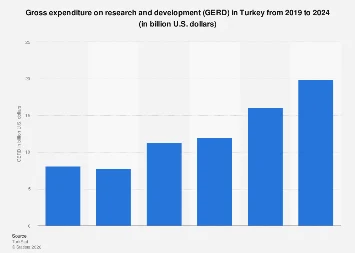
An examination of Turkey’s Gross Expenditure on Research and Development (GERD) reveals a compelling upward trajectory, underscoring the nation’s commitment to fostering innovation as a cornerstone of its economic strategy. Projections indicate that GERD will approach a significant milestone, nearing $X billion USD in 2024, a substantial increase of over $Y billion USD compared to the preceding year. This growth, occurring within a complex global economic landscape marked by inflationary pressures and currency fluctuations, highlights a deliberate and sustained investment in scientific advancement and technological development.
The figures, meticulously tracked over the period from 2019 to 2024, paint a picture of escalating commitment. While precise dollar figures for the entire period require deeper access, the trendline for 2024, showing a considerable jump from 2023, is a clear indicator of intensified focus. This expansion in R&D spending is not merely a statistical uptick; it represents a strategic imperative for Turkey, aiming to bolster its competitiveness in the global market, diversify its economy, and cultivate a knowledge-based industrial ecosystem.
The Turkish government, through various ministries and agencies, has been actively promoting R&D initiatives, offering incentives for private sector investment, and strengthening collaborations between academia and industry. These efforts are designed to translate scientific discovery into tangible economic output, driving higher value-added production and creating skilled employment opportunities. The increasing GERD can be attributed to a multi-pronged approach that includes enhanced public funding for research institutions, tax breaks and grants for companies engaged in R&D activities, and support for the development of innovation hubs and technoparks across the country.
Understanding the scale of this investment requires context. Globally, nations that prioritize R&D often experience higher rates of economic growth, improved productivity, and greater resilience to economic shocks. For instance, leading economies like South Korea, Israel, and the United States consistently allocate a significant portion of their GDP to R&D, reaping the benefits of technological leadership and innovation-driven industries. Turkey’s increasing GERD suggests an ambition to join this league of innovation-powered economies. The supplementary notes, detailing the weighted average exchange rates between the Turkish Lira (TL) and the U.S. Dollar (USD) from 2019 to 2024, are crucial for appreciating the magnitude of this investment. The depreciation of the Lira against the dollar over this period means that the nominal expenditure in Lira has likely seen an even more dramatic increase to achieve the stated dollar-denominated growth. This highlights the scale of commitment required to maintain and grow R&D expenditure in real terms, especially when denominated in a more stable international currency.
The emphasis on R&D is particularly pertinent for Turkey as it seeks to transition from a manufacturing-heavy economy to one that is more reliant on high-tech sectors, advanced services, and intellectual property. Sectors such as defense, automotive, pharmaceuticals, and information technology are often cited as key areas where increased R&D investment can yield substantial returns. By fostering a robust R&D ecosystem, Turkey aims to reduce its reliance on imported technologies, develop indigenous solutions, and become a net exporter of innovative products and services.
Furthermore, the global push towards sustainable development and digital transformation presents both challenges and opportunities for Turkey’s R&D agenda. Investments are likely being channeled into areas such as renewable energy technologies, artificial intelligence, biotechnology, and advanced materials, aligning with global trends and addressing national priorities. The growth in GERD signals a proactive approach to these evolving landscapes, positioning Turkey to capitalize on emerging markets and technological frontiers.
However, translating R&D expenditure into impactful innovation is a complex process. It requires not only financial investment but also a skilled workforce, supportive regulatory frameworks, and a culture that embraces experimentation and risk-taking. The success of Turkey’s R&D strategy will ultimately depend on its ability to nurture these complementary factors. The sustained increase in GERD suggests that the government and the private sector are recognizing this interconnectedness and working towards building a comprehensive innovation ecosystem.
Economically, a higher GERD can have a multiplier effect. Increased R&D leads to the development of new products and services, which can boost export revenues and improve trade balances. It can also lead to the creation of higher-paying jobs, fostering a more skilled and productive workforce. Moreover, a strong R&D base can attract foreign direct investment, as international companies look to tap into Turkey’s growing innovation capabilities and access its strategic geographic location. The long-term economic implications of this sustained investment are therefore significant, pointing towards a future where innovation is a primary driver of national prosperity. As Turkey continues to navigate the complexities of the global economy, its escalating commitment to research and development stands out as a critical strategic lever for achieving sustained growth and enhancing its position on the world stage.