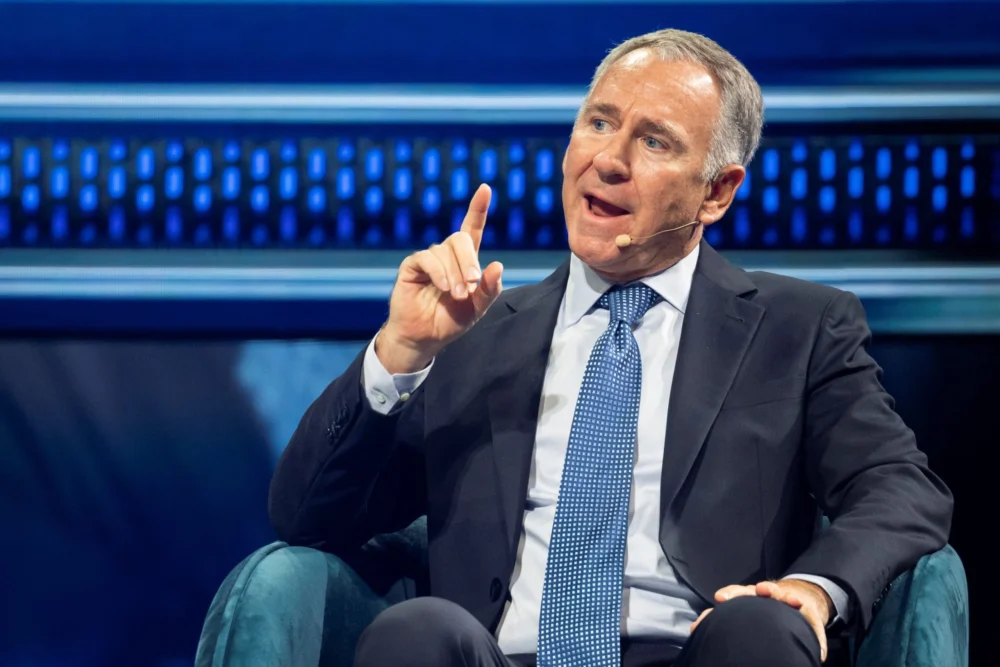
In an era where the world’s largest asset managers often equate success with the relentless pursuit of higher assets under management, Citadel is taking a contrarian path defined by surgical precision and capital discipline. The Miami-based hedge fund titan, led by founder Ken Griffin, has informed its clients of plans to return approximately $5 billion in profits following a year of robust performance across its diversified trading desks. This tactical redistribution of wealth, scheduled for the beginning of 2026, underscores a broader philosophy within the upper echelons of the "pod shop" ecosystem: that maintaining an optimal size is more critical for alpha generation than simply amassing capital.
The decision follows a year of notable gains for Citadel’s flagship Wellington fund, a multi-strategy powerhouse that has become a benchmark for the industry. Through the midpoint of late 2025, the Wellington fund posted a return of approximately 9.3%, according to sources familiar with the firm’s internal performance metrics. While this figure represents a solid outperformance in a complex global macro environment, the firm’s leadership has determined that returning a significant portion of these gains is the most prudent move to ensure future agility. By distributing $5 billion, Citadel will effectively reset its assets under management from a current peak of roughly $72 billion to approximately $67 billion as it enters the new year.
This move is not merely a gesture of goodwill toward its limited partners, which include some of the world’s most prestigious sovereign wealth funds, university endowments, and pension plans. Rather, it is a calculated effort to "right-size" the firm’s capital base against what it perceives to be the available "opportunity set" in the global markets. In the sophisticated world of multi-strategy hedge funds, there is a constant tension between the amount of capital a firm manages and its ability to deploy that capital into high-conviction trades without moving the market against itself. By capping its AUM, Citadel seeks to avoid the "diseconomies of scale" that have historically plagued large-scale investment vehicles, ensuring that its individual trading pods can continue to execute nimble, high-frequency, and idiosyncratic strategies.
The historical context of Citadel’s capital management strategy reveals a consistent pattern of returning profits to maintain performance integrity. Since 2017, including the projected $5 billion distribution for 2025, the firm has returned a staggering $32 billion to its investors. This cycle of "earn and return" has become a hallmark of the Griffin era, distinguishing Citadel from traditional mutual funds or private equity firms that often prioritize AUM-based fee structures. By returning capital, Citadel effectively resets the high-water mark and forces its investment teams to remain hungry, focusing on the quality of returns rather than the quantity of assets.
Citadel’s track record of profitability is unparalleled in the history of the hedge fund industry. According to data from LCH Investments, which tracks the net gains of the world’s most successful money managers, Citadel has been ranked as the most profitable hedge fund manager of all time since its inception in 1990. By the end of 2024, the firm had generated an estimated $83 billion in net gains for its investors over its 34-year history. With the 2025 performance factored in, that cumulative figure is expected to soar past the $88 billion mark when the next industry rankings are published in early 2026. This trajectory saw Citadel surpass Ray Dalio’s Bridgewater Associates in recent years, cementing Griffin’s firm as the preeminent force in the alternative investment landscape.

The broader economic backdrop of 2025 has provided a fertile yet volatile playground for multi-strategy firms. The year was characterized by shifting central bank policies, fluctuating inflation expectations, and significant geopolitical realignments that created massive dispersions in asset prices. For a firm like Citadel, which operates across five core investment strategies—Equities, Fixed Income and Macro, Commodities, Credit, and Quantitative Strategies—this volatility is the lifeblood of its profit model. While a long-only equity fund might struggle in a sideways market, Citadel’s ability to pivot between asset classes and utilize sophisticated hedging techniques allows it to extract profit regardless of the broader market direction.
The "pod shop" model, pioneered by firms like Citadel, Millennium Management, and Point72, has fundamentally reshaped the hedge fund industry over the last decade. In this structure, the firm is divided into dozens, sometimes hundreds, of independent investment teams (pods). Each pod is allocated a specific amount of capital and must adhere to strict risk management protocols. If a pod performs well, its capital allocation grows; if it hits a predetermined loss limit, it is liquidated. This internal Darwinism ensures that only the most effective strategies survive. However, as the total AUM of the firm grows, the pressure to find new, uncorrelated pods increases. By returning $5 billion, Citadel is signaling that it would rather remain at $67 billion with high-conviction teams than expand to $80 billion and risk diluting its talent pool.
Industry analysts note that Citadel’s capital return also serves as a powerful marketing tool in the fierce "war for talent" currently gripping Wall Street. Top-tier portfolio managers and data scientists are increasingly drawn to firms that demonstrate a commitment to performance over asset gathering. Furthermore, the firm’s "pass-through" fee structure—whereby investors cover the actual costs of running the business, including the massive compensation packages required to attract the world’s best traders—demands that the firm deliver exceptional net returns to justify the cost. By returning capital, Citadel maintains a leaner, more efficient operation that can more easily clear the high hurdles set by its sophisticated client base.
The impact of this $5 billion distribution on the wider financial ecosystem is significant. For institutional investors, receiving a multi-billion dollar cash infusion provides much-needed liquidity at a time when many private equity and venture capital distributions have slowed down. These "recycled" profits often find their way back into the market, either through reinvestment in other alternative vehicles or by bolstering the cash reserves of public pension funds. Citadel’s move could also set a precedent for other multi-strategy giants. If Millennium or Balyasny see Citadel successfully navigating the market at a slightly reduced scale, they may face pressure from their own investors to prove that their current AUM levels are truly optimal.
Looking ahead to 2026, the global economic landscape remains fraught with uncertainty. Potential shifts in trade policy, the continued integration of artificial intelligence into financial modeling, and the long-term effects of higher interest rates suggest that the "opportunity set" Griffin referred to will require even more specialized expertise. Citadel’s decision to enter this environment with $67 billion instead of $72 billion suggests a focus on quality over quantity. The firm is betting that a more concentrated, highly capitalized, and agile version of itself will be better equipped to navigate the "known unknowns" of the coming year.
As the rankings from LCH Investments are updated in January, the financial world will likely witness Citadel extending its lead as the most successful wealth-creation machine in the history of hedge funds. While the $5 billion return may seem like a reduction in the firm’s footprint, it is, in reality, a reinforcement of its foundations. Ken Griffin has built an institution that values the integrity of the trade above the size of the fund, a philosophy that has consistently paid dividends—quite literally—to those who have trusted Citadel with their capital. In the high-stakes game of global finance, Citadel has proven once again that sometimes, the best way to move forward is to give back.