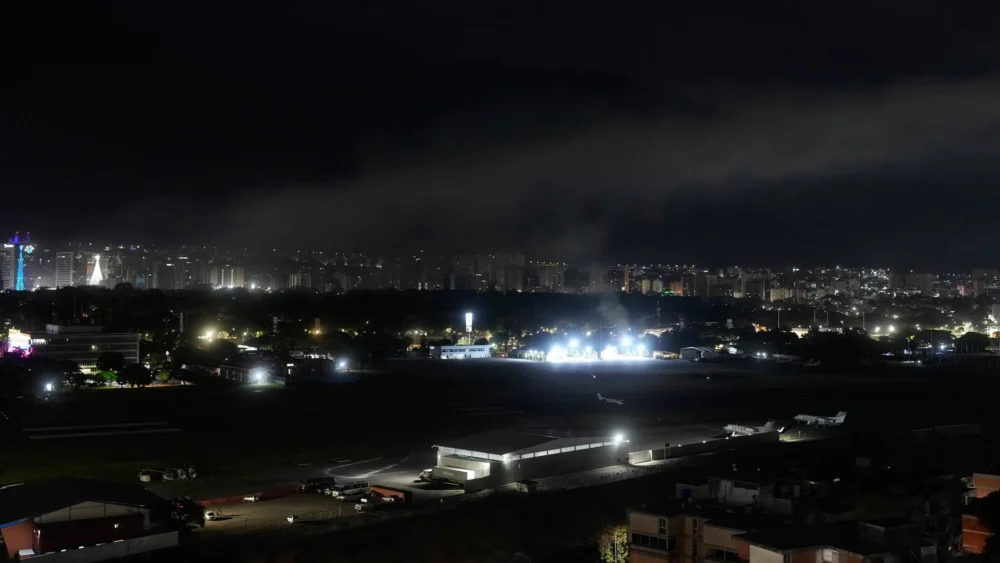
The pre-dawn stillness of Caracas was shattered this week by a series of explosions that have sent shockwaves through Venezuela’s political and economic landscape. While the government of Nicolás Maduro has been quick to label the incidents as acts of "terrorism" orchestrated by foreign interests and domestic "fascists," the blasts underscore a volatile new chapter in the country’s protracted crisis. For investors, regional neighbors, and the Venezuelan populace, these events represent more than just a security breach; they are a stark reminder of the fragile state of a nation caught between authoritarian entrenchment and a desperate push for democratic transition.
The explosions, which reportedly targeted infrastructure and areas near government installations, occur against a backdrop of extreme political friction following the contested presidential election of July 28. Since the National Electoral Council declared Maduro the winner without providing transparent, precinct-level data, the country has been on a knife-edge. The opposition, led by María Corina Machado and candidate Edmundo González Urrutia—who has since fled to Spain—claims a landslide victory based on over 80% of the tally sheets they managed to collect. The resulting stalemate has paralyzed the nation’s hopes for a negotiated exit from its decade-long economic collapse.
From an economic perspective, the timing of this renewed violence could not be more precarious. After years of hyperinflation and a contraction that saw the Gross Domestic Product (GDP) shrink by nearly 80% between 2013 and 2021, the Venezuelan economy had shown modest signs of stabilization. This "fragile recovery" was largely driven by a de facto dollarization and the easing of some U.S. energy sanctions, which allowed Western companies like Chevron to resume limited operations. However, the specter of urban violence threatens to undo these marginal gains. Capital flight, which had slowed in 2023, is expected to accelerate as the risk profile for doing business in Caracas spikes.
Market analysts suggest that the "Venezuela risk" is now being recalibrated by international bondholders. Despite the country being in default on approximately $60 billion in sovereign and PDVSA (the state oil company) debt, there had been a surge in secondary market trading earlier this year on hopes of a "normalization" of relations with the West. Those hopes are now dimming. The explosions in the capital serve as a physical manifestation of the political "dead end" that many feared. If the Maduro administration responds with a further tightening of the "Operación Tun Tun"—a state-sponsored crackdown involving the door-to-door arrest of dissidents—the likelihood of the U.S. Treasury Department re-imposing sweeping sectoral sanctions increases significantly.
The energy sector remains the primary barometer for Venezuela’s economic health and its primary link to the global economy. Currently, Venezuela produces roughly 850,000 to 900,000 barrels of oil per day (bpd), a far cry from the 3 million bpd it produced at the turn of the century, but a notable increase from the lows of 2020. Any disruption to the oil infrastructure or the logistical chains in and around the capital could jeopardize this output. Global energy markets, already sensitive to tensions in the Middle East, view Venezuela as a potential "swing" supplier that could help stabilize prices if political stability were achieved. Instead, the current instability ensures that Venezuela remains a wildcard, capable of exacerbating supply uncertainties rather than mitigating them.
Furthermore, the social implications of the recent explosions are profound. Venezuela is already grappling with one of the world’s largest displacement crises, with over 7.7 million people having fled the country due to poverty, hunger, and repression. Security experts warn that a transition from peaceful protest to clandestine urban insurgency could trigger a fresh wave of migration. For neighboring countries like Colombia and Brazil, another mass exodus would strain public services and create significant domestic political pressure. The Brazilian government, under President Luiz Inácio Lula da Silva, has attempted to act as a mediator, but the lack of transparency from Caracas and the rise in localized violence have made such diplomatic efforts increasingly untenable.
The internal dynamics of the Maduro administration also come into focus following such incidents. In authoritarian regimes, explosions in the capital often prompt internal purges or a consolidation of power within the military and intelligence services. The Venezuelan military, which controls large swaths of the economy—including mining and food distribution—remains the ultimate arbiter of Maduro’s survival. If the explosions are perceived as a failure of the intelligence services (SEBIN) or the military’s ability to maintain order, it could lead to friction between different factions of the "Chavista" elite. Conversely, the government may use the incidents to justify a "state of exception," further curtailing civil liberties and shuttering the remaining independent media outlets.
Comparing Venezuela’s current state to other petrostates facing legitimacy crises, such as Iran or Russia, reveals a unique set of challenges. Unlike Russia, Venezuela does not possess a diversified industrial base to withstand total isolation; it remains a mono-export economy. Unlike Iran, its ruling ideology is less about religious fervor and more about a complex patronage network fueled by resource extraction. When that extraction is threatened by physical insecurity in the capital, the entire "system" of governance is put at risk.
The international community’s response to the Caracas blasts has been one of guarded concern. Washington has reiterated its call for a return to the "spirit of the Barbados Agreement," which outlined a roadmap for competitive elections. However, with the opposition leadership in exile or hiding and the government doubling down on its "iron fist" policy, the diplomatic path forward is obscured by smoke and rhetoric. The European Union and the Organization of American States (OAS) have expressed fears that the country is sliding toward a state of "permanent low-level conflict," where sporadic violence becomes the new normal in a society that has already lost its institutional guardrails.
For the average citizen in Caracas, the explosions are a terrifying addition to the daily struggle for survival. While the "luxury bubble" of Las Mercedes—an upscale neighborhood where high-end restaurants and boutiques cater to the elite—continues to operate, the majority of the city faces crumbling infrastructure, frequent power outages, and now, the threat of sudden violence. The psychological impact of the blasts cannot be overstated; they signal that the relative peace of the last two years was a veneer, easily stripped away by the unresolved grievances of a divided nation.
As the dust settles from the latest incidents, the focus turns to the coming months. If the Maduro government chooses to use these explosions as a pretext for a total crackdown, it may achieve short-term control at the cost of long-term viability. Without political legitimacy, the foreign investment required to repair the oil industry and the power grid will remain out of reach. Venezuela stands at a crossroads: it can either find a way back to the negotiating table to address the electoral dispute, or it can descend further into a cycle of repression and resistance that will leave its economy in ruins and its people in perpetual flight.
In the final analysis, the explosions in Caracas are a symptom of a much deeper malaise. They represent the failure of a political system to provide a peaceful mechanism for change and the failure of an economic system to provide for its people. As long as the "sovereignty of the ballot box" remains in question, the sovereignty of the streets will likely be contested with increasingly violent means. For the global community, the message is clear: the Venezuelan crisis is far from over, and its capacity to export instability remains as potent as its vast, untapped reserves of crude oil. The world is watching, but for those on the ground in Caracas, the sound of the blasts is a reminder that time is running out for a peaceful resolution.