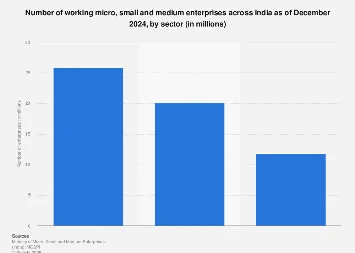
The intricate tapestry of India’s economic landscape is woven, in large part, by its vast and dynamic Micro, Small, and Medium Enterprises (MSMEs). These enterprises, often the backbone of local economies and crucial engines of employment, are not uniformly distributed across the nation’s diverse industrial sectors. Understanding their sectoral concentration is paramount to grasping their full impact, identifying growth opportunities, and formulating effective policy interventions. While precise, up-to-the-minute granular data for commercial use often requires specialized access, the general trends and their implications paint a clear picture of a sector vital to India’s developmental aspirations.
The MSME sector in India, a critical contributor to the nation’s Gross Domestic Product (GDP) and a significant source of employment, encompasses a staggering number of entities. These businesses, ranging from small workshops and local service providers to burgeoning manufacturing units, represent a significant portion of the total industrial output. Their sheer volume and diversity make them a compelling subject for economic analysis, particularly when examining their distribution across different industrial verticals. This distribution is not static; it evolves in response to market dynamics, technological advancements, government initiatives, and global economic shifts.
Manufacturing remains a cornerstone for MSME activity in India. Within this broad category, sub-sectors such as textiles and apparel, food processing, basic metal industries, machinery and equipment, and fabricated metal products typically host a substantial number of these smaller enterprises. The textile industry, for instance, has a long-standing tradition of small-scale production, from spinning and weaving to garment manufacturing, often leveraging local craftsmanship and raw materials. Similarly, the food processing sector benefits from India’s rich agricultural base, with numerous MSMEs involved in value addition, packaging, and distribution of various food products. The demand for both domestic consumption and export markets fuels continuous growth and diversification within these manufacturing segments.
The service sector, however, has emerged as an equally, if not more, significant arena for MSME proliferation. This segment is incredibly broad, encompassing a wide array of activities from retail trade and wholesale distribution to transportation, logistics, and business services. The rise of the digital economy and the increasing demand for specialized services have further expanded opportunities for MSMEs in areas like information technology (IT) and IT-enabled services (ITES), consulting, marketing, and creative industries. The relative ease of entry, lower capital requirements for many service-based ventures, and the growing consumer and business demand have made this sector a fertile ground for entrepreneurial activity.
The retail and wholesale trade sector, in particular, is overwhelmingly dominated by MSMEs. Local kirana stores, small retail outlets, and regional distributors form the capillaries of India’s vast distribution network, ensuring goods reach even the most remote corners of the country. Their agility and deep understanding of local consumer preferences often give them a competitive edge over larger, more centralized operations.
Beyond manufacturing and services, the construction sector also provides a significant platform for MSMEs. From small-scale builders and contractors to suppliers of construction materials, these enterprises play a crucial role in the development of infrastructure and housing across the nation. The government’s focus on affordable housing and infrastructure development projects directly benefits this segment of the MSME ecosystem.
Understanding the sectoral distribution also provides insights into the economic contribution of MSMEs. While individual MSMEs might have a smaller economic footprint than large corporations, their collective impact is profound. They contribute significantly to job creation, often employing a larger proportion of the workforce per unit of capital invested compared to large industries. They also foster innovation and entrepreneurship at the grassroots level, acting as incubators for new ideas and business models. Furthermore, MSMEs are crucial for reducing regional disparities by establishing businesses in less developed areas, thereby creating local employment and economic activity.
Globally, the phenomenon of small and medium enterprises forming the bedrock of national economies is a recurring theme. In countries like Germany, the "Mittelstand" – a robust network of highly specialized and export-oriented SMEs – is credited with much of the nation’s manufacturing prowess and economic stability. Similarly, in countries like South Korea and Taiwan, SMEs have been instrumental in driving export-led growth and technological advancement. India’s journey with its MSMEs mirrors these global trends, albeit with unique cultural and socio-economic contexts.
The challenges faced by Indian MSMEs are also often sector-specific, although common threads exist. Access to credit remains a perennial issue, with many small businesses struggling to secure adequate financing from formal banking channels. Technological adoption can be slow in certain traditional sectors, impacting productivity and competitiveness. Navigating complex regulatory environments and ensuring compliance can also be burdensome. However, the Indian government has recognized the pivotal role of MSMEs and has implemented various schemes and policies aimed at addressing these challenges, including credit guarantee schemes, skill development programs, and initiatives to promote digital adoption and export facilitation.
The implications of MSME sector dynamics extend to foreign direct investment (FDI) and international trade. As MSMEs grow and become more competitive, they can become attractive partners for foreign investors seeking access to the Indian market or looking to leverage Indian manufacturing capabilities. Furthermore, a robust MSME sector can boost India’s export potential across a wider range of products and services, diversifying its trade basket and enhancing its global economic standing.
In conclusion, while precise numerical breakdowns of MSMEs by sector require detailed statistical databases, the overarching narrative is one of immense diversity and critical economic importance. Manufacturing, services (especially retail, wholesale, and IT/ITES), and construction represent key areas of concentration. The continued growth and development of MSMEs across these sectors are not merely an economic objective but a strategic imperative for India’s journey towards becoming a developed economy, fostering inclusive growth, and creating widespread opportunities for its citizens.