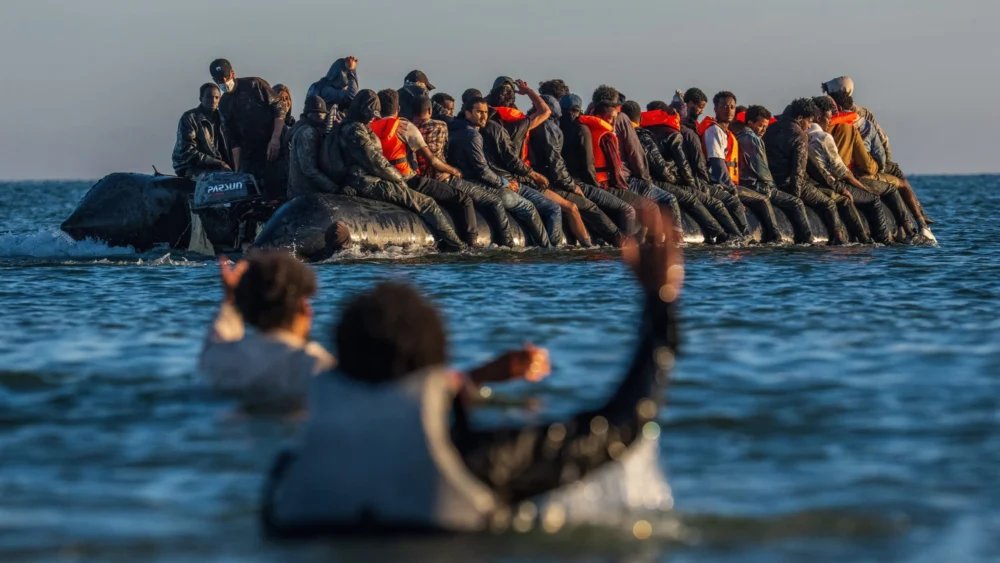
The English Channel, one of the world’s busiest and most treacherous shipping lanes, has witnessed a significant intensification of irregular migration activity throughout 2025, with official data revealing that 41,000 individuals reached British shores via small boats. This figure represents a 13 percent increase compared to the previous year, underscoring the persistent challenges facing border enforcement agencies and the complex geopolitical and economic factors driving displacement across Europe. Despite a series of high-profile legislative attempts to curb these crossings, the upward trajectory of arrivals suggests that the clandestine maritime route from northern France remains a primary conduit for those seeking asylum or economic opportunity in the United Kingdom.
This 13 percent jump in arrivals comes at a critical juncture for British domestic policy, where the management of irregular migration has evolved from a matter of border security into a central pillar of fiscal and social debate. The logistics of the 2025 surge indicate a more sophisticated operational model employed by human smuggling syndicates. These criminal networks have demonstrated an ability to adapt to increased surveillance by utilizing larger, more durable inflatable vessels and diversifying launch points along the French coastline. Analysts suggest that the industrialization of the smuggling trade has lowered the "per-head" cost for some migrants while simultaneously increasing the danger, as boats are frequently overcrowded far beyond their structural capacity.
From an economic perspective, the continued rise in arrivals exerts substantial pressure on the UK’s public finances, specifically within the Home Office budget. The fiscal implications are twofold: the immediate costs of humanitarian processing and temporary accommodation, and the long-term administrative burden of an asylum system already strained by a significant backlog. In 2025, the daily expenditure on hotel accommodation for asylum seekers remained a point of intense political contention, with some estimates suggesting the cost exceeds £7 million per day. This "emergency" spending represents a significant opportunity cost, diverting funds that might otherwise be allocated to infrastructure, healthcare, or integrated border technology.
The economic impact is not limited to government outlays; it also permeates the broader labor market and the "shadow economy." While many arrivals eventually seek legal status to enter the workforce, the protracted nature of the asylum process often leaves thousands in a state of legal limbo. Economists note that this creates a pool of vulnerable labor that can be exploited by the informal sector, potentially depressing wages in low-skilled industries and complicating the government’s efforts to regulate the labor market. Conversely, proponents of more flexible migration policies argue that, given the UK’s aging demographic and acute labor shortages in sectors like construction and social care, a more streamlined process for integrating these arrivals could provide a necessary boost to the nation’s Gross Domestic Product (GDP).
The 2025 data also reflects broader global trends in forced displacement and economic migration. The 41,000 individuals who crossed the Channel are part of a larger movement of people fleeing protracted conflicts in the Middle East, instability in the Horn of Africa, and the worsening economic conditions in parts of South Asia. When compared to the Mediterranean routes—where arrivals into Italy, Greece, and Spain often reach hundreds of thousands annually—the UK’s figures remain relatively modest in volume but outsized in political sensitivity. The "pull factors" often cited by migration experts include the UK’s English-speaking environment, existing diaspora communities, and a perceived flexibility in the labor market compared to more rigid continental European economies.
Technological advancements have played a dual role in the 2025 migration landscape. On one hand, the UK and French governments have increased their investment in sophisticated surveillance, including long-range thermal imaging, aerial drones, and AI-driven movement detection along the beaches of Normandy and Calais. On the other hand, smuggling networks have leveraged encrypted communication platforms and GPS technology to coordinate departures and evade patrols. This technological "arms race" has not only increased the cost of border policing but has also forced migrants into more dangerous, nocturnal crossings to avoid detection, contributing to a tragic increase in maritime fatalities throughout the year.
The political fallout from the 13 percent increase has been felt across the European Union. The 2025 figures have intensified the dialogue between London and Paris regarding the "Le Touquet" treaty and the shared responsibility for border management. While the UK has committed hundreds of millions of pounds in financial support to French law enforcement to bolster beach patrols, the sheer volume of arrivals suggests that a purely securitized approach has its limitations. Diplomatic friction remains over the "returns" policy, as the UK seeks a formal agreement with the EU to return migrants to the first safe country they entered—a proposal that has met with significant resistance from Brussels and individual member states.
Furthermore, the surge has sparked a renewed debate over the "business model" of human smuggling. Experts in transnational organized crime argue that as long as the demand for passage exists and legal routes remain restricted, the profit margins for smugglers will remain high enough to offset the risks of prosecution. In 2025, the estimated revenue for smuggling rings operating across the Channel was projected to be in the tens of millions of euros. This capital is often reinvested into other forms of illicit trade, creating a feedback loop that undermines regional security and rule of law.
Socially, the increase in arrivals to 41,000 has tested the capacity of local authorities in coastal regions, particularly in Kent and the southeast of England. The infrastructure required to process, house, and provide medical care for thousands of individuals—many of whom arrive with significant trauma or health issues—is immense. This has led to localized tensions regarding the allocation of resources, as communities grapple with the visible reality of a global migration crisis on their doorstep. However, there has also been a surge in civil society engagement, with numerous non-governmental organizations (NGOs) and community groups advocating for more humane treatment and faster processing times to allow individuals to move out of state-funded accommodation and into independent living.
Looking ahead to 2026, the 13 percent rise in 2025 serves as a barometer for the efficacy of international cooperation. Economists suggest that without a comprehensive strategy that addresses the "root causes" of migration—such as regional economic disparities and climate-induced displacement—the numbers are unlikely to see a sustained decline. There is a growing consensus among policy analysts that a multi-pronged approach is required: combining rigorous enforcement against criminal syndicates with the creation of more viable legal pathways for refugees.
In summary, the arrival of 41,000 migrants via small boats in 2025 is more than just a statistical increase; it is a reflection of the profound shifts in global mobility and the limitations of national borders in an interconnected world. The 13 percent growth highlights the resilience of migration flows in the face of restrictive policies and the significant fiscal and social challenges that the UK must navigate. As the government continues to refine its strategy, the focus remains on balancing the imperatives of national security and fiscal responsibility with the legal and moral obligations inherent in international humanitarian law. The economic data from 2025 suggests that the "Channel crisis" is not a temporary anomaly but a permanent feature of the modern geopolitical landscape, requiring long-term structural solutions rather than short-term political fixes.