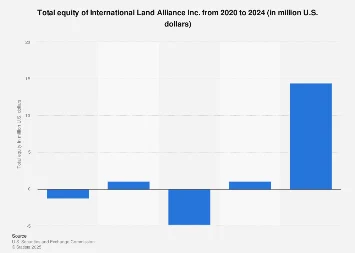
The trajectory of International Land Alliance Inc.’s total equity in 2024 is a focal point for investors and market analysts seeking to understand the company’s financial health and strategic positioning within the global real estate and land development sector. While specific, real-time equity figures are often proprietary and subject to dynamic market fluctuations, the broader economic environment and industry trends provide crucial context for assessing the company’s performance. Global economic indicators, such as inflation rates, interest rate policies by major central banks, and geopolitical stability, significantly influence the valuation of real estate assets and, consequently, the equity held by development firms like International Land Alliance Inc.
The real estate market, a cornerstone of economic activity, is currently characterized by a complex interplay of factors. In many developed economies, a period of sustained low interest rates, which historically fueled property market booms, is giving way to a more cautious monetary policy environment. Central banks, grappling with inflationary pressures, have been implementing interest rate hikes, leading to increased borrowing costs for both developers and potential buyers. This shift can impact demand, transaction volumes, and ultimately, the market value of land and properties. For International Land Alliance Inc., this means that the carrying value of its land holdings and the profitability of ongoing development projects are subject to these macroeconomic headwinds.
Furthermore, the availability and cost of capital are critical determinants of equity growth for land development companies. Access to credit lines, the attractiveness of equity financing, and the overall investor sentiment towards the real estate sector all play a role. In a rising interest rate environment, the cost of debt financing increases, potentially squeezing profit margins. Simultaneously, investors may demand higher returns to compensate for increased risk, making equity capital more expensive. Companies with strong balance sheets, diversified revenue streams, and a proven track record of successful project execution are better positioned to navigate these challenges and maintain or grow their equity base.
The specific segment of the market in which International Land Alliance Inc. operates also dictates its equity performance. If the company focuses on residential development, it will be sensitive to housing affordability, demographic trends, and migration patterns. For instance, regions experiencing population growth and strong employment markets often see sustained demand for housing, supporting land values. Conversely, areas with declining populations or economic stagnation may present greater challenges. Similarly, if the company is involved in commercial or industrial land development, its equity will be influenced by business expansion trends, e-commerce growth (impacting warehousing needs), and the performance of specific retail or office sectors.
Data from market research firms and financial institutions often provides insights into the broader trends affecting real estate equity. For example, reports from organizations like the National Association of Realtors (NAR) in the U.S., or the Royal Institution of Chartered Surveyors (RICS) globally, track property price indices, transaction volumes, and developer sentiment. While these aggregate statistics may not directly reflect International Land Alliance Inc.’s specific equity, they serve as important benchmarks. The average growth or contraction in land values across relevant markets can be extrapolated to infer potential impacts on the company’s asset valuations.
The concept of "total equity" encompasses the company’s assets minus its liabilities. For a land development company, a significant portion of its assets would typically be comprised of land inventory, work-in-progress for ongoing projects, and completed properties held for sale or lease. Liabilities would include construction loans, mortgages, and other forms of debt. Therefore, any increase in the market value of its land holdings, successful sales of developed properties at a profit, or strategic acquisitions of undervalued land would contribute positively to its total equity. Conversely, cost overruns on projects, slower-than-expected sales, or a decline in land values would negatively impact equity.
Expert commentary from real estate economists and financial analysts often highlights key drivers of land value appreciation. These include infrastructure development (new roads, public transport), zoning changes that permit higher-density or more profitable uses, and the long-term economic growth prospects of a particular region. International Land Alliance Inc.’s strategic land acquisition and development decisions, therefore, are crucial to its equity performance. Investing in areas with favorable future growth potential, even if current valuations are lower, can lead to substantial equity gains over time.
In the current global economic climate, several factors demand close attention for companies like International Land Alliance Inc. The ongoing transition towards more sustainable development practices and increasing demand for green building certifications can also influence land values and development costs. Companies that proactively integrate ESG (Environmental, Social, and Governance) principles into their projects may attract a broader investor base and command premium prices for their properties. This can translate into higher profitability and, consequently, an enhancement of total equity.
Geographical diversification can also be a key strategy for mitigating risk and fostering equity growth. By operating in multiple markets, International Land Alliance Inc. can buffer the impact of localized economic downturns or regulatory changes. For instance, if one market experiences a slowdown, positive performance in another region could help offset those losses, leading to more stable and predictable equity growth. Global comparisons of real estate market performance, considering factors like GDP growth, population demographics, and foreign investment trends, can inform such diversification strategies.
The valuation of land, a primary asset for International Land Alliance Inc., is often based on its highest and best use, taking into account zoning regulations, market demand, and potential development yields. Analysts will scrutinize the company’s land bank, assessing its size, location, development potential, and the carrying costs associated with holding these assets. Efficient land management, including timely development and sale, is paramount to converting land inventory into realized equity.
Ultimately, the total equity of International Land Alliance Inc. in 2024 will be a reflection of its operational efficiency, strategic acumen in land acquisition and development, and its ability to adapt to a dynamic global economic and real estate landscape. While precise figures require direct financial reporting, understanding the prevailing market conditions, economic influences, and industry-specific trends provides a robust framework for analyzing the company’s financial standing and future prospects. The company’s success in navigating rising interest rates, potential shifts in consumer demand, and the increasing importance of sustainable development will be critical determinants of its equity performance in the coming year.