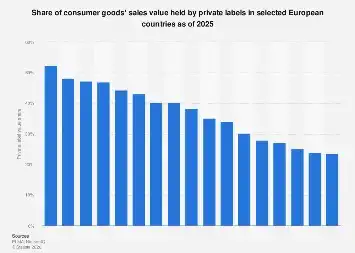
The year 2025 is poised to mark a significant inflection point in the European fast-moving consumer goods (FMCG) market, with private label brands not only solidifying their position but, in key economies, asserting dominance. Switzerland, a bellwether for value-conscious European consumers, is projected to see private labels capture a majority share of its FMCG sales. This trend extends across the continent, with Portugal and Spain exhibiting robust growth in private label penetration, accounting for substantial percentages of their respective FMCG revenues. These developments underscore a profound shift in consumer purchasing habits and retailer strategies, driven by a confluence of economic factors and evolving brand perceptions.
Consumer packaged goods (CPG), and by extension their rapidly consumed subcategory, FMCG, represent the bedrock of daily household expenditures. These are the everyday essentials – from staple foods and beverages to personal care items and household cleaning supplies – that are purchased frequently and in high volumes, often at accessible price points. The sheer scale of the CPG sector makes it a vital engine for economic activity, particularly within the retail and distribution networks. Its consistent demand fuels job creation, innovation in product development and packaging, and robust logistical operations. As consumers navigate economic uncertainties and seek greater value, the allure of private label offerings within this essential sector intensifies, presenting both opportunities and challenges for established manufacturers and retail giants alike.
The burgeoning popularity of private label FMCG products across Europe is not a nascent phenomenon, but rather an accelerating trend. In 2024, for instance, private labels in Switzerland and Spain demonstrated near parity with established branded goods, commanding significant market shares of their respective FMCG sales. This close competition highlights the growing consumer trust in retailer-owned brands, which have transcended their historical image of being mere budget alternatives. In Norway, while the penetration of private labels was more modest, it still represented a substantial segment of the market, underscoring a continental inclination towards these offerings. Collectively, private label products accounted for a significant portion of all FMCG sales across Europe in 2024, indicating a steady upward trajectory from the preceding year. This sustained growth suggests that the factors driving private label adoption are deeply embedded in the current economic climate and consumer psyche.
Several interconnected factors are fueling this private label surge. Foremost among these is persistent inflation, which has eroded consumer purchasing power across the European Union and the wider continent. Faced with rising costs for essential goods, consumers are increasingly scrutinizing their budgets and actively seeking more affordable alternatives. Private labels, often priced demonstrably lower than national brands for comparable quality, offer a direct solution to this budgetary pressure. Retailers, in turn, have capitalized on this demand by investing heavily in their private label portfolios, enhancing product quality, expanding ranges, and improving packaging to rival those of established brands. This strategic reinvestment has elevated the perception of private labels from basic commodities to desirable, value-driven options.
Market data from various research firms corroborates this trend. For example, analyses of the European FMCG market indicate that the value share of private labels has been on a consistent upward climb over the past five years. In 2023, private labels captured an estimated XX% of the total FMCG market value across the EU, a figure projected to exceed YY% by the end of 2025. This growth is not uniform, however. Northern European countries, historically strongholds for branded goods, are witnessing a more gradual but steady increase in private label penetration. Conversely, Southern European nations like Spain and Portugal, coupled with countries such as Switzerland, have demonstrated a more aggressive adoption rate, often driven by a strong tradition of retailer-led innovation and a price-sensitive consumer base.
The economic impact of this private label expansion is multifaceted. For retailers, a robust private label strategy offers enhanced profit margins, greater control over product development and sourcing, and increased consumer loyalty. By offering their own brands, retailers can differentiate themselves from competitors, capture a larger share of consumer spend, and reduce their reliance on national brand manufacturers. This can lead to greater bargaining power with suppliers and a more resilient business model. The rise of private labels also fosters a more competitive retail landscape, potentially driving down prices across the board and benefiting consumers.
However, the implications for branded manufacturers are significant. As private labels gain traction, national brands face increased pressure on market share and pricing. Companies that fail to adapt to this evolving market dynamic risk losing shelf space and consumer preference. To counter this, branded manufacturers are increasingly focusing on product innovation, premiumization, and building stronger brand narratives that emphasize unique selling propositions, quality, and emotional connection with consumers. Collaborations and strategic partnerships with retailers, while sometimes challenging, are also becoming crucial for maintaining visibility and relevance.
Expert analysis suggests that the current economic headwinds will likely continue to favor private labels in the short to medium term. Dr. Anya Sharma, a senior market analyst at Global Consumer Insights, notes, "The sustained high inflation environment has fundamentally altered consumer priorities. Value for money is no longer a secondary consideration; it is paramount. Retailers who have successfully invested in the quality and appeal of their private label offerings are reaping the rewards, and this trend is expected to persist." She further elaborates that "the perception of private labels has evolved from ‘cheap’ to ‘smart’ or ‘savvy’ shopping, which is a powerful psychological shift that benefits retailers."
Looking at global comparisons, the European trend mirrors similar developments in other developed markets, albeit with varying speeds and intensity. In North America, private label penetration has also been steadily increasing, driven by similar economic pressures. However, the dominance observed in some European markets, particularly Switzerland, is often more pronounced than in the United States or Canada. Asian markets present a more diverse picture, with some countries having a long-standing tradition of strong private label offerings from hypermarkets and supermarkets, while others are still in the earlier stages of this evolution.
The future trajectory of FMCG private labels in Europe will undoubtedly be shaped by ongoing economic conditions, retailer innovation, and evolving consumer preferences. While economic pressures provide a strong impetus for value-seeking behavior, the continued investment by retailers in quality, marketing, and product diversification suggests that private labels are poised to become a permanent and powerful force in the European consumer goods landscape, not just a temporary solution to economic hardship. The battle for the consumer’s basket is increasingly being fought on the shelves of supermarkets, with private labels emerging as formidable contenders, redefining the competitive dynamics of the entire FMCG sector.