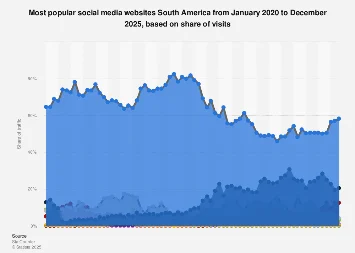
As the digital landscape of South America solidifies its position as a crucial market for global technology giants, Meta Platforms continued to demonstrate significant influence over user engagement in 2025. Data for December 2025 indicates that Facebook maintained its leading position, commanding a substantial portion of the market share among the continent’s most frequented social media platforms. This enduring dominance, however, is set against a backdrop of nuanced shifts in user preference, particularly evident in the performance of its sister platform, Instagram.
While precise figures remain proprietary and accessible through premium subscriptions, market analysis consistently points to Facebook as the primary social media destination across South America. Its broad appeal, catering to diverse demographics and a wide array of communication needs, from personal connections to community engagement and news consumption, has cemented its status. This platform’s ability to adapt and integrate new features, such as evolving marketplace functionalities and enhanced group features, has likely contributed to its sustained traction in a region characterized by rapid digital adoption.
Following closely behind, Instagram, also under the Meta umbrella, held the second-largest share of user visits. This visually driven platform has carved out a significant niche, particularly among younger demographics and for content creators, brands, and influencers seeking to leverage visual storytelling and e-commerce integration. The platform’s emphasis on ephemeral content through Stories and Reels has resonated strongly, providing a dynamic and engaging user experience that complements the more traditional feed-based interactions offered by Facebook.
However, the year-over-year comparison for December 2025 reveals a dynamic interplay between these two giants. Facebook’s market share experienced a notable increase compared to the previous year, suggesting a consolidation of its user base or an influx of new users. This growth, even if incremental, underscores its robust presence and continued relevance in the South American digital ecosystem.
Conversely, Instagram witnessed a decline in its share of total visits. While still a formidable player, this shift suggests a potential recalibration of user habits or increased competition from other platforms vying for visual content consumption. The digital environment is perpetually evolving, and user attention is a finite resource. Factors such as the rise of short-form video content on competing platforms, evolving content trends, or shifts in algorithmic delivery could all contribute to such a performance.
Beyond the Meta ecosystem, the South American social media landscape is a mosaic of diverse platforms, each catering to specific interests and user segments. While the provided data focuses on leading platforms, an examination of the broader market reveals the presence and influence of others. YouTube, for instance, remains a dominant force for video content consumption, education, entertainment, and music across the continent. Its role as a search engine for video-based information and its vast library of user-generated and professionally produced content make it indispensable for a significant portion of the South American internet population.
Pinterest, a platform centered around visual discovery and inspiration, likely holds a steady position, particularly among users interested in lifestyle, home decor, fashion, and DIY content. Its appeal lies in its aspirational nature and its utility for planning and ideation.
Twitter, now X, continues to serve as a critical platform for real-time news, discussions, and public discourse, particularly in urban centers and among those interested in current events, politics, and professional networking. Its role as a public square for immediate reactions and information dissemination remains significant, even as its user base might be more niche compared to broader social networks.
Platforms like Tumblr and Reddit, while potentially having smaller overall market shares in South America, cater to highly engaged communities with specific interests. Tumblr, with its focus on creative expression and subcultures, and Reddit, with its vast array of topic-specific forums (subreddits), represent important hubs for niche content and community building.
LinkedIn, the professional networking platform, plays a crucial role in career development, business connections, and industry insights across South America. As economies grow and professional opportunities expand, its importance in facilitating career advancement and corporate engagement is undeniable.
The "Other" category in market share analysis is often a significant indicator of emerging trends and the fragmentation of the digital space. This segment could encompass a wide range of platforms, including messaging apps with social features (like WhatsApp, which is ubiquitous in South America for communication but also hosts status updates and group functionalities), newer social networks, or platforms with specific regional appeal. The growth of this "Other" category often signals innovation and the constant flux of user preferences, where new entrants can challenge established players.
The economic implications of this social media dominance are profound. For businesses operating in South America, understanding these market shares is paramount for effective digital marketing strategies. The ability to reach targeted demographics on platforms like Facebook and Instagram offers unparalleled opportunities for brand building, customer engagement, and e-commerce. Advertising revenue generated by these platforms forms a significant portion of their global income, and South America represents a growing and dynamic market for digital advertising spend.
Furthermore, the rise of social commerce, facilitated by integrated shopping features on platforms like Instagram and Facebook, is transforming retail landscapes across the continent. Businesses can now directly connect with consumers, showcase products, and process transactions within the social media environment, streamlining the purchasing journey and boosting sales.
The data also highlights the ongoing evolution of digital media consumption. While Meta’s platforms have historically led, the subtle shift in Instagram’s share suggests that user engagement patterns are not static. This necessitates continuous analysis and adaptation by both platforms and businesses. For instance, the sustained growth of Facebook might indicate a strong performance in feature development or a successful strategy in retaining older demographics, while Instagram’s slight dip could prompt a strategic review of its content offerings, user interface, or advertising models to counter competitive pressures.
The broader economic impact extends to the creator economy. Influencers, content creators, and small businesses rely heavily on these platforms for their livelihoods. Fluctuations in market share and user engagement directly affect their reach, monetization potential, and overall business sustainability. A robust performance by Facebook and Instagram ensures continued opportunities for these digital entrepreneurs.
Globally, South America’s social media market is a critical component of the digital economy. Its significant population and increasing internet penetration make it a key growth region for social media companies. The trends observed in South America often mirror or precede shifts in other emerging markets, providing valuable insights into global digital consumer behavior. As the region continues to embrace digital technologies, the interplay between established giants and emerging platforms will undoubtedly shape the future of online communication and commerce for years to come.