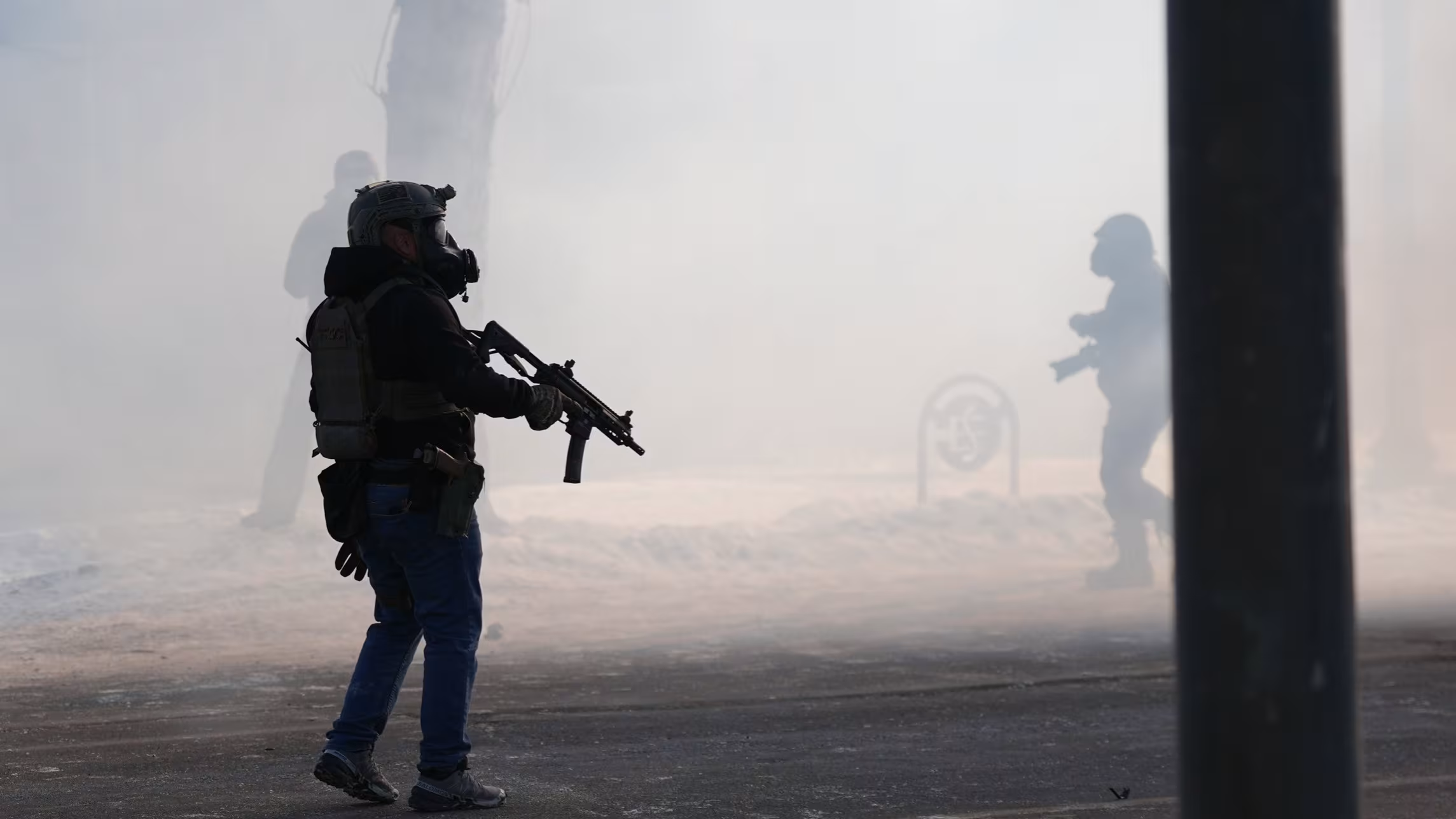
The recent fatal encounter involving federal agents in Minneapolis has once again thrust the metropolitan area into the epicenter of a national dialogue regarding law enforcement oversight, public safety, and the fragile economic stability of American urban centers. While the specific details of the confrontation continue to emerge through official channels, the incident serves as a stark reminder of the persistent tensions that have defined the Twin Cities’ social and political landscape for the better part of a decade. Beyond the immediate tragedy, the event carries significant weight for the region’s fiscal health, corporate environment, and the broader debate over the role of federal task forces in local jurisdictions.
Minneapolis, a city that contributes significantly to the 16th largest metropolitan economy in the United States, has become a case study in the intersection of civil rights and economic resilience. Since 2020, the city has grappled with the dual challenges of navigating a global pandemic and managing the fallout from high-profile police-involved deaths. This latest incident, involving federal personnel rather than local municipal officers, introduces a complex layer of legal and economic variables. Federal task forces, often comprised of members from the U.S. Marshals Service, the FBI, or the DEA, operate under different jurisdictional rules and oversight mechanisms than local police departments, a factor that frequently complicates transparency and public trust.
From a macroeconomic perspective, the stability of a city’s law enforcement environment is inextricably linked to its ability to attract and retain capital. The Minneapolis-St. Paul region is home to a high concentration of Fortune 500 companies, including Target, UnitedHealth Group, Best Buy, and 3M. For these corporate giants, the social climate of their headquarters’ city is a matter of strategic importance. Prolonged periods of unrest or the perception of systemic instability can influence long-term decisions regarding office footprints, employee recruitment, and corporate social responsibility initiatives. When federal interventions result in loss of life, the immediate reaction often ripples through the local business community, manifesting as increased security costs and potential disruptions to commerce.
The fiscal implications for the City of Minneapolis and its surrounding municipalities are equally profound. In the wake of civil unrest in previous years, the city saw hundreds of millions of dollars in property damage and a subsequent spike in insurance premiums for small business owners. For a municipal government, the cost of high-profile law enforcement incidents is measured not just in social capital, but in literal budgetary outlays. While federal agents are generally shielded by sovereign immunity—making the federal government, rather than the city, the target of potential litigation—the local environment still bears the brunt of the aftermath. Municipal bond ratings, which dictate the cost of borrowing for infrastructure and public services, can be sensitive to perceptions of social volatility and the long-term fiscal health of a city’s tax base.
Expert analysis suggests that the persistent friction between federal law enforcement and local communities is exacerbated by a lack of standardized reporting and body-worn camera mandates for federal task forces. Unlike many local departments that have moved toward greater transparency in the last five years, federal agencies have historically been slower to adopt these technologies. This "transparency gap" often leads to a vacuum of information, which in the digital age is quickly filled by speculation and social media narratives. For the economic stakeholders in Minneapolis, this uncertainty is a risk factor. Markets and investors generally favor predictability; when a city becomes a recurring site of federal-level violence, it introduces a "risk premium" that can deter new real estate development and urban revitalization projects.
Global comparisons offer a unique lens through which to view the Minneapolis situation. In many European metropolitan areas, such as London or Paris, policing is more centralized, and the distinction between "local" and "federal" (or national) force is less fragmented than in the American system. This centralization often leads to more uniform standards of accountability, though it does not eliminate the potential for conflict. In the United States, the layering of local, state, and federal agencies creates a patchwork of oversight that critics argue allows for "accountability arbitrage," where the specific rules of engagement depend more on which badge an officer is wearing than the laws of the municipality in which they are operating.
Furthermore, the socioeconomic impact of such incidents is often concentrated in specific neighborhoods that are already facing historical disinvestment. In Minneapolis, the geographic distribution of law enforcement activity frequently overlaps with areas targeted for economic development zones and affordable housing initiatives. When a fatal shooting occurs in these corridors, it can stymie progress on community-led economic growth. Local entrepreneurs, who are the backbone of the city’s neighborhood economies, often face higher hurdles in securing loans or attracting foot traffic when their place of business is perceived as being in a high-conflict zone.
The role of the U.S. Department of Justice (DOJ) also remains a critical factor in the Minneapolis narrative. Following the 2020 unrest, the DOJ launched a "pattern or practice" investigation into the Minneapolis Police Department, leading to a court-enforced consent decree. However, these federal oversight mechanisms do not typically extend to the federal agencies themselves. This creates a paradoxical situation where the federal government is simultaneously the arbiter of local police reform and a participant in the very types of violent encounters that trigger the need for reform. This duality can undermine the perceived legitimacy of federal intervention in the eyes of local residents and business leaders alike.
Looking at the broader American urban landscape, the "doughnut effect"—the migration of people and businesses from city centers to suburbs—has been a concern for post-pandemic recovery. High-profile incidents of violence, whether criminal or law enforcement-related, act as a catalyst for this trend. If Minneapolis is seen as a place where federal-local tensions are perpetually boiling over, it risks losing its competitive edge against other Midwestern hubs like Indianapolis or Columbus. The retention of a vibrant, professional workforce is dependent on the perception of the city as a safe and equitable place to live and work.
From an insurance and risk management standpoint, the "civil unrest" clauses in commercial policies have become a focal point for Minneapolis businesses. Following the 2020 riots, many insurers adjusted their risk models for the region, leading to higher deductibles and more stringent requirements for physical security. Each new incident that carries the potential for civil disturbance reinforces these higher costs. For a small business operating on thin margins, a 20% or 30% increase in insurance premiums can be the difference between remaining open and closing permanently.
In conclusion, the fatal shooting involving federal agents in Minneapolis is more than an isolated law enforcement event; it is a significant socioeconomic disruption. It tests the resilience of the city’s corporate ecosystem, places a strain on its fiscal future, and challenges the progress made in building a more equitable urban environment. As the investigation proceeds, the business and economic community will be watching closely, recognizing that the long-term health of the Minneapolis economy is inextricably linked to the resolution of these systemic tensions. The path forward requires a recalibration of how federal power is exercised in local communities, ensuring that the pursuit of justice does not come at the expense of the social and economic fabric that sustains the city. Without a move toward greater transparency and a more integrated approach to public safety, the Twin Cities may find their economic recovery perpetually shadowed by the specter of institutional conflict.