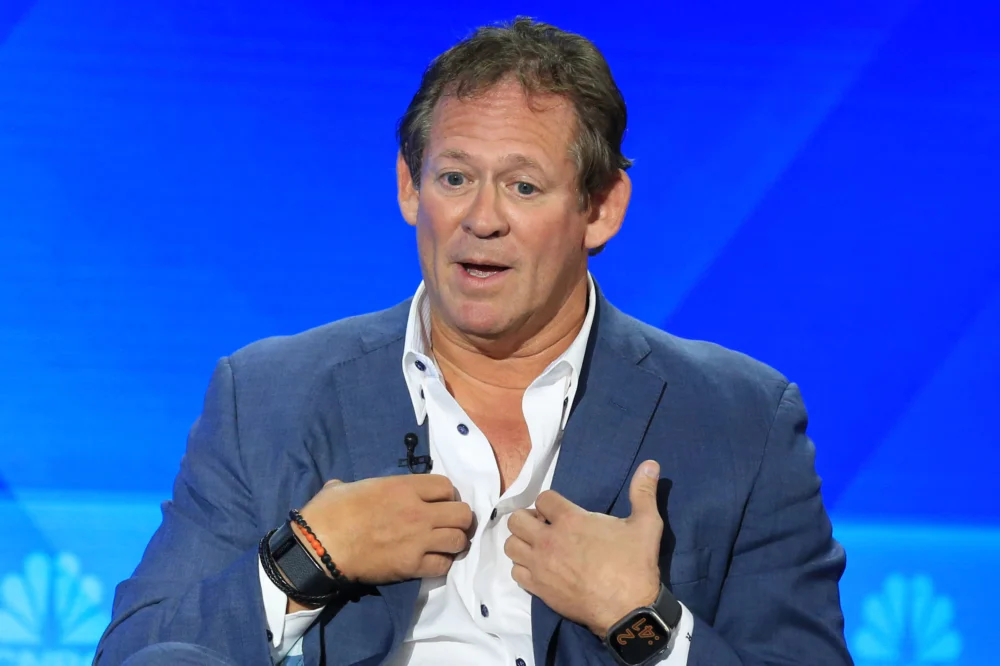
The race to lead the world’s most influential central bank has entered a volatile new phase as President Donald Trump signaled a significant narrowing of the field for the next Chair of the Federal Reserve. Speaking from the sidelines of the World Economic Forum in Davos, Switzerland, the President offered high praise for Rick Rieder, the BlackRock Managing Director and Chief Investment Officer of Global Fixed Income, describing him as "very impressive" following a recent private meeting. This endorsement has sent ripples through global financial markets, fundamentally altering the perceived hierarchy of candidates vying to succeed Jerome Powell, whose term is set to expire in May.
The search for a new central bank chief, which initially considered a diverse slate of 11 potential nominees, has reportedly been whittled down to a shortlist of finalists. According to the President, the selection process is nearing its conclusion, with the field potentially narrowed to a single preferred candidate. This acceleration comes as Treasury Secretary Scott Bessent, who has been spearheading the administration’s vetting process, indicated that a formal announcement could be expected as early as next week. The timing is critical, as the global economy grapples with a complex transition period characterized by fluctuating inflation data, shifting labor market dynamics, and a contentious debate over the "neutral" rate of interest.
Market reaction to the President’s comments was immediate and reflected in the real-time data of prediction markets. On the Kalshi platform, which allows traders to bet on the outcomes of political and economic appointments, the implied probability of Rick Rieder securing the nomination surged to 33%. This represents a doubling of his odds from the beginning of the week, marking the most significant momentum shift in the race thus far. Conversely, former Federal Reserve Governor Kevin Warsh, who has long been considered the frontrunner for the post, saw his odds decline by approximately 14 percentage points. While Warsh remains the statistical leader at 45%, the narrowing gap suggests that the administration is seriously considering a practitioner from the heart of the private sector rather than a traditional academic or career policymaker.
Rick Rieder’s potential elevation to the Federal Reserve Chairmanship would represent a landmark shift in the profile of the American central bank’s leadership. Unlike many of his predecessors who hailed from academia or legal backgrounds, Rieder is a quintessential market practitioner. At BlackRock, the world’s largest asset manager with over $10 trillion under management, Rieder oversees the firm’s massive fixed-income operations. His daily reality involves navigating the intricacies of global bond markets, credit spreads, and liquidity flows. Proponents of his candidacy argue that this "front-line" experience would provide the Federal Reserve with a more nuanced understanding of how monetary policy transmits through the financial system, potentially avoiding the "lag effect" errors that critics often attribute to the Fed’s data-dependent modeling.
The economic context of this transition cannot be overstated. The Federal Reserve is currently at a crossroads, attempting to engineer a "soft landing" while managing the fallout from the most aggressive interest rate hiking cycle in decades. The incoming Chair will inherit a balance sheet that remains significantly larger than pre-pandemic levels and a mandate to maintain price stability while ensuring maximum employment. If Rieder were to take the helm, investors would likely expect a Fed that is highly sensitive to market signals and perhaps more inclined toward a "pro-growth" monetary stance, provided inflation remains anchored.
However, the prospect of a BlackRock executive leading the Fed also invites scrutiny regarding the independence of the institution. Historically, the Federal Reserve has sought to maintain a distance from both the executive branch and the immediate interests of Wall Street to preserve its credibility as a non-partisan arbiter of the economy. The President has been vocal in his desire for a Fed Chair who is more aligned with his administration’s economic goals, which include deregulation and a robust domestic manufacturing base. The challenge for any nominee, whether Rieder or Warsh, will be to demonstrate a commitment to the Fed’s dual mandate while navigating the political pressures of an administration that has frequently criticized the pace of interest rate adjustments.

Kevin Warsh remains a formidable opponent in this selection process. As a former member of the Federal Reserve Board of Governors during the 2008 financial crisis, Warsh possesses deep institutional knowledge and an established reputation among international central bankers. He has often advocated for a more disciplined approach to the Fed’s balance sheet and has been a critic of the "lower for longer" interest rate regimes that characterized the post-crisis era. The choice between Rieder and Warsh may ultimately come down to a choice between a "market-savvy innovator" and a "principled institutionalist."
The role of Treasury Secretary Scott Bessent in this process is also a key variable. Bessent, a former hedge fund manager himself, has emphasized the need for a Federal Reserve that promotes stability and supports the administration’s broader fiscal agenda. The synergy between the Treasury and the Fed is essential for managing the United States’ growing national debt, which now exceeds $34 trillion. As the Treasury issues more securities to fund government spending, the Fed’s role in managing the cost of that debt through its influence on the yield curve becomes a central pillar of national economic strategy.
Globally, the selection of the next Fed Chair will have profound implications. The U.S. dollar remains the world’s primary reserve currency, and the Fed’s interest rate decisions dictate the flow of capital across borders. A shift in leadership that suggests a more hawkish or dovish tilt could trigger significant volatility in emerging markets, many of which are sensitive to changes in dollar-denominated borrowing costs. Central banks in Europe, Japan, and China will be watching the announcement closely, as they coordinate their own monetary policies in an increasingly interconnected global financial system.
The "Davos effect"—where major policy hints are dropped during the annual gathering of the world’s elite—has once again proven to be a catalyst for market speculation. The President’s use of the term "very impressive" is not just a casual compliment in the world of high-stakes appointments; it is a signal to the markets to begin pricing in a new reality. For Rieder, the transition from managing a private portfolio to steering the world’s largest economy would be a leap of unprecedented proportions, yet his supporters suggest that his ability to communicate complex economic ideas to both the public and the markets is exactly what the modern Fed requires.
As the May expiration of Jerome Powell’s term approaches, the lame-duck period for the current leadership begins. This period is often fraught with tension, as the sitting Chair must maintain the integrity of current policy while the "Chair-in-waiting" begins to articulate a competing or evolving vision. The transition in 2026 will be particularly watched for how it handles the "inflation target" debate. There has been ongoing discussion among economists about whether the Fed’s 2% inflation target is still appropriate in a post-pandemic world defined by supply chain shifts and geopolitical fragmentation. A Rieder-led Fed might be more open to re-evaluating these frameworks in light of real-world market conditions.
The final decision, expected within days, will likely define the economic trajectory of the next four years. Whether the President chooses the market-tested expertise of Rick Rieder or the institutional experience of Kevin Warsh, the appointment will signal the administration’s priorities: a preference for growth, a desire for market alignment, or a commitment to traditional monetary discipline. For now, the momentum belongs to Rieder, whose rise from a field of eleven to a "very impressive" finalist marks one of the most rapid ascents in the history of central bank nominations. As the Davos summit concludes, the focus shifts back to Washington, where the official unveiling of the next steward of the American economy is imminent.