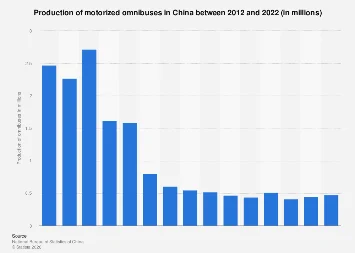
The global transportation industry is undergoing a significant transformation, driven by evolving urban mobility needs, environmental regulations, and technological advancements. At the forefront of this shift is China, which has solidified its position as a dominant force in the production of omnibuses – a broad category encompassing city buses, coaches, and other multi-passenger vehicles. The sheer scale of China’s manufacturing capabilities, coupled with strategic government support and a rapidly growing domestic market, has propelled it to the top of the global bus production landscape.
China’s dominance in omnibus production is not a recent phenomenon but rather a culmination of decades of industrial policy, investment in infrastructure, and a concerted effort to build a robust automotive sector. Initially focused on meeting the immense demand from its own burgeoning cities and expanding public transport networks, Chinese manufacturers have increasingly turned their attention to international markets. This outward push is characterized by a dual strategy: offering cost-competitive vehicles to developing economies and pushing technological boundaries with advanced electric and intelligent bus solutions for more sophisticated markets.
The economic implications of this production prowess are substantial. China’s bus manufacturing sector contributes significantly to its GDP, generates substantial employment, and fosters innovation across a complex supply chain. This includes not only the assembly of vehicles but also the production of key components like engines, chassis, batteries for electric buses, and sophisticated electronic systems. The sector’s growth is intrinsically linked to the broader economic development of China, reflecting its transition from a labor-intensive manufacturing hub to a center for advanced industrial production.
Several key factors underpin China’s leading role. Firstly, the sheer size of its domestic market provides a foundational demand base that allows manufacturers to achieve economies of scale. As China’s urbanization accelerated, so did the need for public transportation solutions. This created a fertile ground for bus manufacturers to refine their production processes, improve efficiency, and develop a wide range of models to suit diverse operational requirements. Government initiatives, including subsidies for public transport infrastructure and preferential policies for electric vehicle adoption, have further stimulated this domestic demand.
Secondly, Chinese manufacturers have demonstrated remarkable agility in adopting and adapting new technologies. While initially known for producing more basic models, the industry has rapidly embraced electrification. China is the world’s largest market for electric vehicles, and this trend extends to buses. Significant investments in battery technology, charging infrastructure, and electric powertrain development have positioned Chinese companies as leaders in the electric bus segment. This is particularly relevant in the context of global efforts to decarbonize transportation and reduce urban air pollution. Many cities worldwide are now actively seeking to transition their bus fleets to electric power, and Chinese manufacturers are well-placed to supply these needs.
The competitive landscape within China is also intense, fostering innovation and driving down costs. A multitude of players, ranging from state-owned giants to agile private enterprises, vie for market share. This competition compels companies to continuously improve product quality, enhance technological features, and optimize production efficiency. Major players like BYD, Yutong, and King Long have not only become dominant in China but have also established a significant international presence, exporting vehicles to regions across Asia, South America, Europe, and Africa.
Globally, China’s omnibus production exerts considerable influence on pricing and market dynamics. The availability of cost-effective Chinese-manufactured buses can present both opportunities and challenges for established manufacturers in other regions. For countries with limited budgets, Chinese buses offer an accessible solution for upgrading public transport systems. However, this also raises questions about fair competition, intellectual property, and the long-term sustainability of local manufacturing in importing nations.
The export market for Chinese buses is expanding, fueled by China’s Belt and Road Initiative (BRI) and increasing trade partnerships. BRI projects often include investments in infrastructure, which in turn creates demand for transportation vehicles. Chinese bus manufacturers are actively participating in these projects, supplying vehicles and, in some cases, establishing local assembly operations. This strategy not only expands their market reach but also helps them to navigate local regulations and build stronger relationships with international partners.
Looking ahead, the trajectory of China’s omnibus production is likely to remain upward, albeit with evolving characteristics. The focus is increasingly shifting towards higher-value segments, including smart buses with advanced connectivity, autonomous driving capabilities, and enhanced passenger comfort features. The development of integrated mobility solutions, where buses play a central role in smart city ecosystems, is also a key area of focus. Furthermore, sustainability will continue to be a driving force, with ongoing innovation in battery technology, alternative fuels, and lightweight materials aimed at further reducing the environmental impact of bus transportation.
The economic impact extends beyond direct manufacturing. The development of a sophisticated bus manufacturing sector spurs growth in related industries such as steel, plastics, electronics, and software. It also necessitates investments in research and development, fostering a culture of innovation. The skilled workforce required for modern bus production, from engineers and designers to assembly line workers and technicians, contributes to overall economic development and human capital formation.
However, challenges remain. Global trade tensions, geopolitical shifts, and evolving environmental standards in different markets can impact export volumes and market access. Maintaining a competitive edge in technological innovation, particularly in rapidly advancing areas like artificial intelligence and autonomous systems, will be crucial. Moreover, the industry must navigate the complex regulatory environments of different countries, including safety standards, emissions regulations, and local content requirements.
In conclusion, China’s role as a global leader in omnibus production is a testament to its industrial strategy, market scale, and technological adaptability. The sector’s influence on global transportation, its contribution to China’s economy, and its role in shaping the future of urban mobility are profound. As the world continues to grapple with the challenges of urbanization and climate change, the evolution of China’s bus manufacturing sector will undoubtedly remain a critical element in the global pursuit of sustainable and efficient transportation solutions.